How Do You Generate Equivalent Fractions? Fractions, 3rd Grade, Khan Academy
TL;DR
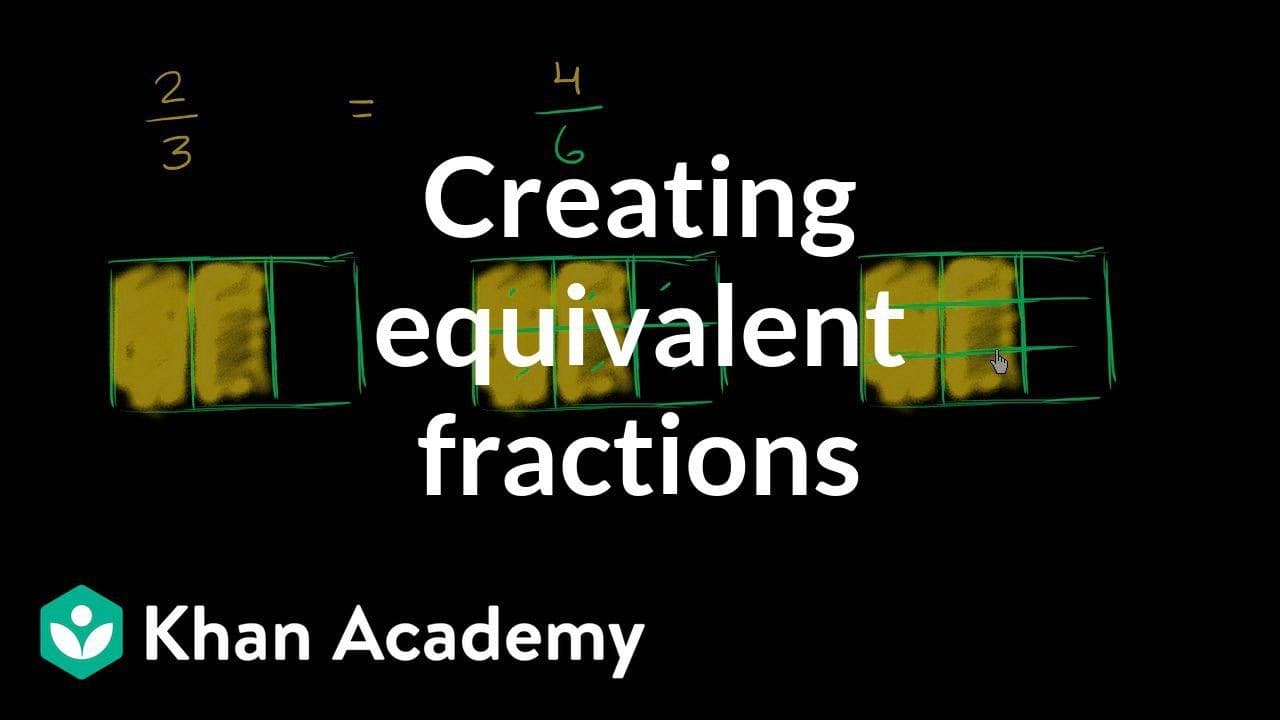
Equivalent fractions represent the same number, so 2/3, 4/6, and 6/9 are equal even though they use different numbers of sections. Dividing each of three equal sections into two creates six sections with four shaded, while dividing each third into three creates nine sections with six shaded. Read on to see how visual models and a number line demonstrate this equivalence.
Transcript
So we've got this fraction written here, 2/3. What I want you to do is pause this video and try to think of any other fractions that are the same that are equivalent to this fraction right over here that essentially represent the same number. So to do that, let's visualize what 2/3 is. So let me draw a whole here. Let me draw a whole, and I'm going... Read More
Key Insights
- 🆘 Visualizing fractions can help in understanding their equivalence.
- 🥳 Dividing each part of an original fraction into equal parts can reveal equivalent fractions.
- ❓ Equivalent fractions represent the same value or amount.
- ❓ The fraction 2/3 is equivalent to 4/6 and 6/9.
Install to Summarize YouTube Videos and Get Transcripts
Explore YouTube Video Summarizer or Get YouTube Transcript Extractor
Questions & Answers
Q: What are equivalent fractions?
Equivalent fractions are fractions that represent the same number or the same fraction of a whole. The examples shown are 2/3, 4/6, and 6/9.
Q: How is 2/3 represented visually?
Divide one whole into three equal sections and shade two of them. The two shaded sections represent 2/3 of the whole.
Q: How do you generate an equivalent fraction for 2/3?
Start with a whole divided into three equal sections, with two sections shaded. Divide every original section into the same number of smaller equal sections, then count all sections and all shaded sections.
Q: Why is 4/6 equivalent to 2/3?
Dividing each of the three original sections into two produces six equal sections. Four of those six sections are shaded, so the same shaded amount can be written as 4/6 or 2/3.
Q: How is 6/9 generated from 2/3?
Divide each of the three original sections into three equal sections. This creates nine equal sections, and six are shaded, giving 6/9.
Q: Are 2/3, 4/6, and 6/9 equivalent fractions?
Yes. Each fraction represents the exact same fraction of the whole, so 2/3 equals 4/6 and 6/9.
Q: How are equivalent fractions shown on a number line?
Divide the space between 0 and 1 into three, six, or nine equal spaces. Moving 2 of 3 spaces, 4 of 6 spaces, or 6 of 9 spaces reaches the exact same point.
Q: Why must the sections in a fraction model be equal?
The whole is divided into equal sections so the numerator can count equal parts of that whole. In the examples, the same shaded amount is counted as 2 of 3, 4 of 6, or 6 of 9 equal sections.
Summary & Key Takeaways
-
Definition: Equivalent fractions represent the same number or the same fraction of a whole.
-
Number: 2/3 represents two of three equal sections of one whole.
-
Step 1: Divide one whole into three equal sections and shade two sections to show 2/3.
-
Step 2: Divide each third into two equal sections, creating six equal sections with four shaded.
-
Number: 2/3 is equal to 4/6 because both show the exact same shaded fraction of the whole.
-
Step 3: Divide each original third into three equal sections, creating nine equal sections with six shaded.
-
Number: 2/3, 4/6, and 6/9 are equivalent fractions.
-
Compare: 2 of 3 spaces, 4 of 6 spaces, and 6 of 9 spaces reach the same point.
-
Number: The number line model focuses on the section between 0 and 1.
-
Tool: A visual fraction model and a number line both show that 6/9 equals 2/3 and 4/6.
Read in Other Languages (beta)
Share This Summary 📚
Summarize YouTube Videos and Get Video Transcripts with 1-Click
Try YouTube Summary with ChatGPT & Claude or YouTube Transcript Generator
Explore More Summaries from Khan Academy 📚



Summarize YouTube Videos and Get Video Transcripts with 1-Click
Try YouTube Summary with ChatGPT & Claude or YouTube Transcript Generator