How to Prove Sequence Convergence to Zero
TL;DR
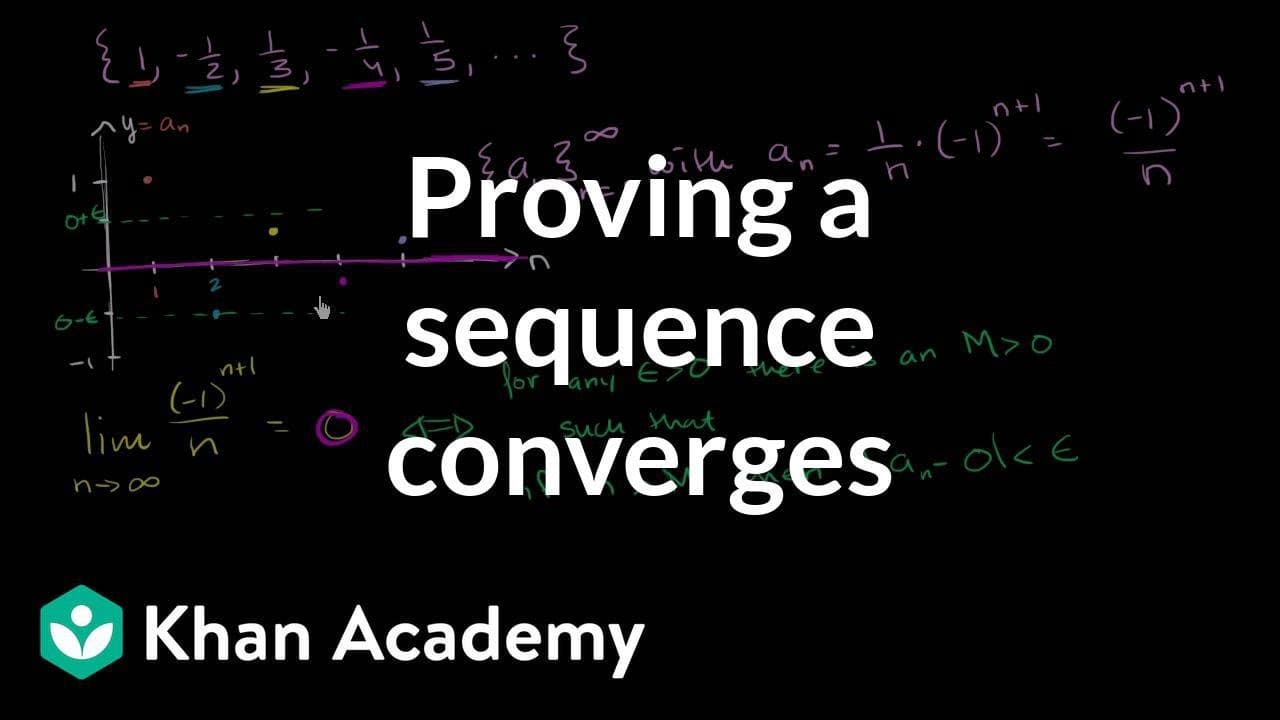
A sequence defined as (-1)^(n+1)/n converges to 0 based on the formal definition of limits. For any epsilon greater than 0, a corresponding M can be found such that if n exceeds M, the sequence remains within epsilon of 0. This demonstrates the validity of the convergence to 0.
Transcript
I made a claim that for this sequence-- and this was in a previous video-- that for this sequence right over here that can be defined explicitly in this way, that the limit of the sequence-- and so I can write this as negative 1 to the n plus 1 over n. That's one way of defining our sequence explicitly-- the limit of this as n approaches infinity i... Read More
Key Insights
- 🎮 The video provides a mathematical proof for the convergence of the sequence (-1)^n+1/n to 0.
- 🧡 The concept of epsilon is used to define a range around the limit value.
- 🍉 The proof demonstrates that for any epsilon greater than 0, there exists an M such that the terms of the sequence are within epsilon of the limit.
Install to Summarize YouTube Videos and Get Transcripts
Explore YouTube Video Summarizer or Get YouTube Transcript Extractor
Questions & Answers
Q: What is the specific sequence being analyzed in this video?
The sequence being examined in the video is (-1)^n+1/n.
Q: What does it mean for a sequence to converge?
Convergence means that as the index of the sequence approaches infinity, the terms of the sequence get arbitrarily close to a specific value or limit.
Q: How is epsilon used in proving the convergence of the sequence?
Epsilon is used to define a range around the limit value. The proof shows that, for any epsilon greater than 0, there exists an M such that if n is greater than M, the sequence will be within epsilon of the limit.
Q: How is the value of M determined in the proof?
The value of M is determined by taking the reciprocal of epsilon. Thus, M is set as 1/epsilon to ensure that for n greater than M, the sequence is within epsilon of the limit.
Q: Why does the sequence (-1)^n+1/n converge to 0?
The proof shows that for any given epsilon, there exists an M such that if n is greater than M, the sequence is within epsilon of 0. Therefore, as the index of the sequence increases, the terms get arbitrarily close to 0.
Summary & Key Takeaways
-
The video presents the claim that a sequence defined as (-1)^n+1/n converges to 0 but lacks proof.
-
To prove the convergence, the video introduces the concept of epsilon and demonstrates how to find a value of M that ensures the sequence is within epsilon of 0.
-
By taking the reciprocal of both sides of the inequality, the video shows that the sequence converges when n is greater than 1/epsilon.
-
The proof is valid for any epsilon greater than 0, demonstrating that the limit of the sequence is indeed 0.
Read in Other Languages (beta)
Share This Summary 📚
Summarize YouTube Videos and Get Video Transcripts with 1-Click
Try YouTube Summary with ChatGPT & Claude or YouTube Transcript Generator
Explore More Summaries from Khan Academy 📚



Summarize YouTube Videos and Get Video Transcripts with 1-Click
Try YouTube Summary with ChatGPT & Claude or YouTube Transcript Generator