How to Use Implicit Differentiation for Derivatives
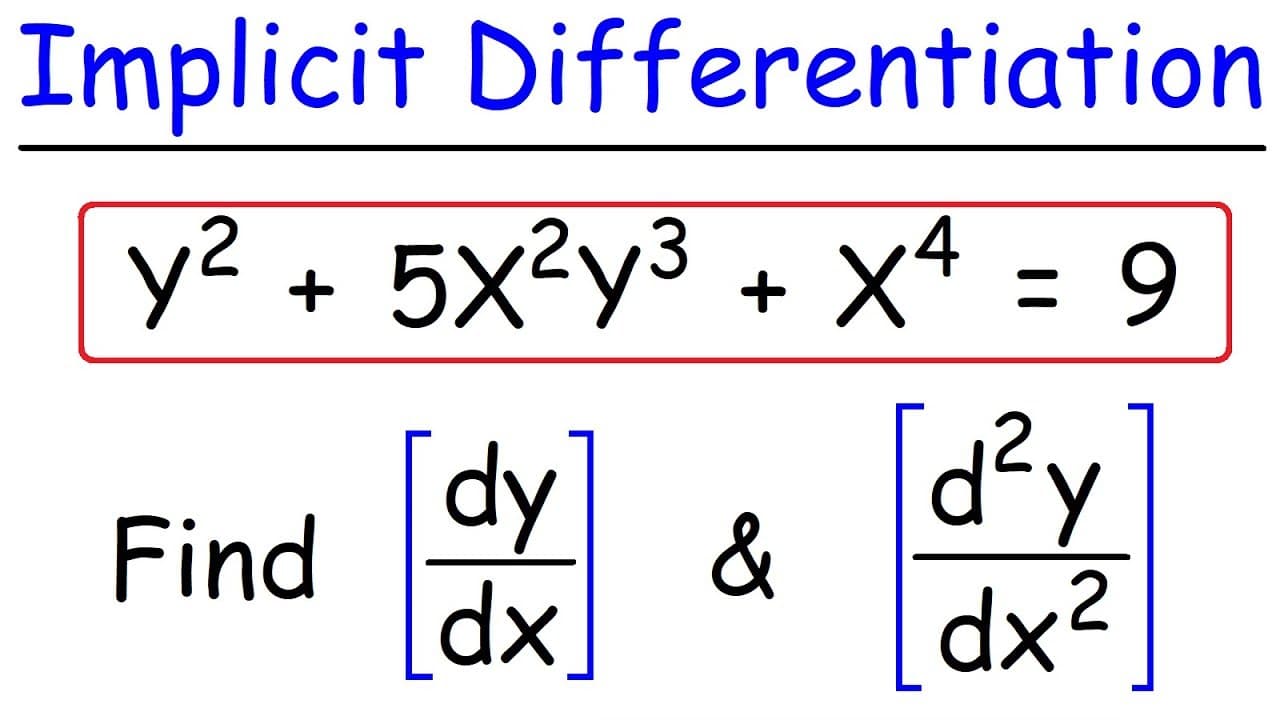
TL;DR
To use implicit differentiation, differentiate both sides of an equation with respect to x, treating y as a function of x. For each term involving y, include dy/dx, isolate dy/dx by moving other terms to the opposite side, and then factor it out to solve for dy/dx.
Transcript
in this video we're going to talk about how to do implicit differentiation so let's say if you're given a problem that looks like this x squared plus y cubed minus 4x is equal to eight and then you're told to find d y over dx so what do you need to do in order to find d y over dx in this problem what you need to do first is you need to differentiat... Read More
Key Insights
- 🙃 Implicit differentiation involves differentiating both sides of an equation with respect to x.
- ☺️ The power rule is used to differentiate terms with x variables.
- 🐞 Terms with y variables have dy/dx added to them.
- 🐞 Factors without dy/dx are moved to the other side of the equation to isolate dy/dx.
- 👻 Implicit differentiation allows for finding derivatives of equations that cannot be easily solved using other methods.
- ❣️ The quotient rule is used when differentiating terms with both x and y variables.
- ✋ Implicit differentiation can be used to find higher-order derivatives.
Install to Summarize YouTube Videos and Get Transcripts
Explore YouTube Video Summarizer or Get YouTube Transcript Extractor
Questions & Answers
Q: What is implicit differentiation?
Implicit differentiation is a method used to find the derivative of an equation with both x and y variables. It involves differentiating both sides of the equation with respect to x, treating y as a function of x.
Q: How do you differentiate terms with x variables?
To differentiate terms with x variables, the power rule is used. For example, the derivative of x^2 is 2x.
Q: How do you differentiate terms with y variables?
When differentiating terms with y variables, dy/dx is added to the equation. For example, the derivative of y^3 is 3y^2 * dy/dx.
Q: How do you isolate dy/dx after differentiation?
To isolate dy/dx, factors without dy/dx are moved to the other side of the equation. Then, dy/dx is factored out and divided by the remaining terms.
Summary & Key Takeaways
-
Implicit differentiation involves differentiating both sides of an equation with respect to x, treating y as a function of x.
-
The power rule is used to differentiate terms with x variables, and dy/dx is added to terms with y variables.
-
After differentiating, factors without dy/dx are moved to the other side of the equation, and dy/dx is factored out to isolate it.
Read in Other Languages (beta)
Share This Summary 📚
Summarize YouTube Videos and Get Video Transcripts with 1-Click
Try YouTube Summary with ChatGPT & Claude or YouTube Transcript Generator
Explore More Summaries from The Organic Chemistry Tutor 📚



Summarize YouTube Videos and Get Video Transcripts with 1-Click
Try YouTube Summary with ChatGPT & Claude or YouTube Transcript Generator