Ring Counter | Logic Diagram | Timing Diagram | STLD | Lec-138
TL;DR
This video explains ring counters, including their structure and counting operations.
Transcript
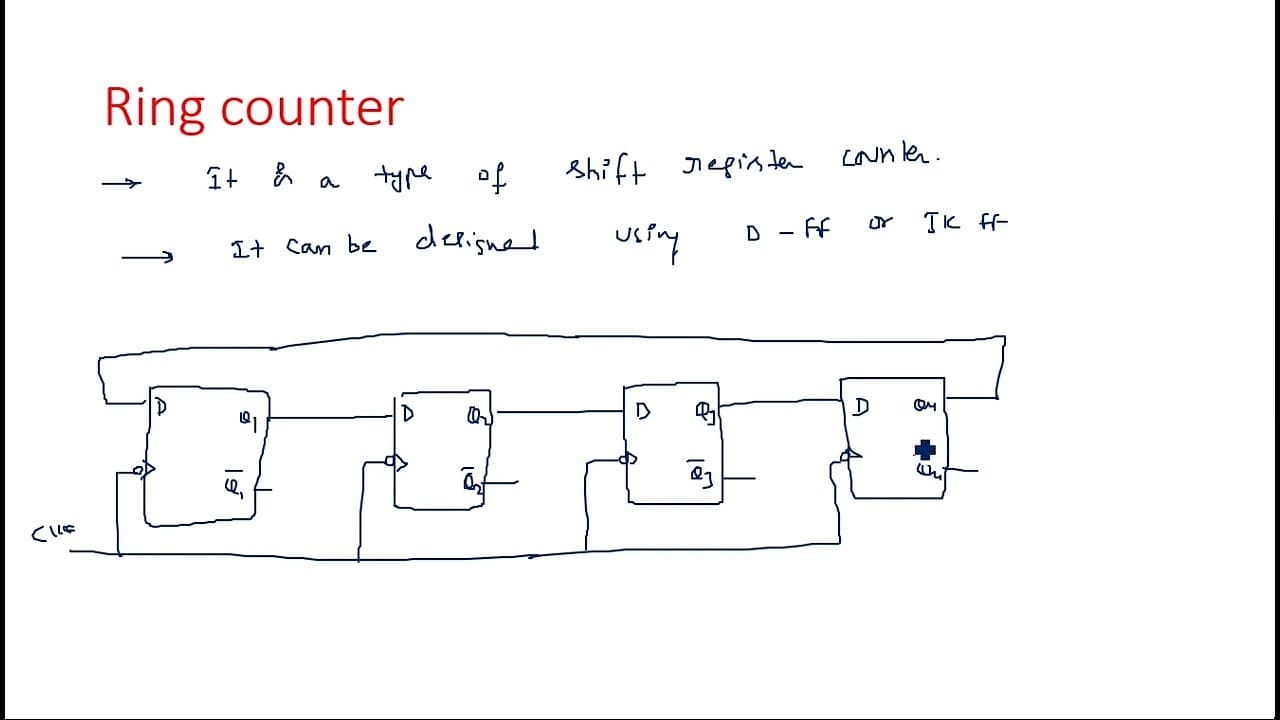
hi everyone in this video I'm going to explain about Ring counter a ring counter basically a type of shift register counter it is a type of it is a type of shift register counter ring counter is a type of shift register counter that means the counting operation is done based on shifting it is also used for the number of clock pulses counting operat... Read More
Key Insights
- 🔄 Ring counters are essential for counting operations in digital circuits, demonstrating their significance in shift register technology.
- 🐬 D flip-flops and JK flip-flops provide the flexibility necessary for designing efficient ring counters, allowing for different implementation options.
- 😋 The feedback mechanism in ring counters establishes a cyclical counting pattern, which is crucial for applications requiring a repetitive counting sequence.
- 🦻 Visualizing operations through state diagrams aids in understanding the behavior and transitions of ring counters effectively.
- 🔄 The precision of clock pulses is foundational to achieving reliable operation in ring counters, ensuring synchronous functioning across all flip-flops.
- 😋 The counting capacity of a ring counter is directly proportional to the number of flip-flops used, establishing a clear relationship between design and performance.
- 🔄 Understanding ring counters paves the way for greater insights into more complex digital systems, including Johnson counters and other advanced counting mechanisms.
Install to Summarize YouTube Videos and Get Transcripts
Explore YouTube Video Summarizer or Get YouTube Transcript Extractor
Questions & Answers
Q: What is a ring counter and how does it operate?
A ring counter is a type of shift register counter where the output of the last flip-flop is fed back into the input of the first flip-flop, creating a circular feedback loop. It counts clock pulses by shifting the '1' value around the flip-flops, with each clock pulse shifting the state through the circuit until it returns to the starting position.
Q: How can a ring counter be implemented using flip-flops?
A ring counter can be implemented using either D flip-flops or JK flip-flops. In both cases, the flip-flops are connected in series, with the output of one feeding the next, and a common clock pulse synchronously triggering the counting and shifting operations across the flip-flops.
Q: What happens to the outputs during the counting operation of a ring counter?
Initially, all flip-flops in a ring counter are cleared except for one, which is set to '1.' With each clock pulse, the '1' shifts to the next flip-flop, while all others remain '0,' resulting in a cycle that continuously repeats as the clock pulses are applied.
Q: Can you explain the circuit diagram of a 4-bit ring counter?
In a 4-bit ring counter, four D or JK flip-flops are used, connected such that the output of each flip-flop feeds into the next. The last flip-flop's output loops back to the first, functioning synchronously with a common clock signal that triggers all flip-flops simultaneously for coherent counting operations.
Q: What is the significance of the clock signal in the operation of ring counters?
The clock signal is crucial as it controls the timing of the shifts in the ring counter. It dictates when the state of each flip-flop changes and ensures that all flip-flops operate in sync, allowing for accurate counting while facilitating the shifting operation.
Q: What is a state diagram and how does it relate to ring counters?
A state diagram visually represents the states of a ring counter as it transitions through its outputs with each clock pulse. It showcases how the '1' moves through the flip-flops, thereby illustrating the sequence of states in response to the ongoing clock signal.
Q: What is the difference between ring counters and Johnson counters?
While both types of counters can use similar flip-flops, the primary difference lies in their feedback mechanisms. A ring counter uses the direct output of the last flip-flop as input for the first, whereas a Johnson counter utilizes the complement output, creating a different counting sequence.
Summary & Key Takeaways
-
Ring counters are a type of shift register counter that count clock pulses while executing a shifting operation. They are often constructed using D flip-flops or JK flip-flops.
-
The design involves interconnecting flip-flops such that the output of the last flip-flop feeds back into the first, creating a ring-like structure that allows for continuous counting.
-
The video describes both the logic circuit designs and the operational sequence, demonstrating how the output states change in response to clock pulses.
Read in Other Languages (beta)
Share This Summary 📚
Summarize YouTube Videos and Get Video Transcripts with 1-Click
Try YouTube Summary with ChatGPT & Claude or YouTube Transcript Generator
Explore More Summaries from Education 4u 📚


Summarize YouTube Videos and Get Video Transcripts with 1-Click
Try YouTube Summary with ChatGPT & Claude or YouTube Transcript Generator