Pie chart | Students Preference | Data Interpretation | Reasoning | Part - 15 | Bharath Kumar
TL;DR
Understanding student beverage preferences using pie chart data and percentage calculations.
Transcript
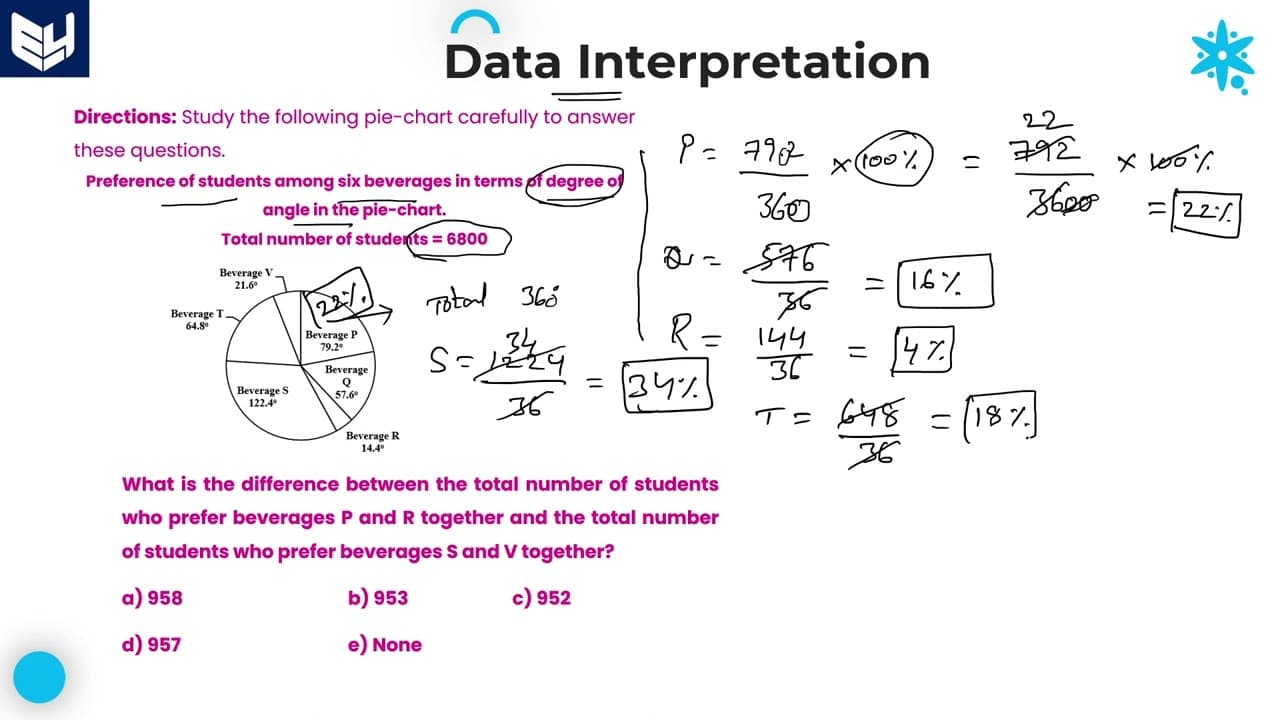
hi everyone welcome to the session in this session I am continuing pie chart date and repetition first of all we need to read the information carefully and then we have to solve the questions according to the information here the information is about preference of students among six beverages in terms of degree of angle in pie chart here whatever t... Read More
Key Insights
- 🥧 Pie chart analysis requires careful reading and methodical conversion of degrees to percentages for clarity in data interpretation.
- 🧑🎓 Joining percentage values from different beverages greatly enhances understanding of student preferences and enables straightforward calculations.
- 🧑🎓 Recognizing relationships between various beverages through percentage calculations assists in deriving greater insights into student choices.
- 🥳 Simplifying ratios and percentages from the analyzed data serves as a practical tool in quantitative analysis, making data-driven decisions more accessible.
- 🤩 Understanding the fundamental principle when dealing with percentage-based questions is key to performing accurate and efficient calculations.
- 🧑🎓 This analysis showcases how systematic calculations yield insights into student behavior and preferences, ultimately enhancing data comprehension.
- 🧑🎓 The calculated total of 6,800 students provides a comprehensive basis for drawing data-driven conclusions about beverage preferences in the surveyed group.
Install to Summarize YouTube Videos and Get Transcripts
Explore YouTube Video Summarizer or Get YouTube Transcript Extractor
Questions & Answers
Q: What is the first step in analyzing the beverage preference data?
The first step involves carefully reading the provided data and converting the angles from degrees into percentages. This conversion simplifies further calculations, as it allows for a clearer understanding of the proportions that each beverage represents in relation to the total preference.
Q: How do you convert degrees to percentages using the example of beverage P?
To convert degrees to a percentage, you take the degree measurement of the beverage (79.2 degrees for beverage P) and divide it by the total degrees of the circle (360 degrees), then multiply by 100. For beverage P: (79.2/360) * 100 results in 22%.
Q: Why is it important to express the data in percentages for easier calculation?
Expressing data in percentages standardizes the values and allows for straightforward comparisons between different beverages. When calculations and comparisons are expressed as percentages, it allows one to easily interpret the proportion of students preferring each beverage relative to the total student population.
Q: What was the calculated percentage of students who preferred beverage R?
The calculated percentage of students who preferred beverage R is 4%. This was derived by converting the degrees attributed to beverage R into a percentage, which helped identify its popularity relative to the other beverages surveyed.
Q: What difference is calculated between the number of students preferring beverages P and R versus S and V?
The difference calculated between the number of students preferring beverages P and R (22% + 4%) and those preferring S and V (34% + 6%) turned out to be 14%. This difference corresponded to 952 students, which was determined by calculating the respective percentages from the total number of students.
Q: How did the analysis determine the ratio of students preferring beverage V to beverage P?
The ratio was established by comparing the percentages of students preferring each beverage: V at 6% and P at 22%. This resulted in a ratio of 3:11, which was derived by simplifying the equivalent fractions of their respective percentages.
Q: What was the total percentage of students who preferred beverages T and V together?
The total percentage of students who preferred beverages T (18%) and V (6%) together amounted to 24%. This calculation demonstrated the combined preference of the two beverages among the surveyed group.
Q: How was the percentage representation of beverage R in relation to beverage S calculated?
To find the percentage representation of R in relation to S, the formula R/S * 100 was applied. With R at 4% and S at 34%, the calculation indicated that R is approximately 11.76% of S, leading to an approximate answer used in answer choices.
Summary & Key Takeaways
-
The content explains how to analyze the preferences of students for six beverages using pie chart data, emphasizing the conversion of angles in degrees to percentages for clarity in calculations.
-
It provides a detailed walkthrough of converting degrees of each beverage into percentages and applying these percentages to derive the number of students preferring each beverage, culminating in a total of 6,800 students surveyed.
-
The tutorial also includes examples of calculating differences, ratios, and percentages based on the derived values, thus reinforcing the practical applications of pie chart analysis in understanding survey data.
Read in Other Languages (beta)
Share This Summary 📚
Summarize YouTube Videos and Get Video Transcripts with 1-Click
Try YouTube Summary with ChatGPT & Claude or YouTube Transcript Generator