What Is Root Locus Angle and Magnitude in Control Systems?
TL;DR
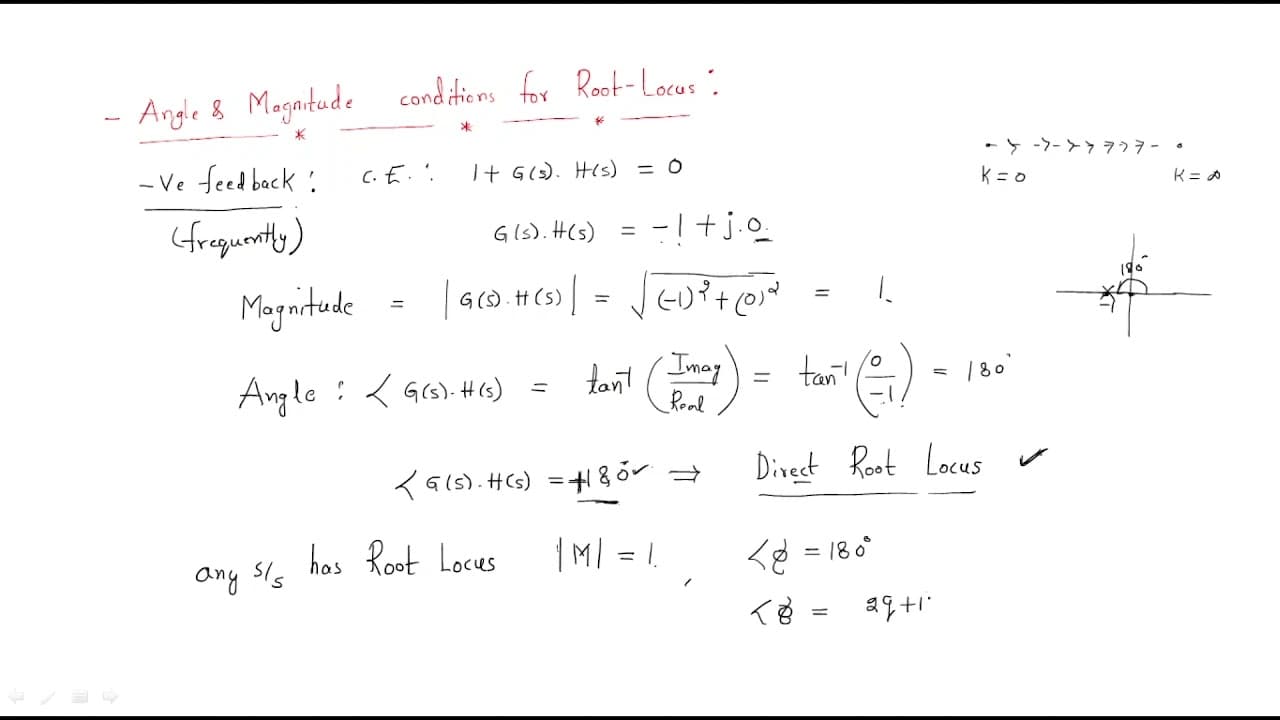
Root locus angle and magnitude describe the stability of feedback systems. The angle is determined by the phase of the transfer function, often aiming for values of ±180 degrees for closed-loop poles. Magnitude is calculated to be one for a stable system; these parameters guide engineers in analyzing system performance and behavior.
Transcript
hello everyone in this session we will discuss about the angle and magnitude first what is angle and what is magnitude so to understand this so generally we have we discussed about root locus means it has starts from k equal to 0 to and it will reach k equal to infinite that will give the information of close loopholes information but how this root... Read More
Key Insights
- 🫚 Root locus analysis requires a deep understanding of angle and magnitude to evaluate system stability effectively.
- 👻 Negative feedback is predominantly used due to its stabilizing effects, allowing engineers to design controllable systems.
- 💈 The characteristic equation for negative feedback is vital in determining pole locations in the complex plane.
- 🎨 Positive feedback, while amplifying signals, poses risks of instability and is used judiciously in system design.
- 🫚 The concepts of direct and indirect root locus help in classifying system behaviors based on feedback type and pole angles.
- 🫚 Analyzing roots requires consistent calculations of both angle and magnitude to ensure system performance aligns with desired specifications.
- ❓ Understanding complex feedback systems involves recognizing the significance of each component of the transfer function.
Install to Summarize YouTube Videos and Get Transcripts
Explore YouTube Video Summarizer or Get YouTube Transcript Extractor
Questions & Answers
Q: What is the significance of negative feedback in control systems?
Negative feedback is crucial in control systems as it stabilizes the system by reducing the overall gain, helping to eliminate oscillations. The characteristic equation derived from negative feedback, 1 + G(s)H(s) = 0, allows for the determination of system stability and response characteristics, ultimately improving performance.
Q: How are angle and magnitude calculated for a given feedback system?
To find the magnitude, we calculate the square root of the sum of the squares of the real and imaginary parts of the open-loop transfer function G(s)H(s). The angle is determined by taking the arctangent of the imaginary part divided by the real part, allowing us to assess the phase shift that occurs in the feedback system.
Q: Why is the angle value significant in root locus analysis?
The angle value informs us about the system stability and how the poles behave as gain varies. Specifically, an angle of 180 degrees indicates a direct root locus scenario, while 0 degrees relates to indirect root locus, which is crucial for understanding feedback and phases within control systems.
Q: What is the impact of using positive feedback in control systems?
Positive feedback tends to amplify signals and can lead to system instability, creating undesirable oscillations. While it is less frequently used, understanding its effects helps pinpoint scenarios where it might be required, albeit usually as a secondary effect or in specific applications.
Q: Can you explain the direct root locus?
The direct root locus refers to the set of points in the complex plane where the system poles are located as gain changes. It typically occurs in feedback systems where the angle is maintained at 180 degrees, providing useful insights into stability and system design parameters.
Q: What does it imply if a system has a magnitude value other than one on the root locus?
If a system's magnitude deviates from one on the root locus, it indicates that the system is not stable, as it may lead to either an underdamped or overdamped response, resulting in either slower or impractical dynamics. This necessitates adjustments to the gain for desired performance.
Summary & Key Takeaways
-
The session covers the definitions of angle and magnitude, specifically in feedback systems analyzing root locus from k equal to 0 to k equal to infinity.
-
It elaborates on negative feedback and its characteristic equation, demonstrating how to compute magnitude and angle from the open loop transfer function.
-
The discussion also touches on positive feedback and contrasts it with negative feedback, emphasizing the significance of using negative feedback in practical engineering applications.
Read in Other Languages (beta)
Share This Summary 📚
Summarize YouTube Videos and Get Video Transcripts with 1-Click
Try YouTube Summary with ChatGPT & Claude or YouTube Transcript Generator