How to Create Objects in Java: Techniques Explained
TL;DR
You can create objects in Java by reference, method, or constructor. Object creation by reference involves using a class reference to initialize properties; method creation uses a function with parameters, and constructor creation allows for value assignment within a specified constructor. Anonymous objects are those created without a reference, suitable for temporary use without the need for reuse.
Transcript
hello everyone and welcome to the next session of Porsche in this session we are going to revisit the concept which we have already discussed as objects what we have discussed so far is what is an object so what is the definition object is instance of a class which has got state and behavior stake is represented by the property values whichever are... Read More
Key Insights
- 🏛️ Objects in Java have state (properties) and behavior (methods), making them instances of classes.
- ❓ Object creation in Java can be done by reference, method, or constructor, depending on the requirement.
- 🏛️ Object creation by reference involves creating a reference variable of a class and initializing its properties using the reference.
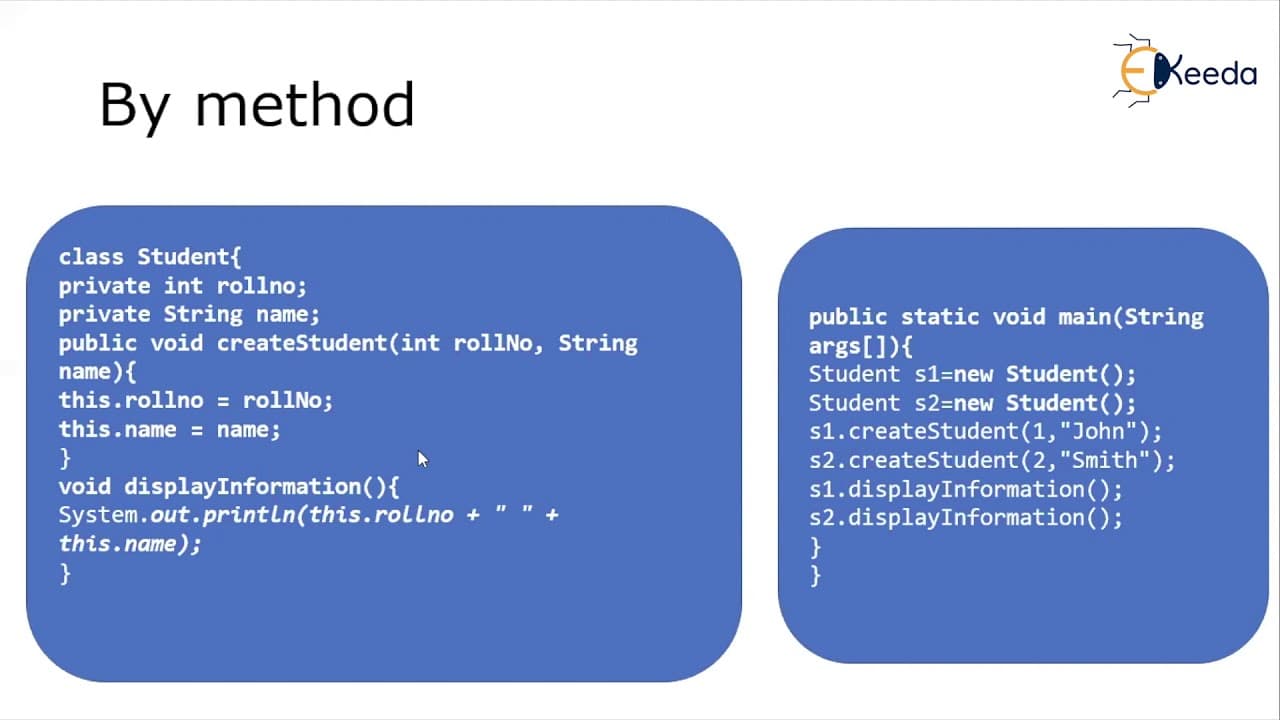
- 🤙 Object creation by method involves calling a method that takes parameters to initialize the object's properties.
- 🏛️ Object creation by constructor specifies a constructor for the class and assigns values to the object's properties within the constructor.
- ❓ Anonymous objects are objects that do not have a reference variable and are used when reusability is not required.
- 🤙 Anonymous objects are useful for temporary use, especially when calling methods that do not need to be called multiple times.
Install to Summarize YouTube Videos and Get Transcripts
Explore YouTube Video Summarizer or Get YouTube Transcript Extractor
Questions & Answers
Q: What is an object in Java?
In Java, an object is an instance of a class that has both state (property values) and behavior (methods).
Q: What are the three ways to create objects in Java?
The three ways to create objects in Java are by reference, by method, and by constructor.
Q: How does object creation by reference work?
Object creation by reference involves creating a reference variable of a class and using the dot operator to access and initialize the object's properties.
Q: What is an anonymous object?
An anonymous object is an object that is created without assigning a reference variable to it, usually used when the object is needed only temporarily and not for reuse.
Q: When is object creation by method used?
Object creation by method is used when a method in a class takes parameters that are used to initialize the properties of the object being created.
Q: How is object creation by constructor different from other methods?
Object creation by constructor involves specifying a constructor for a class and assigning values to the object's properties within the constructor. It allows for the creation of objects with specific initial values.
Q: Why would one use anonymous objects?
Anonymous objects are used when the object is only needed temporarily and does not require reuse. They are particularly useful when calling methods that do not need to be called multiple times.
Q: Can anonymous objects be accessed or reused after creation?
No, anonymous objects cannot be accessed or reused after creation. They are created and used at the same time without assigning a reference variable to them.
Summary & Key Takeaways
-
Objects in Java are instances of classes that have both state (represented by property values) and behavior (represented by methods).
-
There are three ways to create objects in Java: by reference, by method, and by constructor.
-
Object creation by reference involves creating a reference variable of a class and initializing its properties using the reference.
-
Object creation by method involves calling a method that takes parameters, which are then used to initialize the object.
-
Object creation by constructor involves specifying a constructor for a class and assigning values to its properties within the constructor.
-
Anonymous objects are objects that do not have a reference variable and are used when the object is only needed temporarily and not for reuse.
Read in Other Languages (beta)
Share This Summary 📚
Summarize YouTube Videos and Get Video Transcripts with 1-Click
Try YouTube Summary with ChatGPT & Claude or YouTube Transcript Generator
Explore More Summaries from Ekeeda 📚



Summarize YouTube Videos and Get Video Transcripts with 1-Click
Try YouTube Summary with ChatGPT & Claude or YouTube Transcript Generator