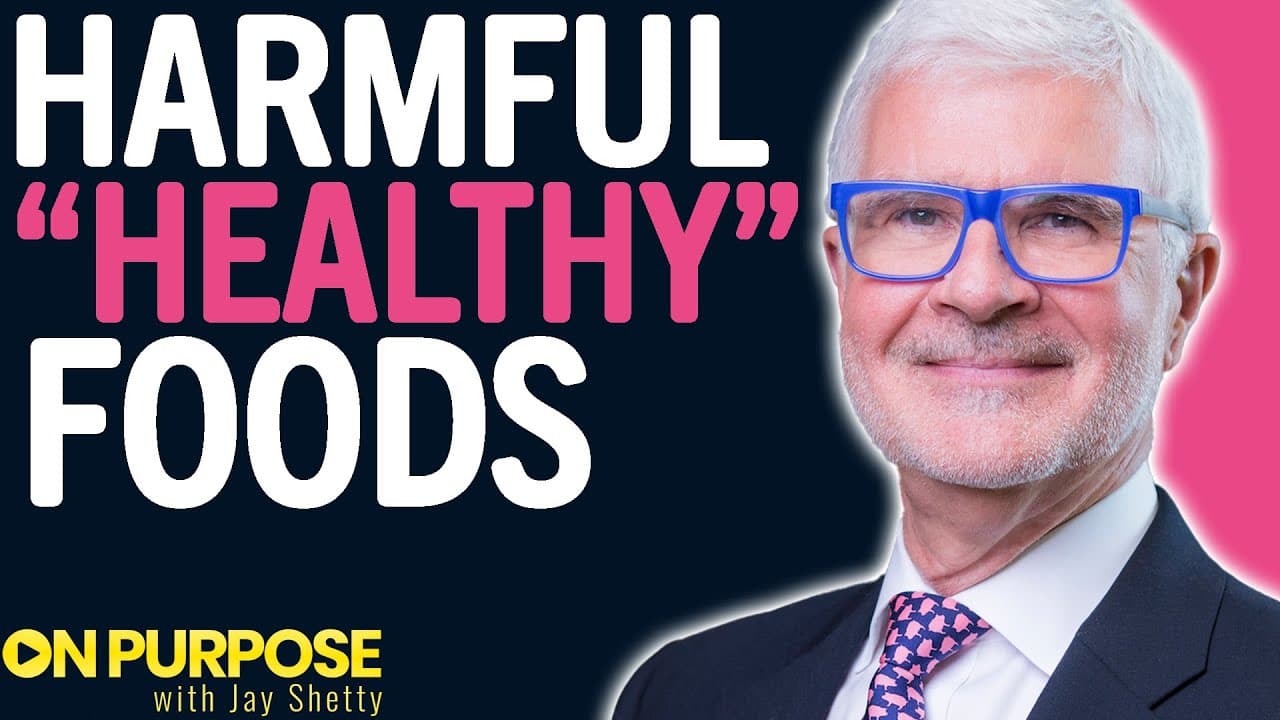
Dr. Steven Gundry ON: “Healthy” Foods You Shouldn’t Be Eating & the Warning Signs of a Leaky Gut
TL;DR
Almost all chronic diseases, from heart disease to dementia and autoimmune conditions, begin in a leaky gut, and sealing that gut can put autoimmune disease into remission. Everyday foods like wheat and conventionally grown oats, soy, and canola carry glyphosate and antibiotic residues that damage the gut microbiome, so what you eat and what your food ate both matter.
Transcript
these foods are designed to be addictive you know there was an old their statement that's any white substance is addictive white flour is addictive white sugar is addictive cocaine is addictive heroin is addictive you choose the white it's addictive unfortunately sickness is good for business and i'm sad to say you know i turned against that over 2... Read More
Key Insights
- Leaky gut is the root of nearly all disease, according to Dr. Gundry, who argues heart disease, cancer, dementia, arthritis, and autoimmune conditions all begin there; anyone with an autoimmune disease has a leaky gut that can now be measured.
- Sealing a leaky gut can reverse autoimmune disease, making it go away and stay in remission, which Gundry once considered pseudoscience but now says can be measured and observed directly.
- 'You are what the thing you eat ate' matters more than the original phrase, because glyphosate, antibiotics, fertilizers, and sprays used on crops and animals pass through the food chain into humans.
- Glyphosate (Roundup) is one of the best gut-destroying substances ever developed, and it is routinely sprayed on conventional wheat, oats, flaxseed, soybeans, and canola without appearing on any label.
- Organic wheat is just as harmful as sprayed wheat for sensitive people because the problem is the lectins in wheat, not only the glyphosate residue, so 'organic' does not eliminate the risk.
- Broad-spectrum antibiotics, introduced about 50 years ago before the microbiome was understood, act like 'napalm on the tropical rainforest' of the gut, and most people swallow antibiotic and glyphosate residues daily unknowingly.
- Glyphosate can be measured in blood and hair, and even careful eaters like Dr. Mark Hyman show significant levels, showing how pervasive the exposure is even among picky, health-conscious people.
- The gut lining has the surface area of a tennis court but is only one cell thick, held together by 'tight junctions'; this thin barrier is a design flaw that, when breached, drives the inflammation behind disease.
- Over 100 trillion gut organisms function as possibly the most important organ, controlling immune function, mood, and whether a person develops heart disease or dementia.
- Related book: Think Like a Monk
- Export your Kindle highlights to Glasp: How to Download Highlights and Notes from Kindle
Install to Summarize YouTube Videos and Get Transcripts
Explore YouTube Video Summarizer or Get YouTube Transcript Extractor
Questions & Answers
Q: What is leaky gut and why does Dr. Gundry say it causes disease?
Leaky gut is a breakdown of the intestinal lining, which is only one cell thick and held together by structures called tight junctions. Dr. Gundry argues that almost all diseases, including heart disease, cancer, dementia, arthritis, and autoimmune conditions, begin in a leaky gut. He echoes Hippocrates, who said all disease begins in the gut, and a Harvard colleague, Dr. Fasano, who refined it to a leaky gut. Once the barrier is breached, it drives the inflammation that underlies chronic disease.
Q: Can sealing a leaky gut reverse autoimmune disease?
According to Dr. Gundry, yes. He says anyone with an autoimmune disease has a leaky gut, and that this can now be measured, whereas 15 years ago he would have called the idea pseudoscience. The good news, he explains, is that when a leaky gut is sealed, and doing so is quite possible, the autoimmune disease goes away and stays in remission. This reflects his broader claim that gut integrity is central to reversing disease rather than only managing symptoms.
Q: Why is glyphosate (Roundup) considered so harmful to gut health?
Dr. Gundry calls glyphosate, sold as Roundup, one of the best ways ever developed to destroy your gut. It is now routinely sprayed not just on GMO crops but on conventional wheat, oats, flaxseed, soybeans, and canola oil, and it does not have to be declared on any label. Because these crops are also fed to animals, glyphosate passes into people who eat those animals. He notes it can be measured in blood and hair, and appears as a culprit in patients who are not improving.
Q: Is organic wheat safer than conventional wheat?
Not necessarily, according to Dr. Gundry. While organic is a reasonable starting point because it avoids glyphosate spraying, he says organic wheat is just as deadly to sensitive people as glyphosate-sprayed wheat. The reason is that the problem lies in the lectins in wheat itself, not only in the chemical residue. So for people who are sensitive to wheat, choosing organic does not remove the harm, because the plant's own compounds, the lectins, are what damage them.
Q: How do antibiotics in food affect the gut microbiome?
Dr. Gundry explains that most animals are still given antibiotics to make them grow faster and fatter, and those antibiotics are passed into humans who eat them. Broad-spectrum antibiotics were introduced about 50 years ago, before science understood the gut microbiome, which was only recognized about 10 years ago. He compares these antibiotics to throwing napalm on the tropical rainforest of the gut. As a result, most people are inadvertently swallowing antibiotics and glyphosate every day without knowing it.
Q: What does 'you are what the thing you eat ate' mean?
Dr. Gundry adds a second part to the familiar phrase you are what you eat, saying you are also what the thing you are eating ate. He calls this one of the biggest surprises of the last 20 years of his career. It means that beyond choosing your own food, you must consider what an animal was fed or what a plant was fertilized or sprayed with. Chemicals like glyphosate and antibiotics enter the food chain and ultimately pass into the humans who consume those animals and plants.
Q: Why do the Hanza people burn the same energy as desk workers?
Dr. Gundry cites Duke researchers who studied the Hanza, a Tanzanian hunter-gatherer tribe whose men walk eight to ten miles a day hunting and women four to five miles gathering. Researchers expected the very fit, lean Hanza to expend far more energy than sedentary American desk workers, but measurements showed identical energy expenditure. Gundry says this failed the sniff test and, from his research, the desk workers' extra energy is being consumed by inflammation, which is itself driven by leaky gut.
Q: How important is the gut microbiome to overall health?
Dr. Gundry describes the gut as home to over 100 trillion organisms, including bacteria, viruses, and fungi, which he calls probably the most important organ in the body, one we were completely unaware of. There is a symbiotic relationship between the gut, skin, and oral microbiomes. These organisms control the immune system, mood, and whether a person develops heart disease or dementia. He notes many people in the West resist the idea that single-celled organisms could control human fate, but he insists they do.
Summary
In this video, Dr. Stephen Gundry discusses the importance of our gut health and its impact on our overall well-being. He explains how the food we eat affects our gut microbiome and how that impacts our immune system, mood, and even the development of diseases like heart disease and dementia. Dr. Gundry also highlights the issue of hidden ingredients in food and the deceptive labeling practices that make it challenging for consumers to make informed choices about their food. He shares insights on the harmful effects of lectins, found in common foods like wheat and legumes, and the benefits of pressure cooking and fermentation in reducing lectin content. Dr. Gundry emphasizes the power of our gut microbiome and its ability to influence our food choices and hunger levels. He also discusses the impact of breakfast on our health and the historical marketing campaigns that influenced our perception of it as the most important meal of the day.
Questions & Answers
Q: How true is the statement "you are what you eat"?
The statement is true, but it is equally important to consider what the things we eat have eaten. The quality of what animals have consumed, as well as the fertilizers and pesticides used on plants, can greatly impact the outcome of our diet.
Q: How can we become aware of what our food has been exposed to?
While organic labels can be a good starting point, it is essential to do further research and consider the impact of factors like wheat lectins and glyphosate (a popular herbicide). Glyphosate is routinely sprayed on conventional crops, including wheat, oats, flaxseed, soybeans, and canola oil, without being declared on labels. Therefore, it is crucial to be cautious even with organic products, as they may still contain harmful substances.
Q: Can glyphosate, commonly associated with GMOs, be found in organic foods?
Yes, glyphosate can be found in many organic foods, including oats. This is a surprising fact that many people are unaware of. Even individuals who are cautious eaters and health experts like Dr. Mark Hyman have found significant amounts of glyphosate in their bodies. This highlights the importance of being informed about the hidden exposure to harmful substances, even in seemingly healthy food choices.
Q: How can glyphosate and antibiotics impact our gut health?
Glyphosate is known to destroy our gut health. Additionally, most animals are given antibiotics to promote growth, and these antibiotics are passed on to humans when we consume animal products. The introduction of broad-spectrum antibiotics about 50 years ago, without knowledge of the impact on the gut microbiome, has resulted in unintentional daily antibiotic intake for most people. These factors contribute to the development of leaky gut and numerous health issues.
Q: What is leaky gut and its connection to autoimmune diseases?
Leaky gut refers to the breakdown of the cell wall lining our intestines, allowing harmful substances like proteins and bacteria to pass through. People with autoimmune diseases often have leaky gut. Sealing a leaky gut can lead to remission of autoimmune diseases. Repairing the gut lining and removing offending compounds, such as lectins found in many common foods, is crucial for improving gut health and overall well-being.
Q: How can we strengthen our digestion and gut health?
One effective approach is to choose foods that are friendly to our gut bacteria, also known as gut buddies. These bacteria thrive on complex carbohydrates and fibers found in certain foods. Avoiding lectin-rich foods like grains, legumes, and nightshades, or preparing them through pressure cooking or fermentation, can reduce lectin content and make them more suitable for consumption. Making conscious choices that support the gut buddies' growth and following a time-restricted eating approach can improve digestion and overall gut health.
Q: Can changing our diet help change our taste preferences?
Yes, certain gut bacteria can influence our food choices and taste preferences. By consistently providing the gut buddies with the foods they thrive on, our taste preferences can shift, and we can develop a liking for healthier options like salads and vegetables which we may have previously disliked.
Q: What are some products and supplements you've created to support gut health?
Dr. Gundry has developed various products and supplements under Gundry MD to aid gut health. These include products that support healthy digestion, enhance the diversity of gut bacteria, balance the gut microbiome, and provide essential nutrients. Examples include the Total Restore supplement, which helps repair the gut lining, and the Gundry MD PrebioThrive, a prebiotic supplement that nourishes the gut bacteria.
Q: Is living a healthy lifestyle expensive?
While some healthy food options may be more expensive, overall, adopting a healthy lifestyle can save money in the long run. Processed and ultra-processed foods have large profit margins, so cutting them out of the diet can lead to financial savings. Additionally, investing in one's health by embracing a nutrient-dense diet can prevent costly health issues in the future.
Q: How can people transition from a traditional diet to a healthier one?
Changing habits and taste preferences can be challenging. Our food choices are heavily influenced by cultural factors and marketing. However, by consistently providing the gut buddies with the foods they thrive on, our taste preferences can shift over time. The transition may involve gradually reducing processed foods, increasing consumption of whole, plant-based foods, and experimenting with fermented and pressure-cooked alternatives to lectin-rich foods. It is essential to be patient and open-minded during this journey.
Q: Could you analyze and provide feedback on my current diet?
Dr. Gundry advises adopting a time-restricted eating approach, consuming all calories within a 6-8 hour window. For individuals interested in following his recommendations, he suggests skipping breakfast and lunch during the week and consuming all calories between 5 pm and 7 pm. This approach involves intermittent fasting for approximately 22 out of 24 hours each day. Dr. Gundry acknowledges that this approach may not be suitable for everyone and advises individuals to consult with a healthcare professional to determine the best approach for their specific circumstances.
Summary & Key Takeaways
-
Dr. Steven Gundry, a cardiothoracic surgeon, tells Jay Shetty that he left surgery over 20 years ago to teach people how to eat instead. He expands 'you are what you eat' to include what the food itself ate, since crop chemicals and animal antibiotics pass into humans.
-
Glyphosate (Roundup) is described as a leading destroyer of the gut and is sprayed on conventional wheat, oats, flaxseed, soy, and canola without label disclosure. Even organic wheat harms sensitive people because of its lectins, and broad-spectrum antibiotics devastate the microbiome we only discovered about 10 years ago.
-
Nearly all disease begins in a leaky gut, and sealing it can send autoimmune disease into remission. Citing Hanza hunter-gatherers who burn the same energy as desk workers, Gundry argues surplus energy goes to inflammation driven by leaky gut across a tennis-court-sized, one-cell-thick intestinal lining.
Read in Other Languages (beta)
Share This Summary 📚
Summarize YouTube Videos and Get Video Transcripts with 1-Click
Try YouTube Summary with ChatGPT & Claude or YouTube Transcript Generator
Explore More Summaries from Health & Wellness 📚






Summarize YouTube Videos and Get Video Transcripts with 1-Click
Try YouTube Summary with ChatGPT & Claude or YouTube Transcript Generator