What Is the Free Space Propagation Model?
TL;DR
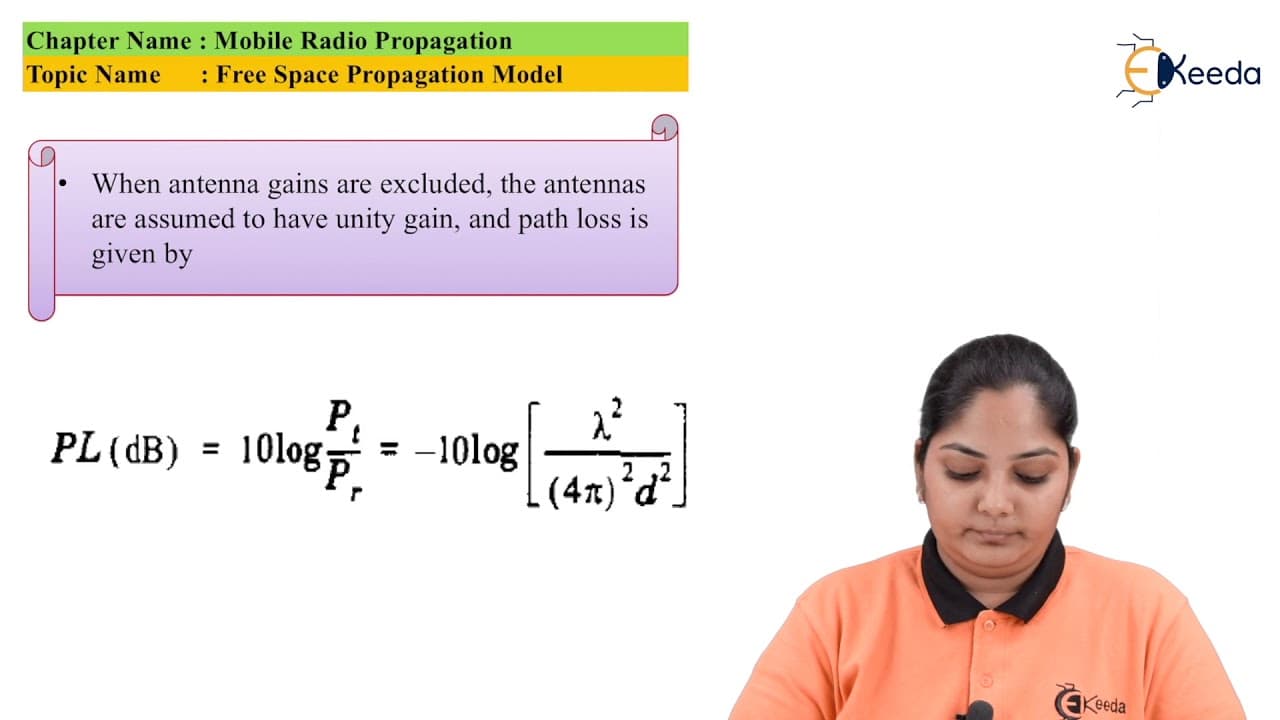
The free space propagation model describes how signals attenuate over distance in a clear line of sight scenario, assuming no obstacles between the transmitter and receiver. It calculates received signal strength using the free space equation, which factors in transmitted power, antenna gains, and the distance between antennas. This model is essential for understanding path loss in wireless communications.
Transcript
click the bell icon to get latest videos from ekeeda hello friends in this lecture we are going to study the free space propagation model but before moving on to the free space propagation model let us first understand what is the path loss that has been observed there are various kind of path laws the first one is called as large scale path loss m... Read More
Key Insights
- 🌸 Path loss refers to the attenuation of a signal during transmission, and it can be calculated using various models such as the large scale and small scale path loss models.
- 🥶 The free space propagation model assumes no obstruction between the transmitter and receiver, enabling the calculation of signal strength using the free space equation.
- 📶 Antenna gain and aperture are important factors in signal transmission and can impact the path loss and received signal strength.
- ✊ An isotropic radiator is an ideal antenna that transmits in all directions with equal gain, while the effective isotropic radiator power (EIRP) represents the transmitted power multiplied by antenna gain.
- 📡 The Fraunhofer distance is the far field distance of a transmitting antenna, and it can be calculated using the formula df = 2D^2/λ, where D is the maximum antenna dimension and λ is the wavelength.
- 📡 The path loss in decibels can be calculated using the transmitted power, received power, and antenna gains, or simplified to a formula without antenna gains for unit gain antennas.
Install to Summarize YouTube Videos and Get Transcripts
Explore YouTube Video Summarizer or Get YouTube Transcript Extractor
Questions & Answers
Q: What is path loss?
Path loss refers to the reduction in signal strength as it travels from the transmitter to the receiver due to various obstructions and attenuation factors.
Q: What are large scale path loss models?
Large scale path loss models estimate the mean signal strength over a large distance between the transmitter and receiver, helping to determine the coverage area.
Q: What are small scale path loss models?
Small scale path loss models account for rapid fluctuations in signal strength over a shorter distance between the transmitter and receiver.
Q: How is the free space propagation model different?
The free space propagation model assumes a direct line of sight between the transmitter and receiver, allowing for the calculation of received signal strength without obstruction.
Summary & Key Takeaways
-
Path loss refers to the attenuation of a signal as it travels from the transmitter to the receiver.
-
Large scale path loss models estimate the signal strength over a large distance, while small scale path loss models account for rapid fluctuations over shorter distances.
-
The free space propagation model assumes a clear line of sight between the transmitter and receiver, allowing for the calculation of received signal strength.
Read in Other Languages (beta)
Share This Summary 📚
Summarize YouTube Videos and Get Video Transcripts with 1-Click
Try YouTube Summary with ChatGPT & Claude or YouTube Transcript Generator
Explore More Summaries from Ekeeda 📚


Summarize YouTube Videos and Get Video Transcripts with 1-Click
Try YouTube Summary with ChatGPT & Claude or YouTube Transcript Generator