How Can Food Waste Become Valuable Products? | Xiaoyan (李晓岩) Li | TEDxTsinghua SIGS
TL;DR
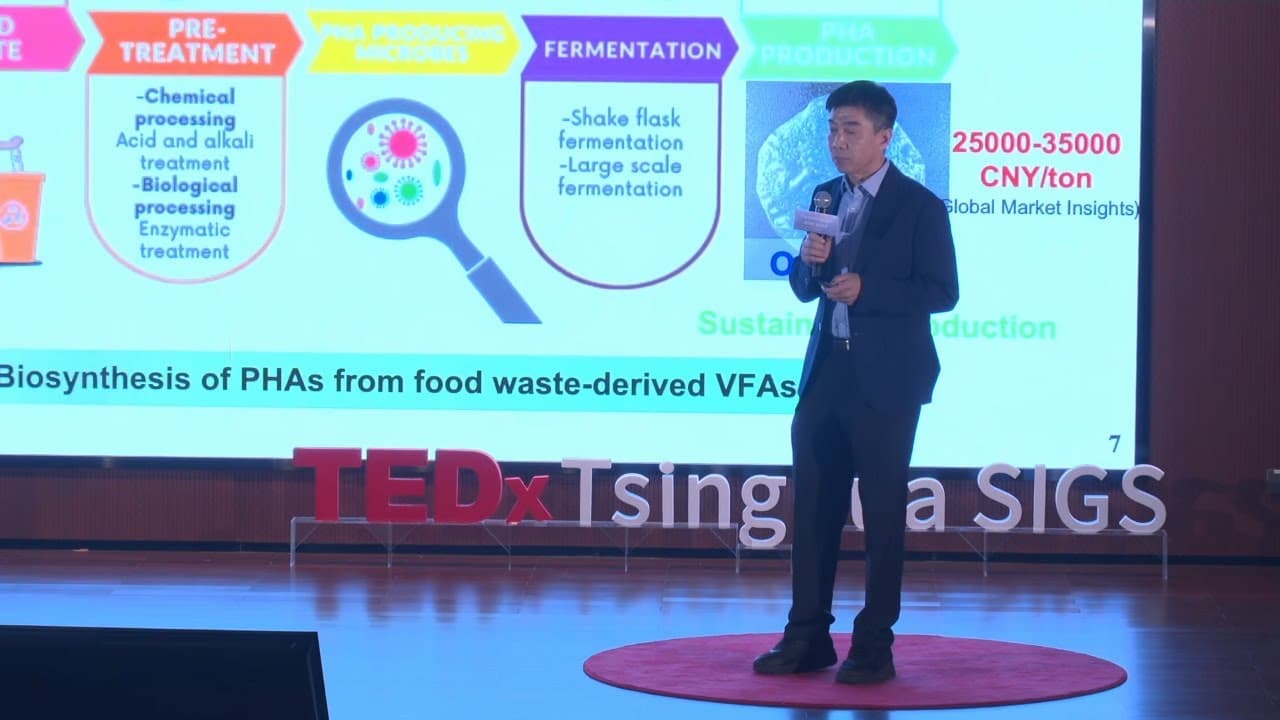
Food waste can become valuable products through anaerobic digestion, fermentation, biosynthesis, and pyrolysis. These processes can produce bioenergy, organic acids, biodegradable plastics, animal-feed protein, microfibers, biochar, bio-oil, and gases; one example, PHA, is valued at 20,000 yuan per ton. Read on to see how each pathway recovers more value from a fast-growing urban waste stream.
Transcript
My talk has no match to the to the dance. The dancing that's a difficult part. I'm in the field of engineering and the technology. So you know basically as engineers we are boring people boring people really boring people. We're working on serious problems. Hopefully arrive to serious solutions. And the topic this hour of the topic this hour is foo... Read More
Key Insights
- Food waste is a significant contributor to urban waste, with China being the largest producer.
- Traditional methods like landfilling and composting are ineffective for current food waste challenges.
- Anaerobic digestion converts food waste into bioenergy, but its value is limited compared to other products.
- Fermentation processes can transform food waste into high-value organic acids used in wastewater treatment.
- Biodegradable plastics can be synthesized from food waste, offering an alternative to fossil fuel-based plastics.
- Yeast fermentation of food waste produces single-cell protein, valuable for animal feed.
- Fungal fermentation can create microfibers for paper and cardboard production.
- Pyrolysis rapidly converts food waste into biochar, bio-oil, and gases, offering a quick waste reduction method.
Install to Summarize YouTube Videos and Get Transcripts
Explore YouTube Video Summarizer or Get YouTube Transcript Extractor
Questions & Answers
Q: How can food waste be transformed into valuable products?
Food waste can be processed through anaerobic digestion, fermentation, biosynthesis, and pyrolysis. These pathways produce bioenergy, organic acids, biodegradable plastics, single-cell protein, microfibers, biochar, bio-oil, and gases.
Q: Why is food waste a serious urban sustainability problem?
Food-waste volumes are large and increasing, with Shenzhen producing more than 5,000 tons per day. It is also wet and rich in organic matter, making it difficult to handle with conventional waste-treatment methods.
Q: Why are landfilling and composting inadequate for current food-waste challenges?
The talk describes landfilling and composting as too slow for today’s growing food-waste volumes. They also generate little return or value compared with processes that recover energy, chemicals, plastics, proteins, or materials.
Q: How does anaerobic digestion convert food waste into energy?
Anaerobic digestion uses biological activity to break organic matter into smaller molecules such as methane. The methane can fuel electricity generation, with estimates in the talk suggesting enough electricity for the domestic use of 1% to 2% of the population.
Q: How can food waste produce organic acids for wastewater treatment?
Incomplete anaerobic digestion, described as fermentation or acetogenesis, converts food waste into organic acids such as volatile fatty acids. These acids can serve as a carbon source for denitrification, helping remove nitrogen during wastewater treatment.
Q: How are biodegradable plastics made from food waste?
Volatile fatty acids produced from food waste can feed a biosynthesis step that creates PHA, a biodegradable plastic valued at 20,000 yuan per ton. Another pathway produces lactic acid, which is a precursor for the biodegradable plastic PLA.
Q: How does yeast fermentation turn food waste into animal feed?
The process begins by sterilizing food waste and inoculating it with a suitable yeast species. Fermentation then produces yeast-based single-cell protein that can be used as animal feed or as an animal-feed ingredient.
Q: What products can fungal fermentation and pyrolysis make from food waste?
Fungal fermentation can convert food waste into microfibers for paper, cardboard, and packing materials. Pyrolysis provides a rapid conversion route that produces biochar, bio-oil, and gases.
Summary & Key Takeaways
-
Food waste is a major urban sustainability problem, with traditional disposal methods proving inadequate. Innovative approaches like anaerobic digestion and fermentation offer solutions by converting waste into valuable products such as bioenergy and biodegradable plastics. These processes not only mitigate waste but also yield high-value materials that can replace conventional products, contributing to a more sustainable future.
-
Anaerobic digestion breaks down food waste into bioenergy, providing electricity for a small percentage of the population. However, the focus is shifting towards producing high-value products like organic acids and biodegradable plastics. These products offer greater economic returns and environmental benefits, highlighting the potential of food waste valorization.
-
Fungal and yeast fermentation processes transform food waste into valuable materials such as microfibers and single-cell proteins. These innovations provide alternative uses for waste, reducing environmental impact and promoting sustainability. Additionally, pyrolysis offers a rapid conversion method, further expanding the possibilities for food waste valorization.
Read in Other Languages (beta)
Share This Summary 📚
Summarize YouTube Videos and Get Video Transcripts with 1-Click
Try YouTube Summary with ChatGPT & Claude or YouTube Transcript Generator
Explore More Summaries from TEDx Talks 📚

Summarize YouTube Videos and Get Video Transcripts with 1-Click
Try YouTube Summary with ChatGPT & Claude or YouTube Transcript Generator