How to Solve Problem No. 1 on Super Nodes in DC Circuits | Basic Electrical Engineering
TL;DR
The current through the 60-ohm resistor is 0.6957 A downward when the DC circuit is solved using super-node nodal analysis. The solution treats nodes A and B as a super node, applies KCL to that combined node and node C, and solves three equations for three unknown voltages. Read on to see how the reference-node choice leads to the super node and the final current.
Transcript
hello friends in this video we are going to see the concept of nodal analysis is applicable to a problem irrespective of any reference point so let's take a numerical to elaborate this concept so i am having only one voltage source of 80 volt and remaining branches consist of resistances only 10 ohm 50 this is 60 ohm one more 50 ohm resistance and ... Read More
Key Insights
- ⚡ Nodal analysis is a useful technique for solving circuit problems by analyzing the voltages at different nodes.
- 😥 Super nodes are created when a voltage source is not taken as a reference point, allowing for the combination of multiple nodes.
- 🦸 Kirchhoff's Current Law (KCL) is applied to both regular nodes and super nodes to solve for the unknown variables in the circuit.
- 😥 By properly applying nodal analysis and understanding super nodes, accurate answers can be obtained even when selecting different reference points.
- 💐 Nodal analysis helps to determine the current flowing through specific resistances by calculating the voltage across them using Ohm's Law.
- 🦸 The video highlights the importance of understanding and applying KCL and the concept of super nodes in circuit analysis.
- 💐 The solved numerical example demonstrates the step-by-step process of using nodal analysis to find the current flowing through a 60-ohm resistance.
Install to Summarize YouTube Videos and Get Transcripts
Explore YouTube Video Summarizer or Get YouTube Transcript Extractor
Questions & Answers
Q: How do you solve Problem No. 1 on super nodes in DC circuits?
Assign voltages Va, Vb, and Vc, with the selected reference node at 0 V. Write Va − Vb = 80 V, form a super node around A and B, apply KCL to the super node and node C, and solve the resulting three equations.
Q: Why is a super node required in this circuit?
The 80 V source lies between nodes A and B because the instructor deliberately selects a different reference point. The two nodes are therefore combined into a super node for the KCL equation.
Q: What voltage-source equation is used between nodes A and B?
The equation is Va − Vb = 80 V. The sign follows from the source having positive polarity on the A side and negative polarity on the B side.
Q: How is KCL applied to the super node containing A and B?
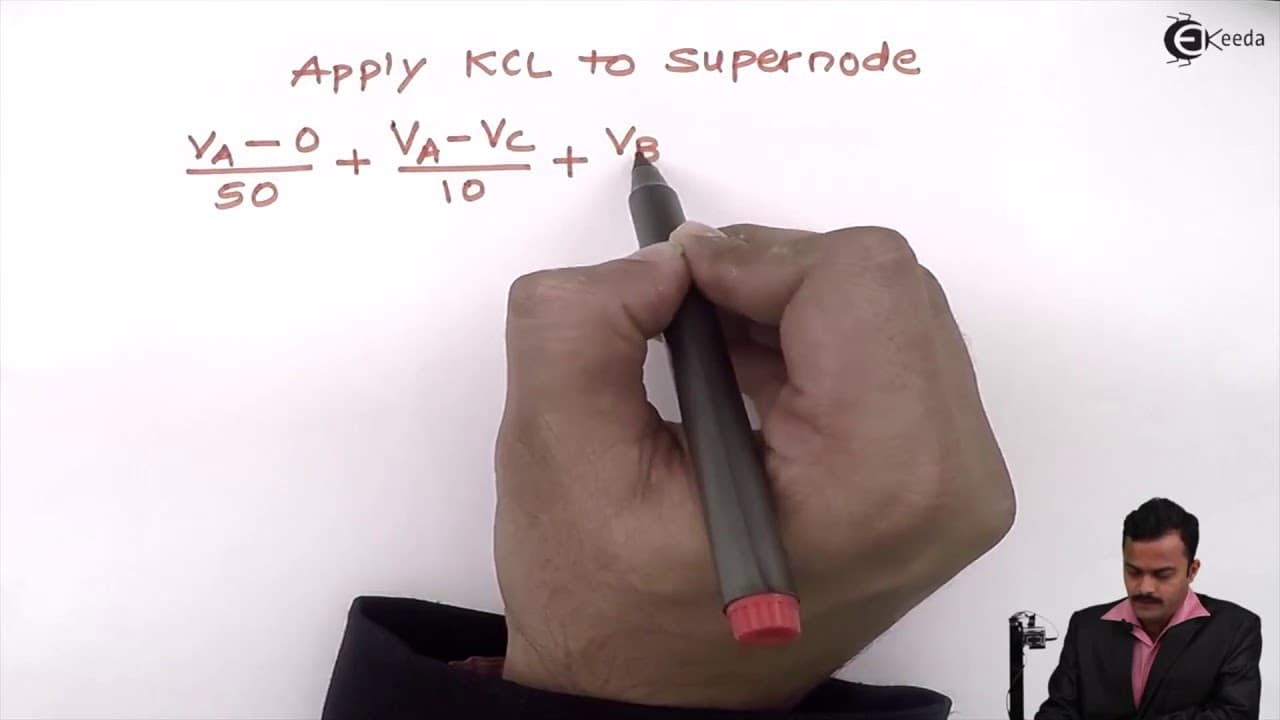
Treat the voltage source between A and B as short-circuited while identifying the super-node boundary. The combined KCL equation is Va/50 + (Va − Vc)/10 + Vb/10 = (Vc − Vb)/50.
Q: What KCL equation is written for node C?
The incoming current is written as (Va − Vc)/10. It equals the outgoing currents through the 50-ohm branch and the 60-ohm branch: (Vc − Vb)/50 + Vc/60.
Q: What node voltages are obtained after solving the equations?
Solving the three equations for the three unknowns gives Va = 60.8696 V, Vb = −19.1304 V, and Vc = 41.7391 V. These voltages are measured relative to the selected 0 V reference node.
Q: What is the current through the 60-ohm resistor?
The current is calculated from Vc/60 using Vc = 41.7391 V. This gives 0.6957 A.
Q: What does the positive current result indicate?
The positive value means the assumed direction for the current through the 60-ohm resistor was correct. In the worked circuit, that direction is downward.
Summary & Key Takeaways
-
The video demonstrates how nodal analysis can be used to find the current flowing through a specific resistance in a circuit.
-
It introduces the concept of a super node, which is created when a voltage source is not taken as a reference point.
-
The video shows how to apply Kirchhoff's Current Law (KCL) to the super node and other nodes to solve for the unknown voltages and currents in the circuit.
Read in Other Languages (beta)
Share This Summary 📚
Summarize YouTube Videos and Get Video Transcripts with 1-Click
Try YouTube Summary with ChatGPT & Claude or YouTube Transcript Generator
Explore More Summaries from Ekeeda 📚


Summarize YouTube Videos and Get Video Transcripts with 1-Click
Try YouTube Summary with ChatGPT & Claude or YouTube Transcript Generator