What Readers Actually Underline in Tiago Forte's Books

Sep 17, 2026
5 min read
1 views
Across five languages, readers agree on the system but stop at different parts of it.
Glasp readers have imported their Kindle highlights from 11 editions of Tiago Forte's books, 211 highlighters between them. Below, editions of the same book are grouped together.
When the same book crosses languages, English readers underline definitions, while readers in other languages underline procedures.
In the two English editions of Building a Second Brain, 23 of 60 highlighters (38%) and 21 of 57 highlighters (37%) chose the same definition of a note as a knowledge building block. The Portuguese edition puts 7 of 16 highlighters (44%) on keeping only what resonates, while the Spanish edition puts 4 of 5 highlighters (80%) on each of three tied instructions, beginning with capture.
The Japanese edition makes the contrast even clearer: 5 of 21 highlighters (24%) chose each of three tied lines, including the CODE acronym. In The PARA Method, both English editions reach 50%, but 9 of 18 highlighters (50%) choose outcomes in one edition while 5 of 10 highlighters (50%) choose a system that frees attention in the other.
Reader Consensus is the passage highlighted by more Glasp readers than any other passage in that edition. The counts below are all-time totals through 2026-09-17, and ties are noted.
1. Building a Second Brain: A Proven Method to Organise Your Digital Life and Unlock Your Creative Potential
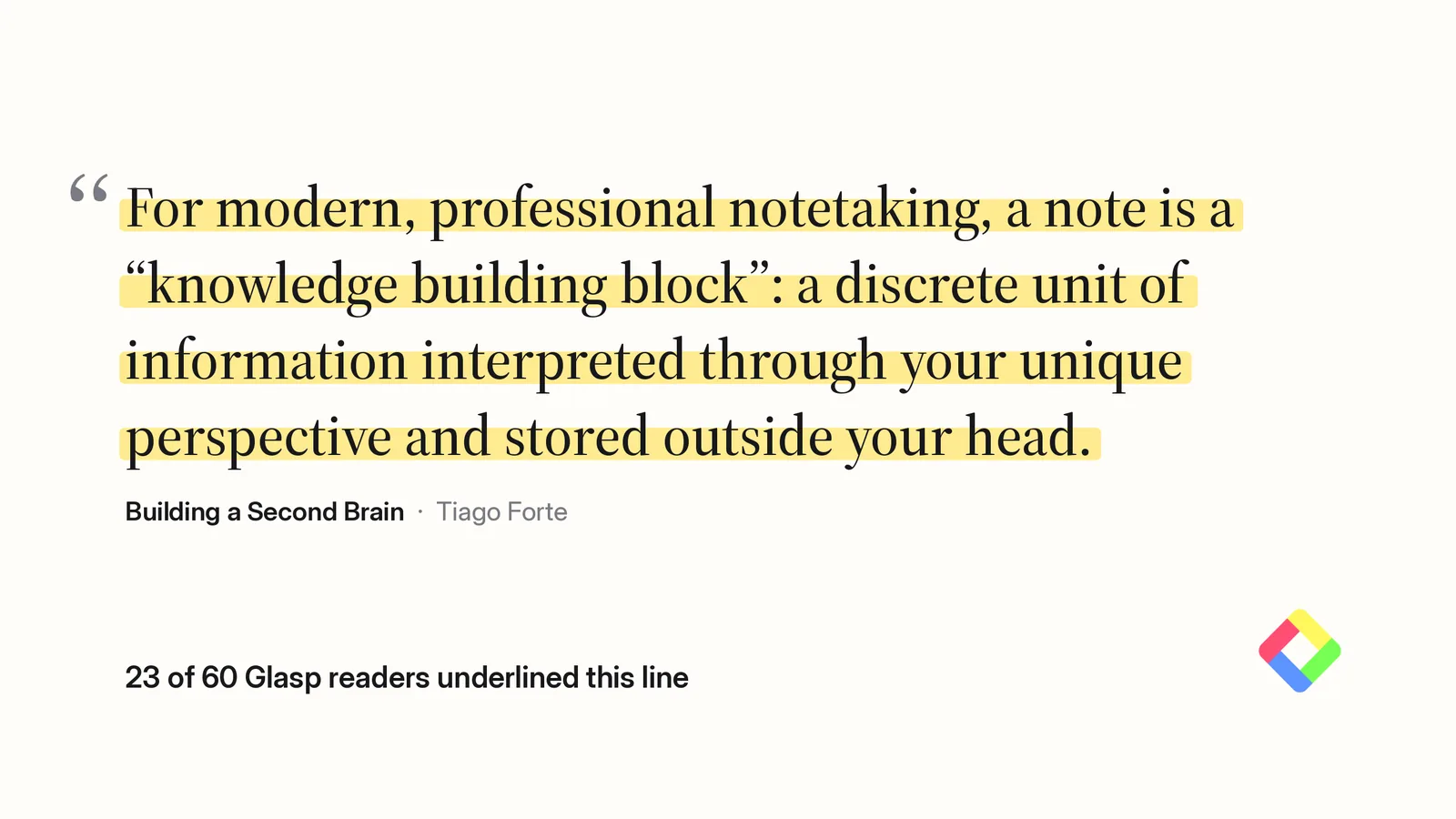
For modern, professional notetaking, a note is a “knowledge building block”—a discrete unit of information interpreted through your unique perspective and stored outside your head.
Reader Consensus: 23 of 60 highlighters (38%).
The other English edition lands on exactly the same sentence, chosen by 21 of 57 highlighters (37%).
The Portuguese edition takes a different line. 7 of 16 highlighters (44%) chose this passage about keeping only what resonates, tied with another passage on the four things a Second Brain can do for you:
A solução é guardar apenas aquilo que repercute em você num lugar confiável, sob controle, e eliminar o resto.
In Spanish, 4 of 5 highlighters (80%) chose each of three tied top lines. One is:
Capturar: guarda aquello con lo que conectas
In Japanese, 5 of 21 highlighters (24%) chose each of three tied top lines. One is:
「CODE」とは、それぞれ キャプチャー(Capture)、オーガナイズ(Organize)、ディスティル(Distill)、エクスプレス(Express) の頭文字を取ったものです。
The Italian edition shifts to future usefulness, with 3 of 7 highlighters (43%) choosing:
Ogni volta che prendete un appunto, domandatevi: «Come posso renderlo il più utile possibile per il futuro?»
📖 English edition: Read on Amazon · Highlights on Glasp
📖 English edition, alternate listing: Read on Amazon · Highlights on Glasp
📖 Japanese edition: Read on Amazon · Highlights on Glasp
📖 Portuguese edition: Read on Amazon · Highlights on Glasp
📖 Italian edition: Read on Amazon · Highlights on Glasp
📖 Spanish edition: Read on Amazon · Highlights on Glasp
2. The PARA Method: Simplify, Organize, and Master Your Digital Life
What you do have, both at work and in life, are outcomes you are trying to achieve.
Reader Consensus: 9 of 18 highlighters (50%).
The other English edition also reaches 50%, but its readers choose simplicity: 5 of 10 highlighters (50%) marked this line instead:
The system you use to organize information has to be so simple that it frees up your attention, instead of taking more of it. Your system must give you time, not take time.
📖 English edition: Read on Amazon · Highlights on Glasp
📖 English edition, alternate listing: Read on Amazon · Highlights on Glasp
3. Extend Your Mind
The inventory of knowledge work is ideas. What you are selling, as a “worker of knowledge,” are the ideas you’ve “processed” through the focused application of your attention.
Reader Consensus: 2 of 7 highlighters (29%).
📖 Read on Amazon · Highlights on Glasp
4. Design Your Work: Praxis Volume 1
But what if depriving pain of much of its power was as simple as paying attention to it? Anger, doubt, shame, envy, vengeance — all these feelings have such a hold over us only because they operate in the dark. Shine a light on them, and they wither.
Reader Consensus: 2 of 5 highlighters (40%), tied with another passage about responding to distractions.
📖 Read on Amazon · Highlights on Glasp
5. Simple Marketing For Smart People: The One Question You Need to Win Customers without Gimmicks, Hype, or Hard Selling (English Edition)
Here are some of the beliefs I came up with when I first did the Belief Building exercise for my online course, Building a Second Brain: • My brain is for having ideas, not holding them. • I am already creative and do creative work. • My thoughts and ideas are valuable and worth saving and revisiting. • I am already doing most of the work required. • I can get and stay organized quickly and easily. • If I don’t make an intentional effort to preserve my thinking, it will be lost.
Reader Consensus: 2 of 5 highlighters (40%), tied with three other passages.
📖 Read on Amazon · Highlights on Glasp
❤️ Before you go
Across editions, readers keep returning to the point where information becomes usable. They underline the definition of a note in English, capture and CODE in translation, and outcomes or freed attention in the two editions of The PARA Method.
The discovery is not that one language understands the system differently. It is that the same system offers different places to enter it. Some readers stop to name the unit; others stop at the next action.
If any of these books are on your shelf, import your highlights and add your own underline to the count.
The Glasp Team