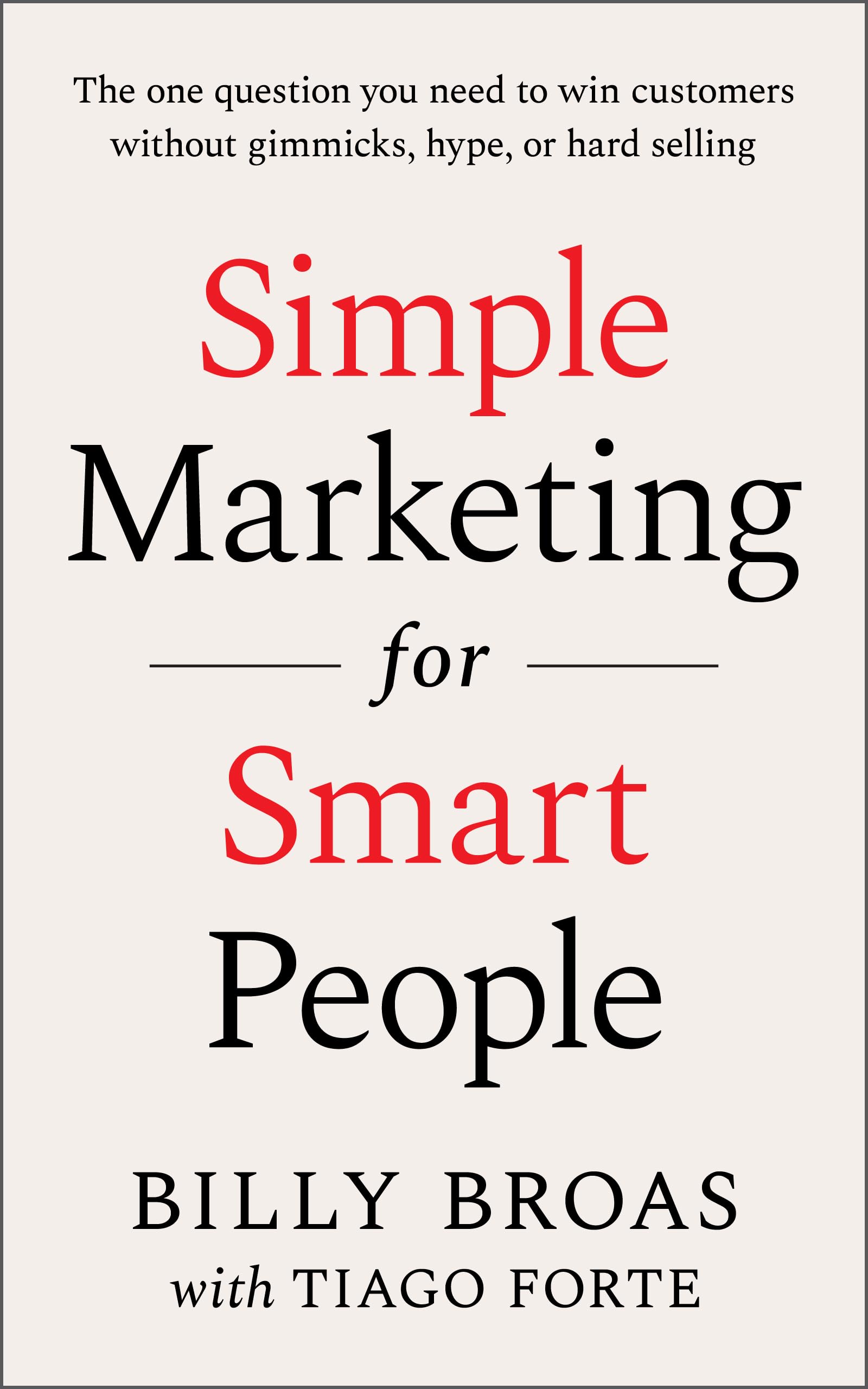
Simple Marketing For Smart People: The One Question You Need to Win Customers without Gimmicks, Hype, or Hard Selling


About This Book
Simple Marketing for Smart People argues that effective marketing hinges on a single focusing question: "What does my customer need to believe in order to buy?" The authors (Billy Broas, with Tiago Forte) call the answer-and-execute process Belief Building, and they frame it as the antidote to the "curse of knowledge" that plagues intelligent experts.
The central insight: smart people overcomplicate. Deep expertise causes a single topic to splinter into endless subtopics, leaving experts unsure where to start and prone to drowning prospects in technical detail. The remedy is convergence rather than divergence—distilling your message to its essence without dumbing it down.
The book organizes marketing around a river metaphor with three sections:
- Upstream: your core message—the central, documented argument for why someone should buy.
- Midstream: distribution channels (YouTube, email, SEO, social).
- Downstream: tactics (pop-ups, retargeting, giveaways).
The key point is that most channel "experts" obsess downstream, while 90% of the real work happens upstream on the core message—which only you can create.
Belief Building follows three steps: identify your prospects' current beliefs, identify the beliefs required to make purchase obvious, then create content that builds each belief. The authors introduce the chain of beliefs, mapping prospects from "unaware" outer rings to "ready-to-buy" inner rings, and tools for uncovering beliefs—listening for "bad" questions, asking gentle "what/how" questions, and a cycles-based research approach.
Drawing on copywriting legend Eugene Schwartz, the book reframes marketing as teaching rather than deception. Belief Building is sophisticated objection-handling done early, so prospects arrive pre-sold. The promise: sustainable, ethical growth without gimmicks, hype, or hard selling.
Key Takeaways
- 1.The only question you need to develop your core message is "What does my customer need to believe in order to buy?"
- 2.Smart people sabotage their marketing through the curse of knowledge—the antidote is convergence and distillation, not dumbing down.
- 3.Your core message is the upstream source of all marketing; channels and tactics are the cherry, not the cake.
- 4.Marketing is teaching, not deception—educate prospects so buying becomes their only logical choice.
- 5.Map prospects along a chain of beliefs and meet them where they are; cold and warm prospects need different messaging.
- 6.Belief Building is early objection-handling, so prospects arrive at checkout already pre-sold.
- 7.Most so-called marketing experts are merely channel experts—never bet your success on a single channel.
Top Highlights
The lesson is clear: when you keep things simple, you free up the time, attention, and headspace to invest in what matters most. (And in most cases, going back to simple will also free up cash.)
Highlighted by 3 people
Here’s my point: when you have an analytical mind and dive deep into a topic, one topic becomes many. It splits into hundreds or thousands of subtopics. Do you now see why smart people are prone to getting lost in details? When experts talk about “being in the weeds,” this is what they mean. Those details are the weeds, and those weeds are tough to escape.
Highlighted by 3 people
Smart marketers take the following mindset toward marketing channels: • They put most of their effort into creating a compelling core message. • They don’t put too much hope into a single marketing channel. They test multiple channels. • When they find a channel that works, they double down on that channel until it fails to deliver an acceptable return on investment.
Highlighted by 3 people
What does my prospect need to believe in order to buy? That question—What does my prospect need to believe in order to buy?— is the only question you need to ask yourself to develop your core message. You’ll take your answers to this question and use them to create your marketing material. We call this entire process Belief Building. One easy way to think about Belief Building is as a sophisticated form of objection handling. If you removed all the prospect’s objections to buying, they would have no logical choice but to buy from you.
Highlighted by 3 people
Once you realize that your prospects don’t hold the beliefs required to accept your offer, your task switches from selling to Belief Building. You ask the all-important question, “What does my customer need to believe in order to buy?”
Highlighted by 3 people
When faced with a challenge, Keller recommends we ask, “What’s the one thing I can do that makes everything else easier?” This type of question—a focusing question—is the perfect solution for the smart person. It focuses your divergent mind and deep knowledge in your area of expertise on a single goal.
Highlighted by 3 people
A heads up: as you do your Belief Building exercises, you are going to create content that may feel very basic. You may even feel like you’re “dumbing down” your ideas. That’s a good thing. Rather than think of it as dumbing down, think of it as distilling, refining, boiling it down, finding the essence, or finding the signal in the noise. Those are all more helpful ways of describing what you’ll actually be doing with your marketing content. Still, smart people resist this advice tremendously.
Highlighted by 3 people
What is a core message? It’s the central argument for why someone should choose your product or service. Think of your core message as the underground spring of your marketing river. It’s not visible to your customers, but it’s essential for providing direction and coherence to all your marketing efforts. This message should be well documented and referred to whenever you create new marketing material.
Highlighted by 2 people
A core messaging document is not a brand manual. A brand manual dictates a business’ visuals, like its logo, fonts, and colors. A core messaging document, on the other hand, focuses on the beliefs your prospects need to hold for your product to be an obvious purchase.
Highlighted by 2 people
The smart marketer knows marketing is far more than channels or advertisements. The smart marketer knows that 90% of their hard work is done before their ad appears on their customer’s social media feed.
Highlighted by 2 people
AI Review
Based on Glasp's analysis of highlights from 4 readers, this is a focused, principle-driven marketing guide whose single big idea—Belief Building—resonates strongly and is consistently quoted across readers.
Pros
- +A genuinely single, memorable focusing question that organizes all marketing decisions
- +The upstream/midstream/downstream river metaphor makes prioritization intuitive
- +Reframes marketing as teaching, appealing to integrity-minded experts
- +Practical tools: chain of beliefs, cycles-based research, and "what/how" questions
- +Directly addresses the curse of knowledge that traps intelligent professionals
- +Promises sustainable growth over short-term spikes or hype
Cons
- −The core concept is repeated extensively, which may feel padded to some readers
- −Light on advanced channel- and tactic-level execution, since the focus stays upstream
Glasp AI analysis based on highlights from 4 readers.
Who Should Read This
Ideal for expert solopreneurs, course creators, consultants, coaches, and service providers who are brilliant at their craft but feel overwhelmed by marketing. It especially suits the analytical "smart person" who suffers from the curse of knowledge—someone who overcomplicates messaging, distrusts sleazy tactics, and wants ethical, sustainable growth. Readers who keep collecting tactics without implementing, or who believe a good product should sell itself, will benefit most. No prior marketing background is required.
Frequently Asked Questions
What is the book about?
Who is the book for?
What are the key lessons?
What is Belief Building?
What is the upstream vs. downstream metaphor?
How do I discover what my prospects believe?
Is it worth reading?
How to Apply What You Read
- 1.Write a core messaging document and list every belief a prospect must hold before buying becomes obvious.
- 2.Ask the focusing question—what must my customer believe to buy?—before creating any new piece of content.
- 3.Listen to the "bad" questions prospects ask and use gentle "what/how" questions to uncover their current beliefs.
- 4.Map your prospects' chain of beliefs from unaware to ready-to-buy, then create content to fix each broken link.
- 5.Audit your existing marketing for assumptions you've taken for granted due to the curse of knowledge.
Discussion Questions
- Q1.What beliefs must your customers hold before buying becomes their obvious choice, and which are missing today?
- Q2.Where in your own marketing have you fallen victim to the curse of knowledge and assumed too much?
- Q3.How comfortable are you reframing marketing as teaching rather than selling, and why?
- Q4.Which of your current efforts are upstream versus downstream, and are you over-investing in tactics?
- Q5.Have you been chasing a single channel for success instead of perfecting your core message?
- Q6.What "bad" questions do your prospects repeatedly ask, and what beliefs do those questions reveal?
- Q7.Are you protecting your identity as an expert at the expense of meeting customers where they are?
Recommended Books




Revisit Your Highlights, Deepen Your Understanding
Import your Kindle highlights to review, organize, and share the ideas that matter most to you.
Get the free browser extension