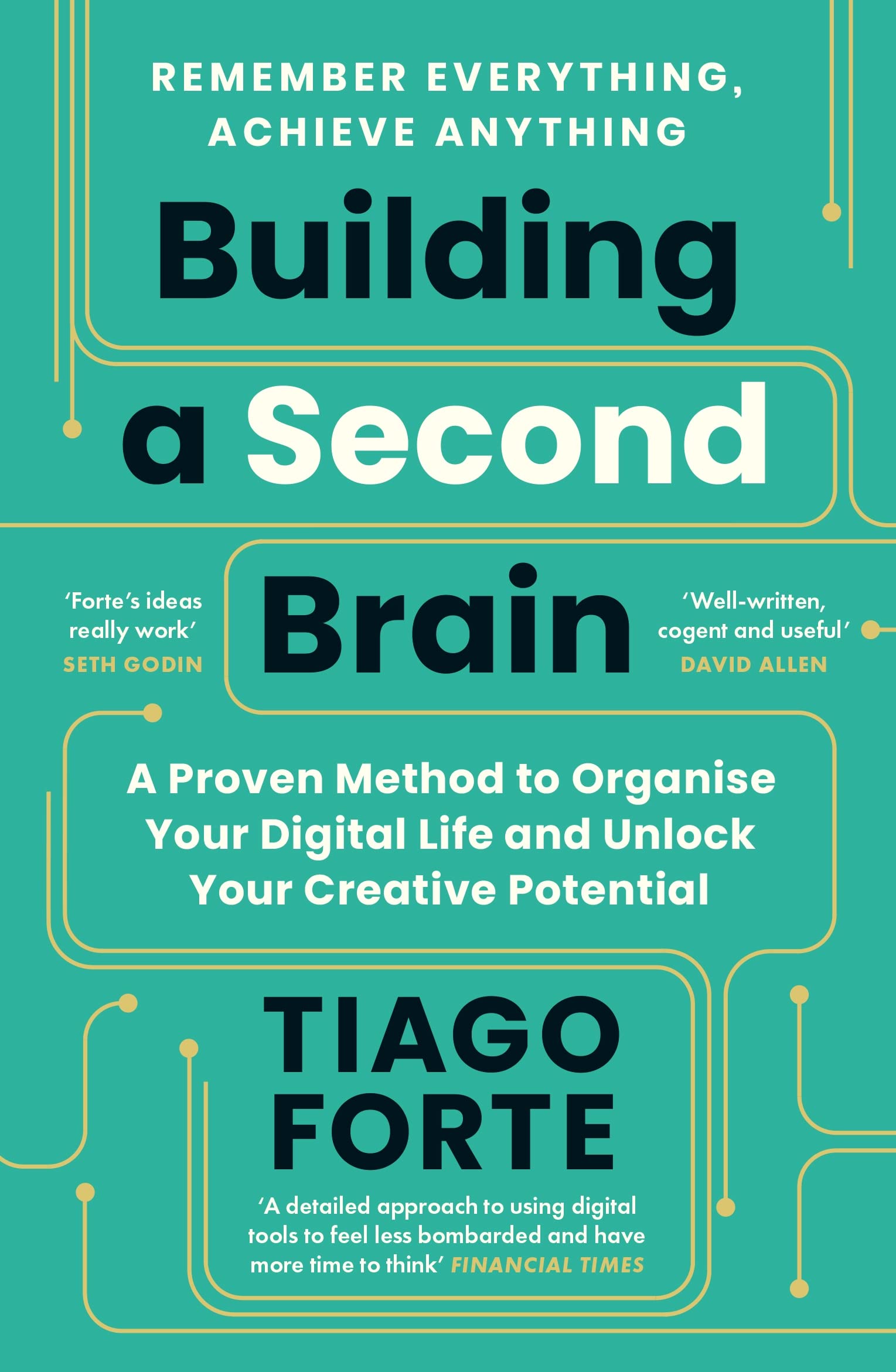
Building a Second Brain: A Proven Method to Organise Your Digital Life and Unlock Your Creative Potential
About This Book
Building a Second Brain argues that in an age of information overload, the real advantage is not consuming more, but building a trusted external system that helps you remember, connect, and create. Tiago Forte frames a note not as a verbatim record, but as a knowledge building block: a discrete unit of information filtered through your perspective and stored outside your head. The book’s core promise is simple: your mind is for having ideas, not holding them.
The highlights show that readers most strongly resonated with the book’s action-first philosophy. Instead of organizing notes by source or abstract topic, Forte recommends organizing them by where they are going—especially the current projects they can help move forward. This idea becomes the basis of the PARA system:
- Projects: short-term efforts with a clear outcome
- Areas: ongoing responsibilities to maintain
- Resources: topics that may be useful later
- Archives: inactive material
The workflow is structured through the CODE method:
- Capture what resonates
- Organize for action
- Distill notes to their essence
- Express ideas by creating and sharing
A major theme is that notes should serve your future self. Readers repeatedly highlighted the advice to make each note useful, discoverable, and easy to decode later by adding commentary, summaries, and layers of emphasis. Distillation matters because the best notes are not the longest—they preserve the essence in a sentence or two.
The book also links personal knowledge management to creativity. A Second Brain helps make ideas concrete, reveal unexpected associations, incubate thinking over time, and sharpen your unique perspective. Creativity, in this view, is not mysterious inspiration but a repeatable process of gathering raw material, revisiting it, and turning it into something concrete.
Ultimately, the book presents note-taking as a system for action, reflection, and expression—not storage for its own sake.
Key Takeaways
- 1.Organize for action, not for perfect taxonomy; the best place for a note is where it can help a current outcome.
- 2.A note becomes valuable when it is filtered through your own perspective and stored as a reusable knowledge building block.
- 3.The best notes are written for your future self, with enough context and commentary to be understood quickly later.
- 4.Distilling information to its essence makes it easier to find, review, and apply under real-world time pressure.
- 5.Creativity improves when diverse ideas live in one trusted system, making unexpected associations more likely.
- 6.Capturing everything creates noise; capturing only what resonates preserves attention and raises signal quality.
- 7.The purpose of a Second Brain is not hoarding information but expressing ideas through finished work.
Top Highlights
The best way to organize your notes is to organize for action,
Highlighted by 27 people · 2 left notes
Every time you take a note, ask yourself, “How can I make this as useful as possible for my future self?”
Highlighted by 25 people · 2 left notes
For modern, professional notetaking, a note is a “knowledge building block”—a discrete unit of information interpreted through your unique perspective and stored outside your head.
Highlighted by 21 people · 1 left a note
keep only what resonates in a trusted place that you control, and to leave the rest aside.
Highlighted by 21 people · 2 left notes
four essential capabilities
Highlighted by 20 people · 1 left a note
powerful way to facilitate and speed up this process of rapid association: distill your notes down to their essence.
Highlighted by 20 people
To be able to make use of information we value, we need a way to package it up and send it through time to our future self.
Highlighted by 16 people
Your mind is for having ideas, not holding them.
Highlighted by 16 people · 1 left a note
This digital commonplace book is what I call a Second Brain. Think of it as the combination of a study
Highlighted by 16 people · 3 left notes
a piece of content has been interpreted through your lens, curated according to your taste, translated into your own words, or drawn from your life experience, and stored in a secure place, then it qualifies as a note.
Highlighted by 16 people · 1 left a note
AI Review
Glasp’s AI analysis of 47 reader highlights suggests strong consensus that this is a highly actionable and memorable productivity book. The most-highlighted passages center on practical systems like action-based organization, future-self note design, and distilling ideas, indicating broad reader value rather than isolated quotability.
Pros
- +Actionable framework built around CODE and PARA
- +Strong emphasis on organizing notes by current projects
- +Memorable advice on writing notes for your future self
- +Turns note-taking from storage into a creative process
- +Useful distinction between capturing, organizing, and expressing
- +Encourages selective curation instead of information hoarding
- +Highlights creativity as connection-making, not mere inspiration
Cons
- −Some readers may find the Projects vs Areas vs Resources boundary hard to apply at first
- −The system depends on regular review habits to work well
- −May feel repetitive if you already follow mature PKM methods
Glasp AI analysis based on highlights from 47 readers.
Who Should Read This
This book is best for knowledge workers, students, creators, researchers, managers, and entrepreneurs who feel overwhelmed by bookmarks, tabs, highlights, and scattered files. It is especially useful for people juggling multiple projects and wanting a practical system for turning information into output.
You do not need deep technical knowledge. It works well for readers using apps like notes tools, cloud drives, or task systems who want a simpler framework for organizing ideas, preserving insights, and creating from what they already know.
Frequently Asked Questions
What is the book about?
Who is it for?
What are the key lessons?
What is the PARA method?
What does CODE stand for?
Why does the book focus so much on future self?
Is it worth reading?
How to Apply What You Read
- 1.List your active projects and create simple PARA folders for Projects, Areas, Resources, and Archives.
- 2.Capture only notes that feel inspiring, useful, personal, or surprising instead of saving entire sources.
- 3.Annotate each new note with why it mattered and how it might help your future self.
- 4.Distill one long note using progressive summarization so the core message is visible at a glance.
- 5.Review your notes weekly and move inactive material to Archives to keep your workspace clear.
Discussion Questions
- Q1.How would your note-taking change if you organized everything around current projects instead of topics or sources?
- Q2.What kinds of information do you currently save that are unlikely to help your future self?
- Q3.Which of your recurring questions or “favorite problems” could guide what you capture from now on?
- Q4.Do your current notes function more as storage, memory support, or creative raw material?
- Q5.How much of your information intake is actually leading to expression or action?
- Q6.What would it mean to treat your digital workspace as a creative environment rather than a filing cabinet?
- Q7.Which parts of the PARA or CODE system would be easiest—and hardest—for you to adopt consistently?
Recommended Books
Revisit Your Highlights, Deepen Your Understanding
Import your Kindle highlights to review, organize, and share the ideas that matter most to you.
Get the free browser extension