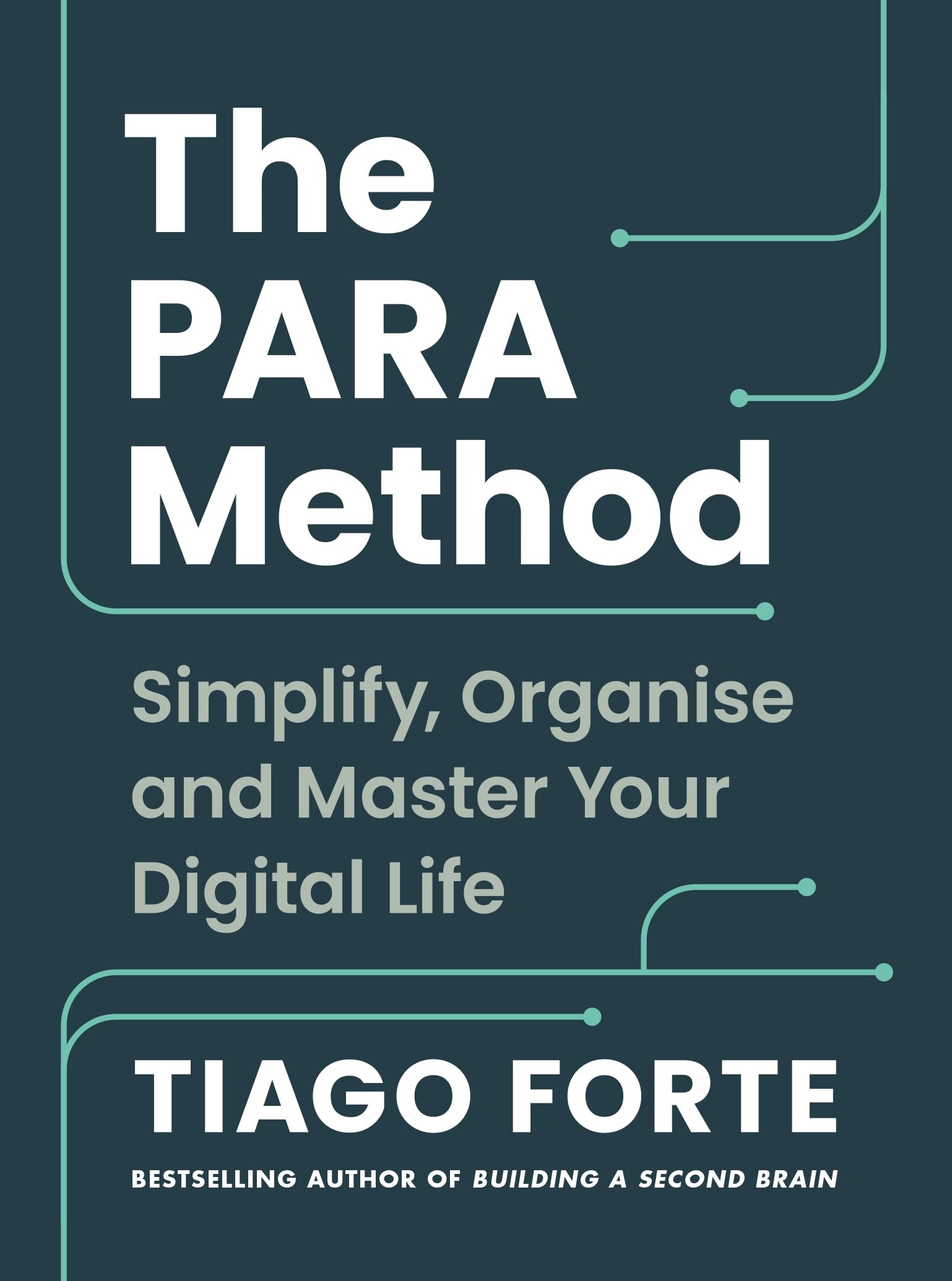
The PARA Method: Simplify, Organise and Master Your Digital Life





About This Book
The PARA Method by Tiago Forte presents a deceptively simple system for organizing all of your digital information across every platform you use. Its central insight is that everything in your digital life fits into just four categories, ordered by actionability:
- Projects — short-term efforts with a goal and a deadline
- Areas — long-term responsibilities with a standard to maintain and no end date
- Resources — topics or interests that may be useful in the future
- Archives — inactive items from the other three categories
Forte argues that traditional organizing by broad subject (as in school) is the wrong approach. Instead, you should organize information by the projects and goals you are committed to right now, because only by breaking responsibilities into concrete projects can you know the true extent of your commitments and connect daily effort to long-term goals.
A recurring theme is minimal effort: "organize as little as possible, as late as possible, and only as much as absolutely needed." Precision is required in only one place—defining projects—while everything else is allowed, even encouraged, to stay messy, because rigid systems block the unexpected connections that spark breakthroughs. Forte introduces the principle of organizing just in time rather than just in case, and treats PARA as an organic system (like a pond) where information must keep flowing between categories as your relationship to it changes.
The book also covers practical habits: a weekly review with a five-step project-list exercise, naming conventions, an inbox for processing, "digital bankruptcy" as a reset, and applying PARA to teams through a culture of writing. Forte closes with a philosophical turn—from the era of the knowledge worker to the "Wisdom Worker"—arguing that getting organized is ultimately about freeing your attention so you can take action in the real world.
Key Takeaways
- 1.All of your digital information fits into just four categories—Projects, Areas, Resources, and Archives—arranged by actionability.
- 2.Organize by the outcomes and projects you're committed to now, not by broad academic subjects, so you can connect daily effort to long-term goals.
- 3.A project needs a completable goal and a deadline; an area needs a standard to maintain and has no end date—treating one like the other causes either aimlessness or relapse.
- 4.Practice just-in-time organizing: wait until your needs are clear, then organize only what you need for the project at hand, pushing everything else aside.
- 5.Precision matters only in defining projects—embrace messiness elsewhere, because rigid systems block the unexpected connections that produce breakthroughs.
- 6.PARA is an organic system like a pond: keep information flowing between categories as your relationship to it changes, or it stagnates and loses relevance.
- 7.Much of what we call "organizing" is procrastination in disguise; a system should give you time, not take it.
Top Highlights
PARA requires precision in only one place: the definition of projects. Everything else is not only allowed to remain somewhat messy; that’s how it should be.
Highlighted by 6 people
This experience led me to form a new rule: never create an empty folder (or tag, or directory, or other container) before you have something to put in it.
Highlighted by 4 people
An area of responsibility has: 1. A standard to be maintained 2. An indefinite end date
Highlighted by 4 people
Instead of organizing information according to broad subjects like in school, I advise you to organize it according to the projects and goals you are committed to right now.
Highlighted by 4 people
When you break down your responsibilities into bite-size projects, you ensure that your project list is constantly turning over. This turnover creates a cadence of regular victories that you get to celebrate every time you successfully complete a project. Imagine how motivated and accomplished you’d feel by breaking out a broad area like “Events” into each individual event you’re organizing: Event projects: 1. Quarterly staff retreat 2. Annual stakeholder conference 3. Workshop on research methods 4. End-of-year hiring fair 5. Executive summer retreat
Highlighted by 4 people
Instead of asking, “Is this interesting?” which always results in overcollecting, I ask myself, “Is this useful?” That’s a much higher bar and forces me to consider what this piece of information will allow me to do
Highlighted by 4 people
Areas of responsibility are inherently private. It’s no one else’s business what material you save related to your Health, Finances, Personal Growth, or Kids. For example, in my Health (area) folder, I keep blood panels, notes from doctor’s visits, medical bills, and vaccination records
Highlighted by 4 people
HABIT #1: Organize According to Outcomes
Highlighted by 4 people
HABIT #2: Organize Just in Time
Highlighted by 4 people
What does our motivation depend on? Mostly, on making consistent progress. We can endure quite a bit of stress and frustration in the short term if we know it’s leading somewhere. Which brings us to our second problem: without a list of individual projects, you can’t connect your current efforts to your long-term goals.
Highlighted by 3 people
AI Review
Based on Glasp's analysis of highlights from 9 readers, The PARA Method delivers a memorable, immediately actionable framework with unusually strong consensus around its core definitions and principles.
Pros
- +A genuinely simple four-category system (Projects, Areas, Resources, Archives) that readers repeatedly flag as the core takeaway
- +Strong, quotable principles like organizing by outcomes and just in time rather than just in case
- +Practical and platform-agnostic—works across to-do apps, file systems, cloud storage, and note apps
- +Liberating philosophy that embraces messiness and warns against over-organizing as procrastination
- +Concrete weekly-review and project-list exercises readers found clarifying
Cons
- −The core idea is simple enough that some readers may feel the book repeats itself to fill pages
- −Later chapters lean into philosophical claims (the "Wisdom Worker," sources of power) that feel less grounded than the practical sections
Glasp AI analysis based on highlights from 9 readers.
Who Should Read This
This book is for knowledge workers, students, creators, and busy professionals drowning in files, notes, and apps who want a single, low-maintenance system that works everywhere. It suits readers overwhelmed by digital clutter, fans of productivity methods like Getting Things Done or Building a Second Brain, and managers wanting to bring PARA to a team. No technical background is needed—just a willingness to define your real commitments and resist the urge to over-organize.
Frequently Asked Questions
What is The PARA Method about?
Who is The PARA Method for?
What are the key lessons of the book?
Is The PARA Method worth reading?
What is the difference between an Area and a Resource?
How does PARA define a project?
How much maintenance does PARA require?
How to Apply What You Read
- 1.Archive everything in your Documents folder into a single dated "Archive" folder, then create project folders only as you need them.
- 2.List your current projects using a five-minute brainstorm, add a goal and deadline to each, then prioritize only for the coming week.
- 3.Run a weekly review that walks through the five-step project-list process to regain clarity and decide what to cancel, delegate, or postpone.
- 4.Replicate the same PARA structure across every app you use—down to identical spelling and capitalization—so you can move between platforms seamlessly.
- 5.Ask one question of each new item—"When will this be relevant next?"—instead of meticulously tagging or filing, and never duplicate a file.
Discussion Questions
- Q1.Which of your current responsibilities are really ongoing areas, and which could be broken down into completable projects?
- Q2.Where in your digital life do you over-organize as a way of avoiding the work you're actually dreading?
- Q3.How honest can you be about what is truly inside your circle of responsibility versus what you're merely interested in?
- Q4.Do you tend to behave like a sprinter or a marathoner, and how does that shape the way you handle projects and areas?
- Q5.What would change if you organized information "just in time" instead of "just in case"?
- Q6.Which goals you say are important have no projects attached—and which projects have no goals behind them?
- Q7.Do you agree with Forte that allowing some messiness leads to more creative breakthroughs than a rigidly tidy system?
Recommended Books

Revisit Your Highlights, Deepen Your Understanding
Import your Kindle highlights to review, organize, and share the ideas that matter most to you.
Get the free browser extension