What Readers Actually Underline in Morgan Housel's Books

Sep 17, 2026
4 min read
35 views
Readers open books about money and underline the limits that make money useful.
Glasp readers have imported their Kindle highlights from 8 editions of Morgan Housel's books, 137 highlighters between them. Below, editions of the same book are grouped together.
Housel's readers read about money but stop at the lines about enough and control over time.
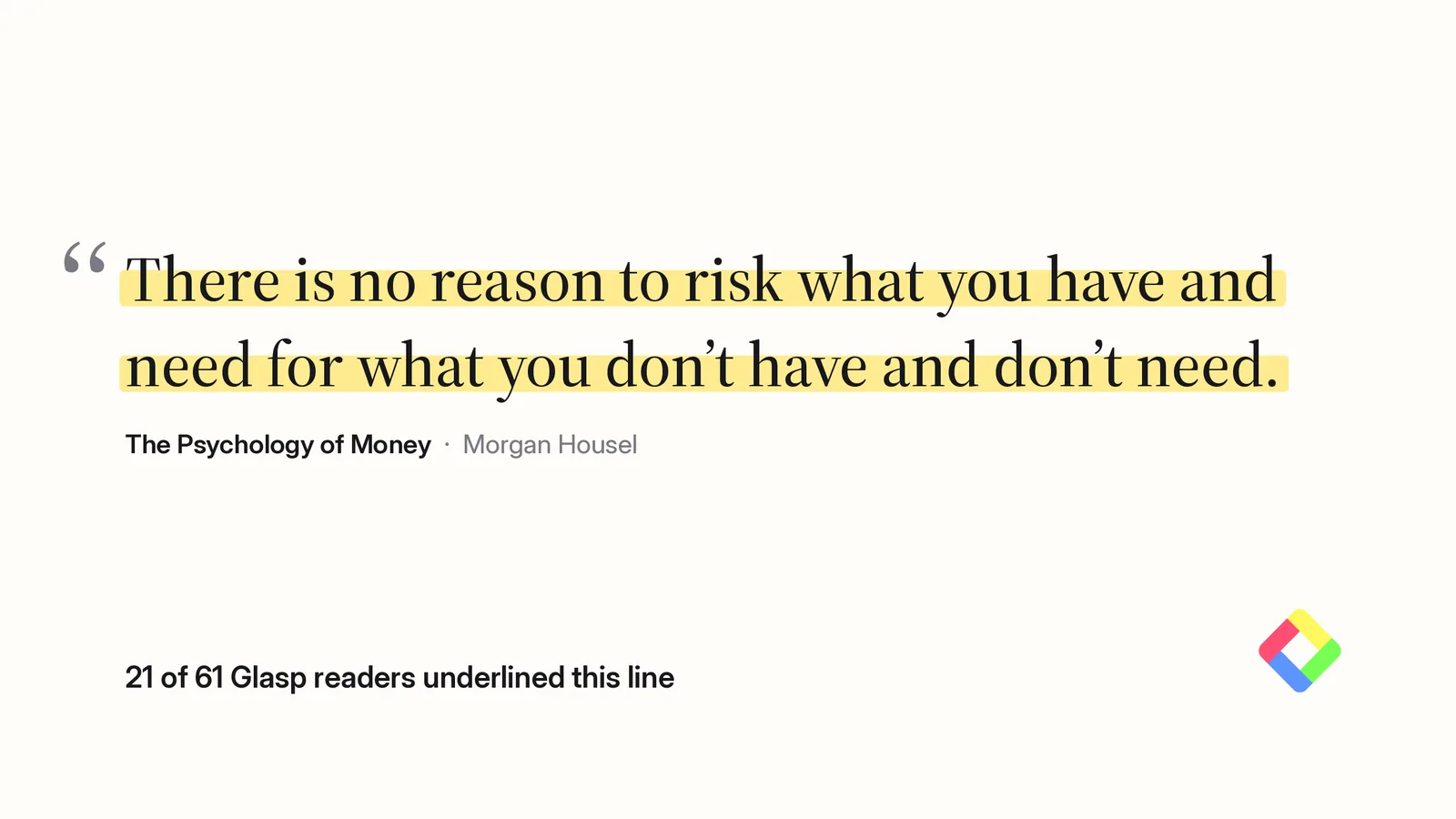
Across the main English, Spanish, and Japanese editions of The Psychology of Money, the same warning leads: do not risk what you have and need for what you do not have and do not need. It draws 21 of 61 highlighters (34%) in the main English edition, 6 of 9 highlighters (67%) in Spanish, and 5 of 11 highlighters (45%) in Japanese.
Portuguese readers choose a different dividend, with 5 of 8 highlighters (63%) marking control of their own time. In Same as Ever, 15 of 20 highlighters (75%) choose the same line, the highest agreement among Morgan Housel's books, while The Art of Spending Money puts 5 of 8 highlighters (63%) on the difference between using money as a tool and using it as a yardstick.
Reader Consensus is the passage highlighted by more Glasp readers than any other passage in that edition. The counts below are all-time totals through 2026-09-17, and ties are noted.
1. The Psychology of Money: Timeless lessons on wealth, greed, and happiness
There is no reason to risk what you have and need for what you don’t have and don’t need.
Reader Consensus: 21 of 61 highlighters (34%).
The other English edition selects exactly the same line, with 9 of 15 highlighters (60%).
The Spanish edition selects its translation of the same line, with 6 of 9 highlighters (67%):
No hay motivo alguno para arriesgar lo que tienes y necesitas por algo que no tienes ni necesitas.
The Japanese edition also stops at the same warning, with 5 of 11 highlighters (45%):
彼らは不要な金を稼ぐために、大切な資産を危険にさらしてしまった。それはまったく愚かなことだ。不要なものを得ようとして重要なものを失ってしまうことほど、無意味な行為はない。
The Portuguese edition is the exception. Its leading line, chosen by 5 of 8 highlighters (63%), is about time:
Ter o controle do próprio tempo é o maior dividendo que o dinheiro pode pagar.
📖 English edition: Read on Amazon · Highlights on Glasp
📖 English edition, alternate listing: Read on Amazon · Highlights on Glasp
📖 Japanese edition: Read on Amazon · Highlights on Glasp
📖 Spanish edition: Read on Amazon · Highlights on Glasp
📖 Portuguese edition: Read on Amazon · Highlights on Glasp
2. Same as Ever: A Guide to What Never Changes
Money buys happiness in the same way drugs bring pleasure: incredible if done right, dangerous if used to mask a weakness, and disastrous when no amount is enough.
Reader Consensus: 15 of 20 highlighters (75%), the highest agreement among Morgan Housel's books.
📖 Read on Amazon · Highlights on Glasp
3. The Art of Spending Money: Simple Choices for a Richer Life
There are two ways to use money. One is as a tool to live a better life. The other is as a yardstick of status to measure yourself against others. Many people aspire for the former but spend their life chasing the latter.
Reader Consensus: 5 of 8 highlighters (63%).
📖 Read on Amazon · Highlights on Glasp
4. Everyone Believes It; Most Will Be Wrong: Motley Thoughts on Investing and the Economy
It's not the experts, but the people who listen to the experts, who are the real fools.
Reader Consensus: 3 of 5 highlighters (60%), tied with four other passages.
📖 Read on Amazon · Highlights on Glasp
❤️ Before you go
Across languages, the most stable warning is about refusing a trade that endangers what is needed for what is not. The Portuguese edition changes the wording and the focus, but it stays with the same boundary by making control of time the return that matters.
The other leading lines sharpen that discovery. Enough sets a limit, time names the dividend, and the tool-or-yardstick choice asks what money is for. Readers keep underlining the point where accumulation gives way to judgment.
If any of these books are on your shelf, import your highlights and add your own underline to the count.
The Glasp Team