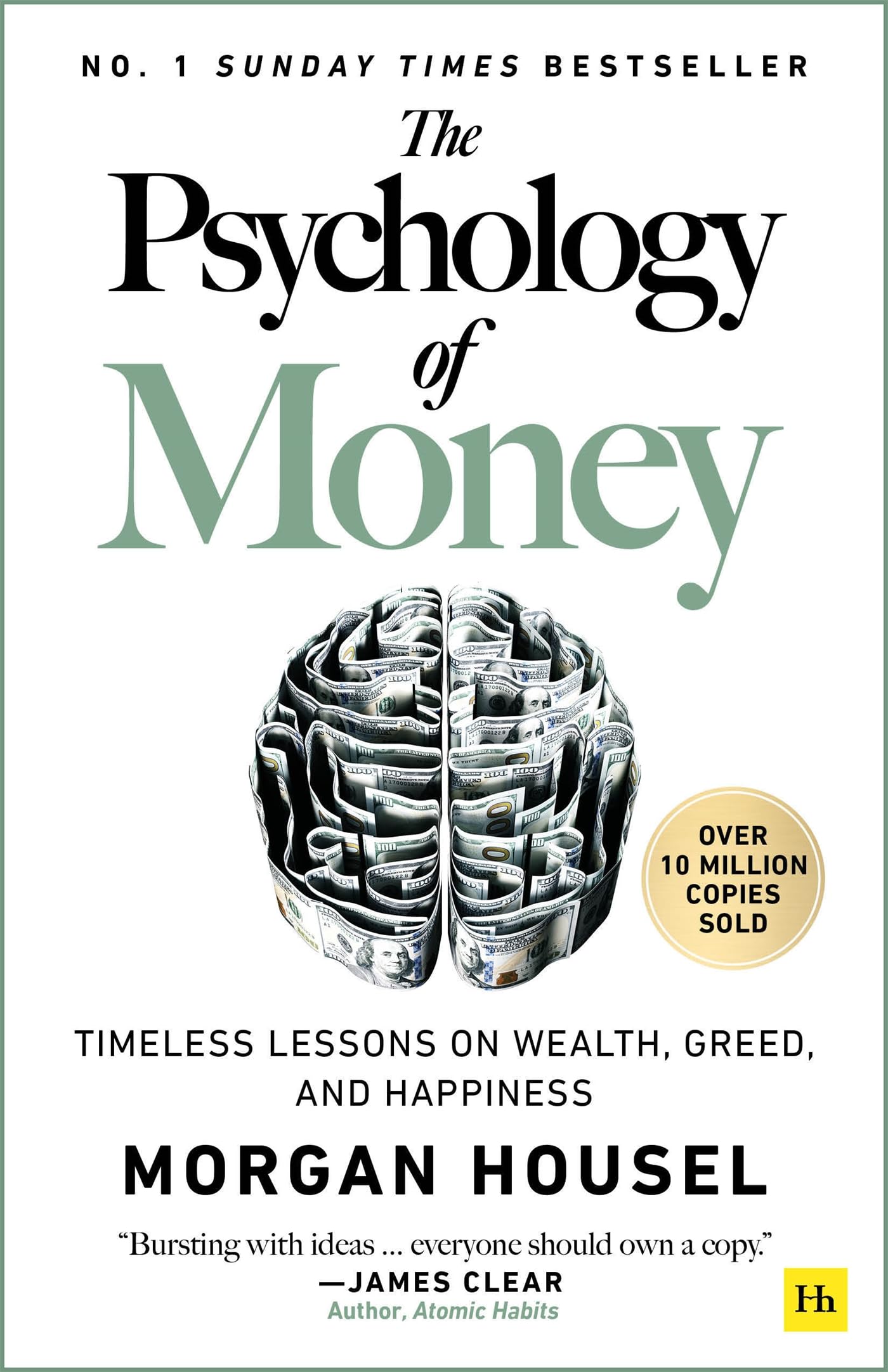
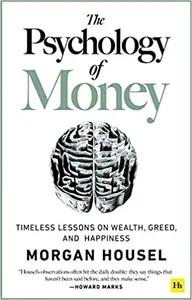
The Psychology of Money: The transformative multimillion-copy personal finance bestseller
About This Book
Morgan Housel’s The Psychology of Money argues that financial success is driven less by intelligence or technical knowledge than by behavior: patience, humility, emotional control, and the ability to survive uncertainty. Drawing on short stories rather than formulas, the book shows that money decisions are shaped by personal history, fear, envy, ego, and luck as much as by spreadsheets.
A major theme is that luck and risk are inseparable. Extreme success and failure often reflect forces outside individual control, so readers should study broad patterns instead of copying celebrity investors, billionaires, or spectacular case studies. This leads to one of the book’s strongest ideas: winning with money is often about staying in the game long enough for compounding to work, not about making brilliant moves.
The book repeatedly emphasizes survival over maximization.
- Keep money by being frugal, humble, and wary of ruin.
- Build room for error into plans because reality will not follow forecasts.
- Accept volatility as a fee of investing, not a fine.
- Avoid risking what you have and need for what you don’t have and don’t need.
Another core lesson is the importance of knowing when you have enough. Housel argues that modern capitalism generates both wealth and envy, and that social comparison creates a game with no finish line. Wealth, in his framing, is mostly invisible: it is money not spent, flexibility preserved, and options retained.
Perhaps the book’s most resonant claim is that money’s highest value is control over your time. Financial independence matters not because of status or luxury, but because it lets you decide what to do, when to do it, and with whom. Overall, the book presents money as a deeply human subject where reasonable habits, endurance, and self-awareness matter more than optimization.
Key Takeaways
- 1.Financial success is a soft skill: how you behave under uncertainty matters more than how much you know.
- 2.Compounding rewards endurance more than brilliance, so avoiding ruin is often more important than chasing maximum returns.
- 3.Wealth is hidden in unspent money, flexibility, and options—not in visible consumption.
- 4.Enough is a financial skill because unchecked envy and rising expectations can erase satisfaction.
- 5.Room for error makes plans durable by allowing for mistakes, bad luck, and an unknowable future.
- 6.Control over your time is one of money’s highest benefits and a major driver of wellbeing.
Top Highlights
focus less on specific individuals and case studies and more on broad patterns.
Highlighted by 25 people · 1 left a note
The hardest financial skill is getting the goalpost to stop moving.
Highlighted by 25 people
Reputation is invaluable. Freedom and independence are invaluable. Family and friends are invaluable.
Highlighted by 21 people
Planning is important, but the most important part of every plan is to plan on the plan not going according to plan.
Highlighted by 19 people
doing well with money has a little to do with how smart you are and a lot to do with how you behave.
Highlighted by 18 people · 1 left a note
It’s a soft skill, where how you behave is more important than what you know.
Highlighted by 18 people · 1 left a note
no amount of studying or open-mindedness can genuinely recreate the power of fear and uncertainty.
Highlighted by 18 people
There is no reason to risk what you have and need for what you don’t have and don’t need.
Highlighted by 18 people
Modern capitalism is a pro at two things: generating wealth and generating envy.
Highlighted by 18 people
Getting money requires taking risks, being optimistic, and putting yourself out there.
Highlighted by 14 people · 1 left a note
AI Review
Glasp’s AI analysis of 47 reader highlights suggests a very strong consensus: this book delivers unusually memorable, actionable ideas about wealth, risk, and happiness. The most-highlighted passages center on behavior, survival, and knowing when you have enough, indicating broad reader resonance rather than niche appeal.
Pros
- +Highly quotable insights with strong highlight consensus
- +Clear focus on behavior over technical complexity
- +Memorable lessons on compounding, risk, and endurance
- +Useful reframing of wealth as freedom and optionality
- +Balances optimism with caution in a practical way
- +Accessible to non-experts without feeling simplistic
Cons
- −Less tactical for readers seeking detailed investing formulas
- −Some ideas repeat across stories and examples
- −Relies on aphoristic wisdom more than rigorous step-by-step systems
Glasp AI analysis based on highlights from 47 readers.
Who Should Read This
This book is ideal for beginning investors, professionals building long-term wealth, and anyone who feels anxious, envious, or confused about money. It is especially useful for readers who already know basic personal finance but struggle more with behavior than math. Founders, managers, savers, and people chasing financial independence will get practical value from its lessons on enough, compounding, risk management, and using money to create autonomy rather than appearances.
Frequently Asked Questions
What is the book about?
Who is this book for?
What are the key lessons of the book?
What does the book mean by having enough?
Why does the book emphasize room for error so much?
Is it worth reading?
What is the book’s view of investing?
How to Apply What You Read
- 1.Define what “enough” means for your lifestyle so your financial goals stop moving endlessly.
- 2.Build a margin of safety with cash savings, lower fixed expenses, or more conservative assumptions.
- 3.Write a simple investing or money philosophy statement that matches your actual time horizon.
- 4.Track your savings rate and spending habits to separate real wealth-building from status spending.
- 5.Use money intentionally to buy autonomy, flexibility, and time rather than just visible upgrades.
Discussion Questions
- Q1.Which idea in the book most challenges the way you currently think about money?
- Q2.How do luck and risk complicate the way we judge both successful and unsuccessful people?
- Q3.What does having enough mean in practical terms, and why is it so hard to define?
- Q4.Do you agree that control over your time is the highest dividend money pays? Why or why not?
- Q5.How much room for error should a healthy financial plan include, and what does that look like in real life?
- Q6.What is the difference between looking rich and actually being wealthy, and why do so many people confuse the two?
- Q7.How can someone stay optimistic about long-term investing while still being realistic about short-term pain?
Recommended Books

Revisit Your Highlights, Deepen Your Understanding
Import your Kindle highlights to review, organize, and share the ideas that matter most to you.
Get the free browser extension