10 Best Charlie Munger Videos on Investing and Decision Making

Jul 27, 2026
9 min read
1 views
Last updated: July 2026
This list gathers ten of the best video talks, interviews, and lectures on Charlie Munger's approach to investing and decision making. It is built for founders who want Munger's mental models and rational habits, mostly in his own words rather than secondhand summaries.
Together the set runs roughly nine hours, from ten-minute primers to Munger's full lectures and his final CNBC interview. It is canonical because it pairs his most-cited talks, the Psychology of Human Misjudgement and the Caltech lecture, with focused explainers on inversion and mental models.
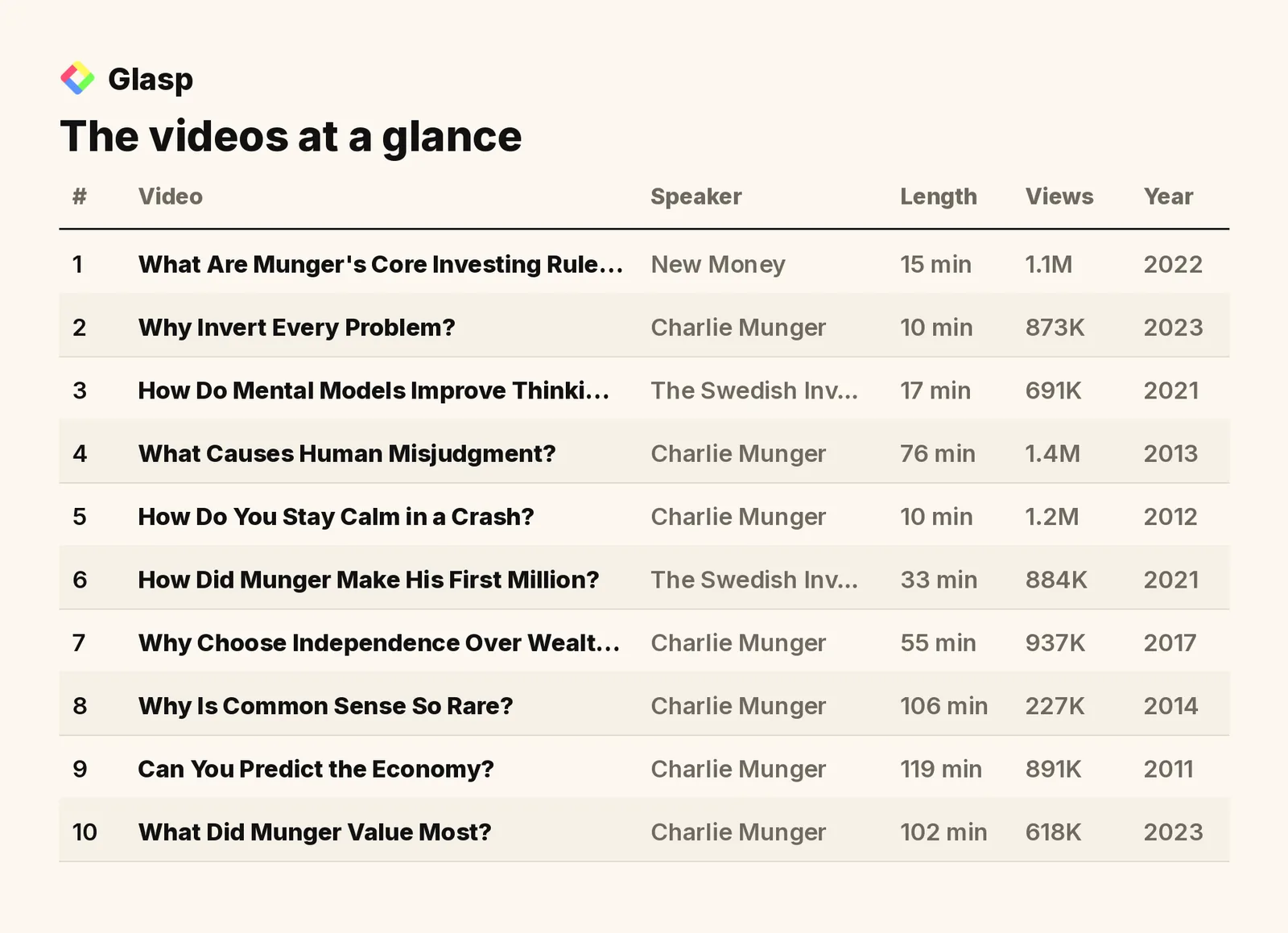
The videos on this list, in the order to watch them, are:
What Are Munger's Core Investing Rules? (New Money)
Why Invert Every Problem? (Charlie Munger)
How Do Mental Models Improve Thinking? (The Swedish Investor)
What Causes Human Misjudgment? (Charlie Munger)
How Do You Stay Calm in a Crash? (Charlie Munger)
How Did Munger Make His First Million? (The Swedish Investor)
Why Choose Independence Over Wealth? (Charlie Munger)
Why Is Common Sense So Rare? (Charlie Munger)
Can You Predict the Economy? (Charlie Munger)
What Did Munger Value Most? (Charlie Munger)
Total: 10 videos, 543 minutes of watch time (about 9 hours), and 8.9M combined views.
1. What Are Munger's Core Investing Rules?

New Money · 15 min · 1.1M views · 2022
In short: Munger relies on inversion, humility about your circle of competence, staying rational, simple solid businesses, and lifelong self-education.
This fifteen-minute primer distills five of Munger's guiding tricks into one watch. It earns the opening slot because it names the principles the rest of the list explores in depth.
Key takeaways
Inversion means thinking in reverse to uncover risks and pitfalls before they damage a decision, a habit Munger applied consistently.
Humility keeps an investor inside a circle of competence, forcing rational choices based on what you actually understand rather than guess.
Staying rational through market swings and focusing on the long term is one of Munger's central mental tricks for investing.
Keeping investments simple and centered on intrinsic business quality is a key principle of Munger's approach, alongside committing to lifelong self-education.
Watch on YouTube · Read the summary and Q&A
2. Why Invert Every Problem?

Charlie Munger · 10 min · 873K views · 2023
In short: Inverting a problem, thinking in reverse about what could go wrong, reveals risks and pitfalls that forward thinking often misses.
A short, focused talk on Munger's signature method with personal anecdotes. It answers how inversion actually works in practice, from weather forecasting to real estate appraisal.
Key takeaways
Munger attributes much of his success to learning basic tricks early in life and then applying them consistently to solve problems.
Inverting problems lets Munger identify and avoid potential risks, which he considers more reliable than only chasing what could go right.
As a wartime weather forecaster, Munger asked how he might harm pilots, then worked backward to avoid those outcomes.
Munger criticizes excessive due diligence, arguing over-analysis often stems from insecurity rather than a genuine need for more information.
Watch on YouTube · Read the summary and Q&A
3. How Do Mental Models Improve Thinking?

The Swedish Investor · 17 min · 691K views · 2021
In short: Collecting mental models from many disciplines and inverting problems helps you avoid single-tool thinking and make better decisions across life.
This explainer builds on inversion by showing how Munger assembles a full toolkit of thinking tools. It answers why a broad, multidisciplinary base beats a single expertise.
Key takeaways
Learning new thinking tools and mental models across disciplines is, for Munger, crucial to success in different areas of life.
Avoiding the man with a hammer syndrome keeps thinking open and diversifies the perspectives you bring to any problem.
Reading the writings and wisdom of historical figures adds to the worldly wisdom Munger considers essential for good judgment.
Compounding, the concept of exponential growth, plays a significant role in long-term investing and the accumulation of wealth.
Watch on YouTube · Read the summary and Q&A
4. What Causes Human Misjudgment?
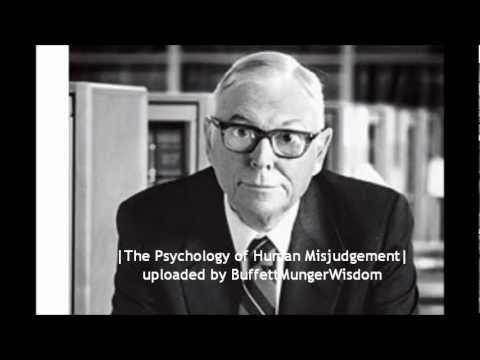
Charlie Munger · 76 min · 1.4M views · 2013
In short: Deeply ingrained cognitive biases, amplified by incentives and social influence, drive most human misjudgment unless you study them directly.
Munger's landmark full speech on the psychology of error, and the intellectual core of this list. It answers why smart people make bad decisions and how to guard against it.
Key takeaways
Human misjudgment is often caused by cognitive biases that sit deeply ingrained in our psychology and operate below awareness.
Incentives and reinforcement play a significant role in shaping human behavior, which is why Munger studies them before judging outcomes.
Social proof and the influence of authority figures can heavily sway individual actions and beliefs, distorting independent judgment.
Combining multiple biases can produce a lollapalooza effect that significantly amplifies their impact on a single decision.
Watch on YouTube · Read the summary and Q&A
5. How Do You Stay Calm in a Crash?

Charlie Munger · 10 min · 1.2M views · 2012
In short: Expect your stocks to fall 50 percent a few times in a lifetime, and hold equanimity instead of selling.
A ten-minute talk on the emotional discipline long-term investing demands. It answers what a serious shareholder should expect from markets and how simple, rational strategy beats reacting to noise.
Key takeaways
Long-term shareholders should expect their stocks to decline by 50 percent a few times over their investing lifetime.
Successful investing involves understanding the business, its intrinsic value, and holding a margin of safety, principles Munger calls simple but neglected.
Munger and Buffett focus on buying undervalued businesses with durable competitive advantages rather than trading around market noise.
Munger criticizes the locker room culture of finance, which prioritizes winning over ethical conduct and causes broad harm.
Watch on YouTube · Read the summary and Q&A
6. How Did Munger Make His First Million?

The Swedish Investor · 33 min · 884K views · 2021
In short: Munger reached his first million by combining careers in law, real estate, and stock investing while learning from every setback.
This biographical explainer grounds the principles in Munger's actual path to wealth. It answers how the theory played out across decades of law, real estate, and investing.
Key takeaways
Munger's path to his first million combined different careers, including law, real estate, and stock market investing over many years.
His early investment partnerships showed strong returns that surpassed the performance of several other renowned investors of the era.
Mental models such as Occam's Razor and inverting problems were instrumental in Munger's analytical approach to investing.
Munger's philosophy emphasizes focusing on quality businesses and avoiding bad investments, a stance he held across decades.
Watch on YouTube · Read the summary and Q&A
7. Why Choose Independence Over Wealth?

Charlie Munger · 55 min · 937K views · 2017
In short: Munger valued independence over wealth, treating rational thinking as a moral duty and lifelong learning as the real goal.
A wide-ranging campus conversation on career, character, and what to actually optimize for. It answers why Munger chased independence rather than status and how that shaped Berkshire.
Key takeaways
Munger believes rational thinking is a moral duty and the key to long-term success in business and life.
He transitioned from law to investing because he valued independence over wealth, advising others to seek the same.
Berkshire Hathaway's success lies in buying good businesses rather than trying to fix bad ones, according to Munger.
Munger is skeptical of Bitcoin, viewing it as a speculative bubble with no intrinsic value behind the price.
Watch on YouTube · Read the summary and Q&A
8. Why Is Common Sense So Rare?

Charlie Munger · 106 min · 227K views · 2014
In short: Common sense is rare because it requires multidisciplinary learning and knowing the edge of your own competence to avoid folly.
Munger's Caltech lecture on why sensible thinking is uncommon and how a broad knowledge base protects you. It answers how to avoid the follies that sink professionals and academics.
Key takeaways
Common sense is not common, and for Munger it means avoiding folly and operating broadly without major mistakes.
Munger values learning across disciplines, integrating ideas from many fields to make better and more informed decisions.
He warns that complex financial instruments few people understand create systemic risks across the wider economy.
Knowing the edge of your own competency is, for Munger, essential to avoiding disastrous decisions.
Watch on YouTube · Read the summary and Q&A
9. Can You Predict the Economy?

Charlie Munger · 119 min · 891K views · 2011
In short: No, Munger considers macroeconomic predictions unreliable and advises focusing on long-term competence, character, and rational thinking instead.
The longest conversation on this list, and a full picture of Munger's worldview on markets and character. It answers why forecasting is futile and what to do instead.
Key takeaways
Munger believes macroeconomic predictions are unreliable and advises focusing on long-term competence rather than forecasting the economy.
He emphasizes character and rational thinking as central to achieving and maintaining long-term success through economic cycles.
Munger criticizes the accounting profession for failing to prevent financial crises due to overly optimistic standards.
He stresses the dangers of short-term incentives in business and politics, advocating instead for a long-term perspective.
Watch on YouTube · Read the summary and Q&A
10. What Did Munger Value Most?

Charlie Munger · 102 min · 618K views · 2023
In short: Munger valued gathering big ideas and mental models from many disciplines, a habit of critical thinking he kept lifelong.
Munger's final CNBC interview, recorded two weeks before his death at 99, closes the list. It answers how he built his mind and who shaped it.
Key takeaways
Munger built his success not on prodigy-level intelligence but on gathering big ideas and mental models from many disciplines.
He deliberately avoided fields requiring prodigy-level genius and instead played the hand he was dealt for maximum advantage.
Munger's habit of critical thinking started in grade school, where he mentally revised textbooks to make them more correct.
Harvard professor Lon Fuller was the most influential teacher in Munger's life because he integrated law and economics.
Watch on YouTube · Read the summary and Q&A
Frequently asked questions
What is the best Charlie Munger video to start with?
Charlie Munger: The 5 Investing Tricks That Made Him a Billionaire is a fifteen-minute primer covering inversion, humility, rationality, simplicity, and self-education.
What is Charlie Munger's most famous speech?
The Psychology of Human Misjudgement is his most cited talk, a full lecture on the cognitive biases that drive human misjudgment and how to counter them.
What did Charlie Munger mean by invert, always invert?
Munger meant solving problems in reverse by asking what could go wrong, which reveals risks and pitfalls that forward thinking often misses.
How did Charlie Munger make his money?
Munger reached his first million by combining careers in law, real estate, and stock investing, then focused on buying quality businesses with durable advantages.
What was Charlie Munger's investing philosophy?
Munger favored simple, rational investing: understand the business, demand a margin of safety, stay calm through declines, and buy undervalued companies with durable advantages.
How to use this list
Watch these in order and you move from short primers on inversion and mental models to Munger's full lectures and his final reflections, building a complete picture of how he thought. If you have only fifteen minutes, start with Charlie Munger: The 5 Investing Tricks That Made Him a Billionaire, then set aside a full hour for the Psychology of Human Misjudgement when you can give it real attention. Founders will get the most from pairing one short explainer with one long talk each week.
Related lists
💡 Want summaries and transcripts for any YouTube video? Try YouTube Summary with ChatGPT & Claude.