Naval Ravikant's 10 Best Interviews and Talks

Jul 20, 2026
10 min read
281 views
Last updated: July 2026
This is a curated set of ten Naval Ravikant interviews and talks, chosen for founders who want his thinking on wealth, judgment, happiness, and technology in one place. It is built as a learning journey, not a ranking by views.
Together the ten run roughly seventeen hours, spanning his canonical wealth talk, deep podcast conversations, and short high-signal clips. This is the set to send someone who wants Naval's worldview without guessing which uploads are worth their time.
The videos on this list, in the order to watch them, are:
What Skill Makes You Rich? (Picking Nuggets)
How Do You Judge a Founder? (The Tim Ferriss Show)
How Should You Read and Decide? (The Knowledge Project)
What Traps Keep You Stuck? (Picking Nuggets)
Is Happiness a Choice? (Joe Rogan Experience)
How Do You Find Inner Peace? (Chris Williamson)
What Is Ethereum Actually For? (The Tim Ferriss Show)
Will AI Replace Programmers? (Naval)
What Big Shifts Are Coming? (Chris Williamson)
Total: 10 videos, 1019 minutes of watch time (about 17 hours), and 36.4M combined views.
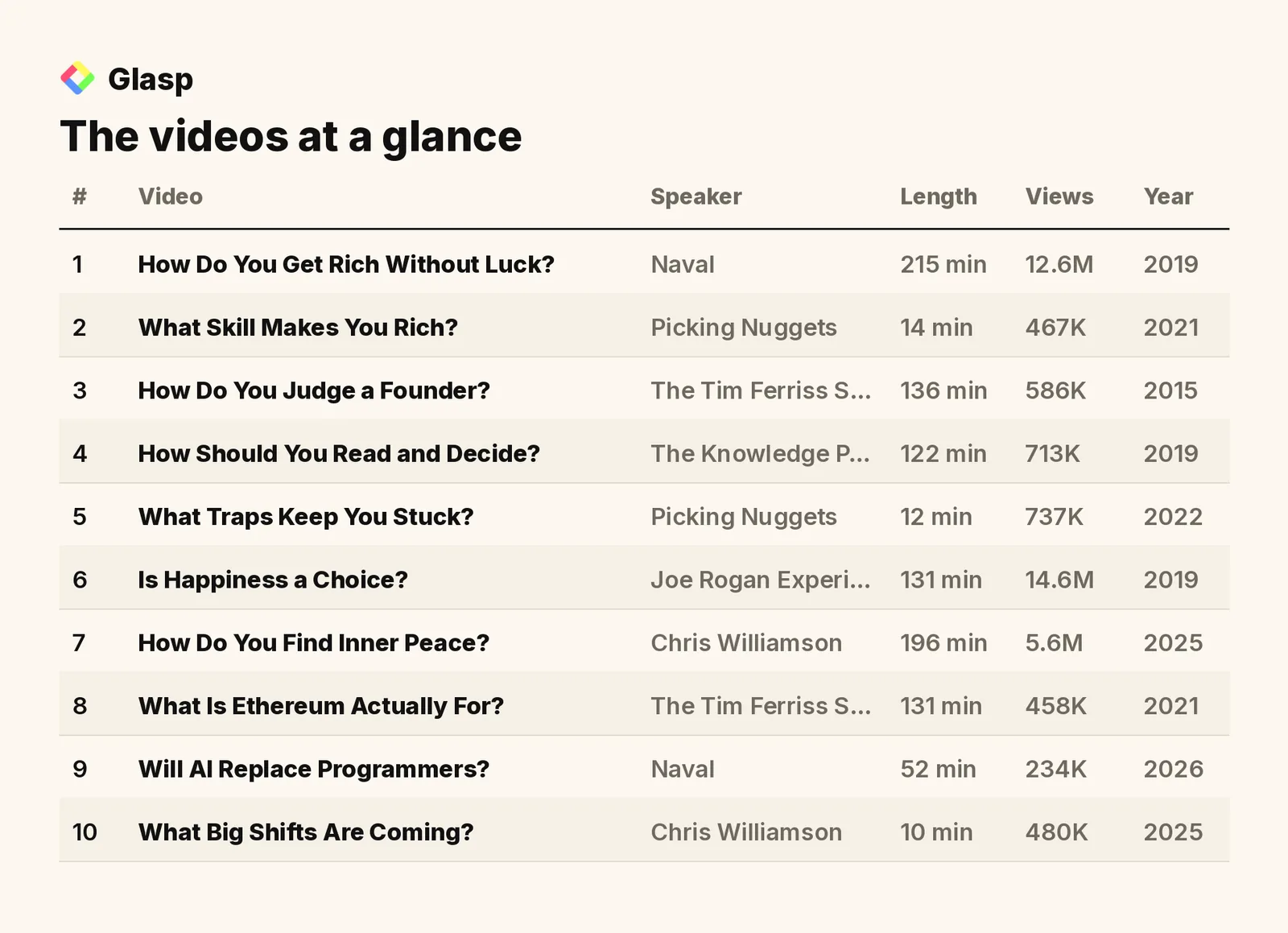
1. How Do You Get Rich Without Luck?

Naval · 215 min · 12.6M views · 2019
In short: You get rich by owning equity and building assets that earn income while you sleep, then playing long-term games with trusted partners.
This is Naval's canonical breakdown of wealth creation, expanded from his tweetstorm into a full talk. It answers how ordinary people can build wealth without relying on luck or renting out their time.
Key takeaways
Wealth is assets that generate income while you sleep, distinct from money, which is a medium for transferring that wealth.
The purpose of wealth is to buy freedom, not to fund status or unfulfilling jobs and lifestyles.
Wealth creation is a positive-sum game, while status is a zero-sum game that distracts from building.
Building wealth requires long-term games and partners who combine high intelligence, high energy, and high integrity.
Watch on YouTube · Read the summary and Q&A
2. What Skill Makes You Rich?
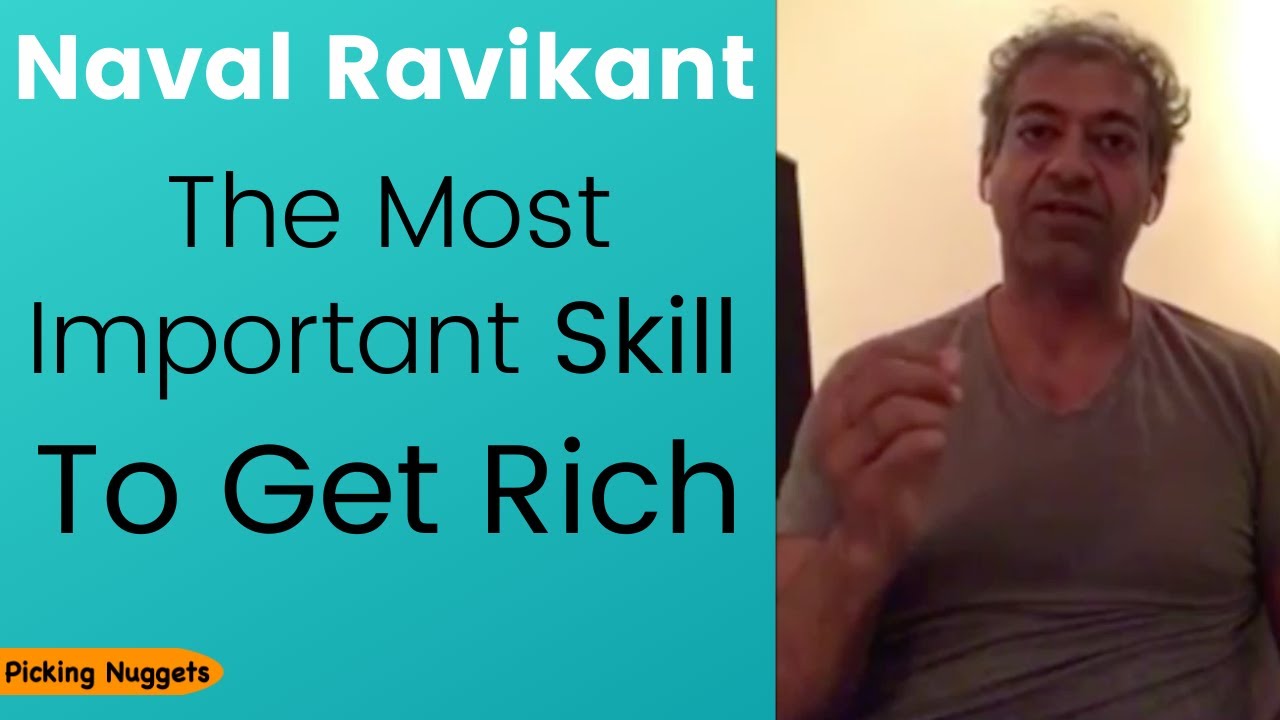
Picking Nuggets · 14 min · 467K views · 2021
In short: The most important skill is becoming a perpetual learning machine, because knowing what, who, and when matters more than raw work ethic.
Naval argues that wealth follows from directed learning, not hours logged. This short clip distills why building strong foundations in math, science, and economics keeps your options open.
Key takeaways
Knowing what to do, who to do it with, and when to do it outweighs a strong work ethic alone.
Becoming a perpetual learner is the core skill for getting rich, since it lets you learn any difficult subject.
Reading originals and classics in science and basics builds a higher-quality foundation than current interpretations or popular opinion.
Mastery comes from sinking deep time into one or two areas, while foundations in many areas support that focus.
Watch on YouTube · Read the summary and Q&A
3. How Do You Judge a Founder?

The Tim Ferriss Show · 136 min · 586K views · 2015
In short: Back founders who combine intelligence, energy, and integrity, think independently, and keep learning through books and blogs while filtering their sources.
Ferriss calls Naval the person he phones most for startup advice, and this early conversation shows why. It covers judging founders, contrarian investing, and the reading habits behind independent thinking.
Key takeaways
Founders worth backing show intelligence, energy, and integrity, plus the ability to think independently rather than follow trends.
Venture capitalists often miss great opportunities by following conventional wisdom and staying closed to genuinely unique ideas.
Good investment decisions come from minimizing bias and emotion, learning from mistakes, and keeping a diverse portfolio.
Books and blogs build personal development, but you must filter sources and stay intellectually honest.
Watch on YouTube · Read the summary and Q&A
4. How Should You Read and Decide?

The Knowledge Project · 122 min · 713K views · 2019
In short: Read to understand, build deliberate habits aligned with your values, and treat foundational beliefs as non-negotiable guides for big decisions.
This two-hour conversation is Naval's most complete take on how he reads, decides, and structures habits. It connects daily practice to happiness, self-awareness, and internal freedom.
Key takeaways
Happiness is described as the absence of desire and freedom from internal and external constraints.
Deliberate habits that align with your values and goals are central to personal growth and success.
Foundational values and beliefs should stay non-negotiable, since they guide important life decisions and daily actions.
You can control how you interpret and respond to situations, and meditation supports that internal freedom.
Watch on YouTube · Read the summary and Q&A
5. What Traps Keep You Stuck?

Picking Nuggets · 12 min · 737K views · 2022
In short: Escape four traps: working only for rewards, comparing yourself to peers, victim thinking, and chasing competition instead of authentic work you love.
A tight twelve-minute clip on the mindset traps that keep people stuck. It reframes happiness as a choice and authenticity as the way out of competition.
Key takeaways
Working only for things as rewards can trap people in a forty-hour workweek and slow financial progress.
Changing how you define your peers reduces societal pressure and helps you escape the keeping-up-with-the-Joneses phenomenon that drives spending.
Authenticity is the way to escape competition, since being unique removes you from direct comparison.
Greatness comes from being hard on yourself and holding your own standards rather than being hard on other people.
Watch on YouTube · Read the summary and Q&A
6. Is Happiness a Choice?
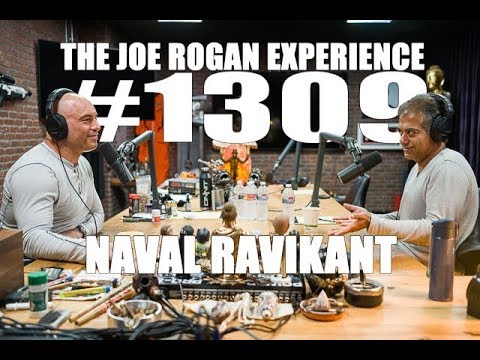
Joe Rogan Experience · 131 min · 14.6M views · 2019
In short: Yes, happiness is a choice much like fitness or wealth, reached by understanding your desires and cultivating a calm, learning mind.
The most-watched Naval interview on this list, and a broad introduction to his worldview. It covers happiness, lifelong learning, meditation, and why specialization is for insects.
Key takeaways
Happiness is presented as a choice similar to fitness and wealth, achievable by cultivating a calm mind.
Lifelong learning and adaptability matter more than narrow specialization, since in his view specialization is for insects.
Reading should be about understanding rather than completion or vanity, so you can abandon books that fail to teach you.
Meditation is treated as essential for mental clarity and for processing the unresolved issues that clutter a busy mind.
Watch on YouTube · Read the summary and Q&A
7. How Do You Find Inner Peace?

Chris Williamson · 196 min · 5.6M views · 2025
In short: Inner peace comes from being satisfied with what you have, minimizing desires, detaching from ego, and enjoying the journey over the destination.
A recent, long-form return to Naval's philosophy of contentment. It goes deeper on self-esteem, ego, and why fewer desires lead to a more fulfilling life.
Key takeaways
Happiness is framed as being satisfied with what you have rather than constantly seeking more.
Self-esteem improves by living up to your own moral code and by helping other people.
Detachment from ego and self-centered thoughts reduces unhappiness and mental turmoil, since much suffering comes from a restless, self-focused mind.
Focusing on fewer desires and being selective about goals leads to a more content life.
Watch on YouTube · Read the summary and Q&A
8. What Is Ethereum Actually For?
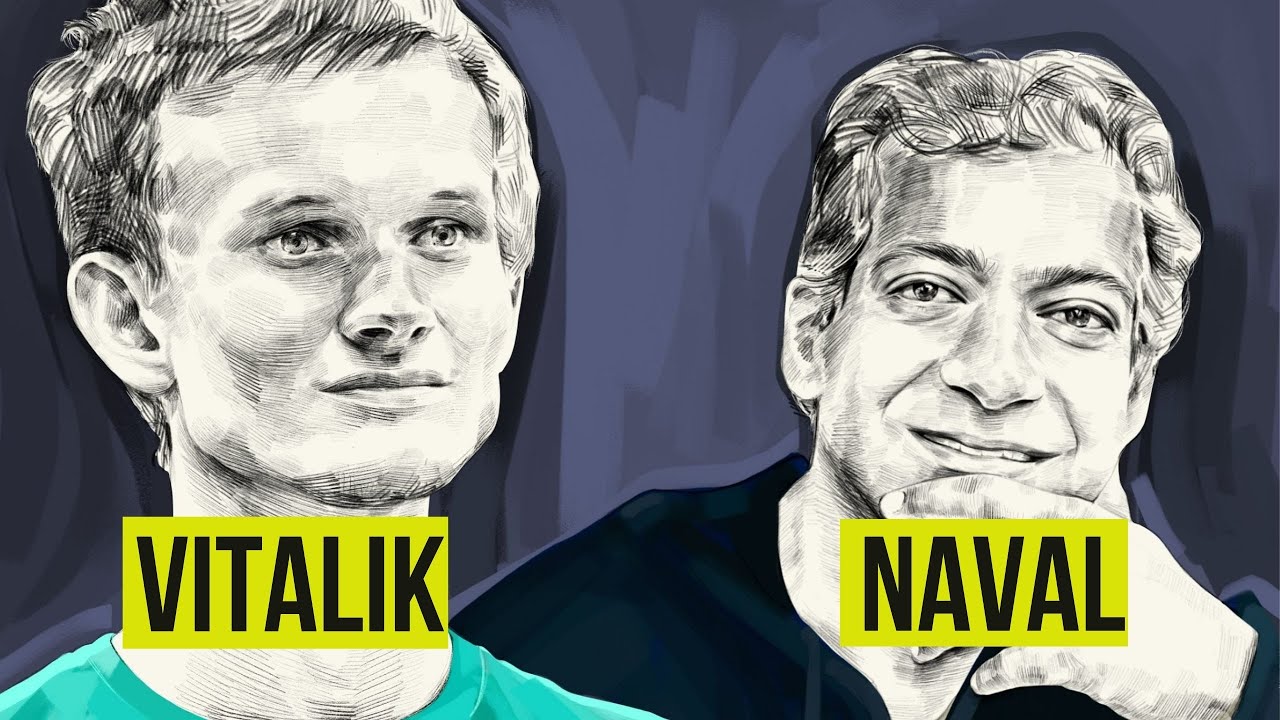
The Tim Ferriss Show · 131 min · 458K views · 2021
In short: Ethereum is a general-purpose blockchain for decentralized applications and smart contracts, scaling through proof of stake, sharding, and layer 2 solutions.
Naval joins Ferriss to interview Ethereum's creator, giving founders a clear primer on how the platform works and scales. It answers what Ethereum is actually for and where it is headed.
Key takeaways
Ethereum is a general-purpose blockchain that lets developers build decentralized applications and smart contracts on a shared network.
Scalability is a major focus, addressed through Ethereum 2.0, sharding, and layer 2 scaling solutions.
Layer 2 solutions such as payment channels and roll-ups process transactions off the main chain to raise throughput.
The move to Ethereum 2.0 shifts the network from proof of work to proof of stake and adds sharding.
Watch on YouTube · Read the summary and Q&A
9. Will AI Replace Programmers?

Naval · 52 min · 234K views · 2026
In short: AI lets non-coders build apps with natural language, democratizing software, while traditional programming still matters for optimizing and refining generated code.
Naval's own recent talk on how AI reshapes building and learning. It answers whether AI replaces programmers and where human creativity and agency still hold an edge.
Key takeaways
AI enables non-programmers to create applications using natural language, which democratizes software development and opens more niche markets.
Vibe coding shifts users toward product management while AI handles much of the coding work.
Traditional programming skills remain vital for optimizing AI-generated code and for handling the complex problems AI cannot solve alone.
AI enhances productivity but lacks true creativity and agency, making it an ally rather than a replacement.
Watch on YouTube · Read the summary and Q&A
10. What Big Shifts Are Coming?

Chris Williamson · 10 min · 480K views · 2025
In short: Three shifts are coming: modern medicine is overestimated, drones will dominate warfare, and GLP-1 drugs could transform health and obesity.
A ten-minute look forward that ends the journey on where the world is heading. It answers which big shifts Naval expects across medicine, defense, and health.
Key takeaways
Modern medicine is described as overestimated, relying too much on surgery and too little on biological understanding.
Drones are expected to dominate future warfare, potentially replacing aircraft carriers, infantry, and other traditional assets.
GLP-1 drugs are seen as groundbreaking, with benefits reaching addiction treatment and cancer risk reduction beyond weight loss.
Wider access to GLP-1 drugs could cut healthcare costs and change views of obesity as a moral failing.
Watch on YouTube · Read the summary and Q&A
Frequently asked questions
What is the best Naval Ravikant talk to start with?
Start with How to Get Rich, his canonical breakdown of building wealth through equity ownership and long-term games.
Is happiness a choice according to Naval Ravikant?
Naval argues happiness is a choice much like fitness or wealth, reached by understanding your desires and cultivating a calm mind.
What does Naval Ravikant say is the most important skill for getting rich?
He says becoming a perpetual learning machine is the most important skill, because it lets you learn any subject and stay ready for opportunity.
What are Naval Ravikant's biggest traps in life?
He names working only for rewards, comparing yourself to peers, victim thinking, and chasing competition instead of authentic work you love.
Does Naval Ravikant think AI will replace programmers?
He believes AI democratizes coding through natural language, but that traditional programming skills remain vital for optimizing and refining generated code.
Who should watch Naval Ravikant's talks?
Naval Ravikant's interviews and talks are best suited to founders, investors, and anyone who wants to build wealth without relying on luck while also thinking seriously about happiness and inner peace. The material assumes you are willing to sit with ideas about judgment, decision making, and personal responsibility rather than looking for step by step tactics.
In what order should you watch Naval Ravikant's videos?
A natural path is to begin with the wealth and skill material on getting rich without luck and the specific skill that compounds into wealth, then move into judgment, reading, and decision making, and finish with the sections on happiness, inner peace, and the traps that keep people stuck. The list is grouped so the practical wealth ideas come first and the philosophical ones build on them.
Does Naval Ravikant only talk about money and startups?
No, that is a common misconception: alongside wealth creation and how to judge a founder, Naval Ravikant spends significant time on happiness, inner peace, and the mental traps that keep people stuck. Roughly half of this collection is about how to think and how to live rather than how to earn.
What does Naval Ravikant say about crypto and the future of technology?
Naval Ravikant's talks cover what Ethereum is actually for, whether AI will replace programmers, and the larger shifts he sees coming, so his technology commentary sits alongside his wealth and philosophy material rather than being separate from it. These are the sections to watch if you care less about personal finance and more about where the industry is heading.
How to use this list
Use this list as a path rather than a playlist: begin with the wealth and learning talks, move through decisions, traps, and inner peace, then finish with his views on crypto, AI, and the near future. If you are short on time, start with How to Get Rich, since it packs the core of Naval's thinking on freedom, ownership, and long-term games into one talk. Watch it first, then follow the thread wherever your own questions pull you.
Related lists
💡 Want summaries and transcripts for any YouTube video? Try YouTube Summary with ChatGPT & Claude.