How Does Inverting Problems Lead to Success?
TL;DR
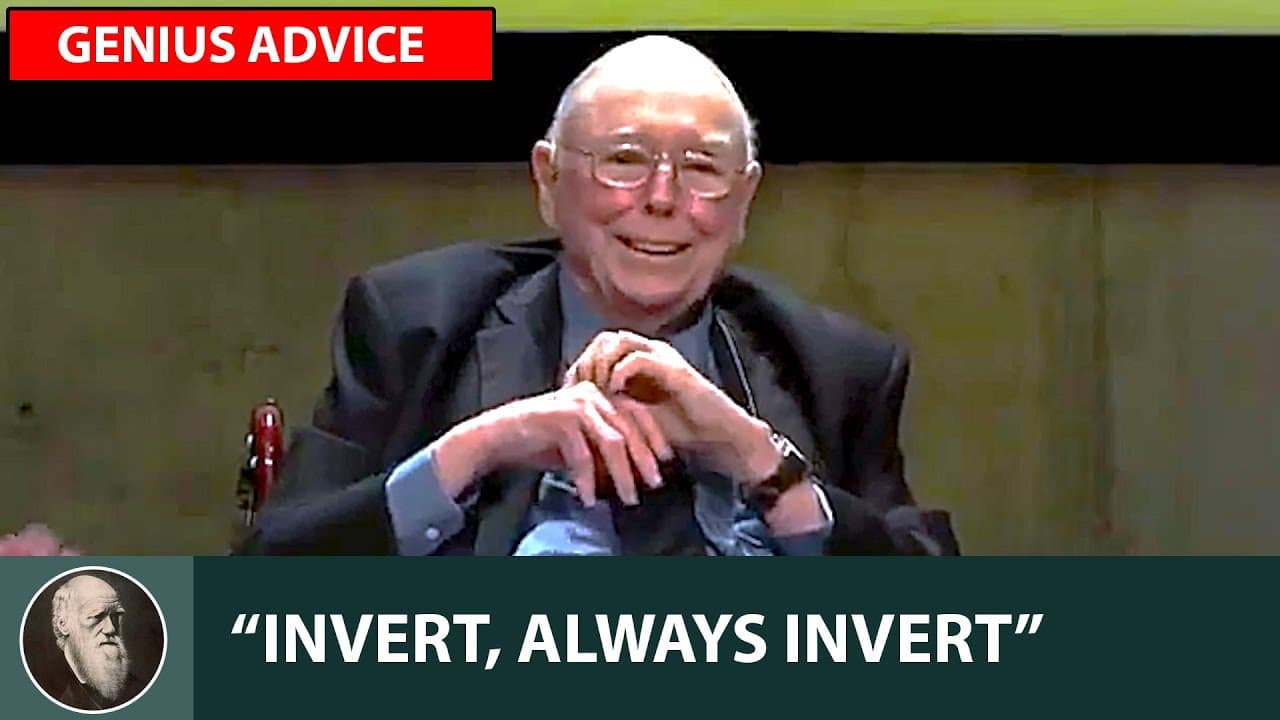
Inverting problems reveals effective solutions by focusing on risks and potential pitfalls. Charlie Munger illustrates this approach with personal anecdotes, highlighting that thinking in reverse and from different perspectives can yield better results in decision-making.
Transcript
but what caused the financial success was not extreme Mobility you know I have a good mind but I I'm way short of Prodigy and I've had results in life that are prodigious and that came from tricks I just learned a few basic tricks from people like my grandfather what were those tricks kind of now everybody's leaning in wanti... Read More
Key Insights
- Charlie Munger attributes his success to learning basic tricks early in life, which he applies consistently to solve problems.
- Munger emphasizes the importance of inverting problems, a method that allows him to identify and avoid potential risks effectively.
- He shares an example from his time as a weather forecaster, where he considered how he might inadvertently harm pilots to avoid such outcomes.
- Munger highlights the value of thinking in three dimensions, as demonstrated in his advice to a client on a real estate appraisal case.
- He criticizes the excessive due diligence performed by some, arguing that over-analysis often stems from insecurity rather than necessity.
- Munger and Warren Buffett's long-standing partnership allows them to make swift decisions without exhaustive research, relying on their accumulated knowledge and intuition.
- He believes that understanding the fundamentals and sticking to basic principles often leads to better decision-making and results.
- Munger's approach is rooted in practicality and simplicity, advocating for a focus on essential truths rather than getting bogged down in unnecessary details.
Install to Summarize YouTube Videos and Get Transcripts
Explore YouTube Video Summarizer or Get YouTube Transcript Extractor
Questions & Answers
Q: What is Charlie Munger's main problem-solving strategy?
Charlie Munger's main problem-solving strategy is to invert problems. By looking at situations from the opposite perspective, he identifies potential risks and avoids them. This approach allows him to find more creative and effective solutions, and he applies it consistently across various aspects of his life.
Q: How did Munger apply his inversion technique as a weather forecaster?
As a weather forecaster, Munger applied his inversion technique by considering how his forecasts could potentially harm pilots. By identifying the easiest ways to endanger them, such as flying into icing conditions or running out of fuel, he focused on avoiding these scenarios, thus ensuring safer outcomes.
Q: What lesson does Munger share from a real estate appraisal case?
In a real estate appraisal case, Munger emphasizes the importance of thinking in three dimensions. He advised a client to consider the impact of utility towers on land development, which the original appraiser overlooked by only analyzing in two dimensions. This insight led to a significantly higher valuation for the client.
Q: Why does Munger criticize excessive due diligence?
Munger criticizes excessive due diligence because he believes it often results from insecurity rather than necessity. He argues that many individuals overcomplicate problems, leading to inefficient decision-making. Instead, he advocates for relying on fundamental understanding and intuition to make swift, informed choices.
Q: How does Munger's partnership with Warren Buffett influence their decision-making?
Munger's partnership with Warren Buffett allows them to make quick decisions without exhaustive research. Their long-standing collaboration means they can communicate effectively with minimal discussion, relying on their shared knowledge and intuition to assess opportunities and risks, leading to successful outcomes.
Q: What does Munger believe about understanding fundamentals in decision-making?
Munger believes that understanding and adhering to fundamental principles is crucial in decision-making. By focusing on essential truths and avoiding unnecessary complexities, individuals can make better choices and achieve more successful results. This approach is central to his problem-solving philosophy.
Q: How does Munger view the role of intuition in business decisions?
Munger views intuition as a key component in business decisions. He argues that, when combined with experience and a solid understanding of fundamentals, intuition allows for quicker and more effective decision-making. Munger values this approach over exhaustive analysis, which he sees as often unnecessary.
Q: What is Munger's opinion on the Perian Basin investment?
Munger considers the Perian Basin investment a 'no-brainer' due to its status as America's top oil reservoir. He highlights the strategic advantage of a preferred stock with an 8% dividend and the competence of the management team. Munger emphasizes that understanding these fundamentals negates the need for excessive due diligence.
Summary & Key Takeaways
-
Charlie Munger shares his philosophy of inverting problems to find effective solutions, a technique he has used throughout his successful career. He stresses the importance of identifying risks by considering the opposite perspective, which often leads to more creative outcomes.
-
Munger provides examples from his life, including his time as a weather forecaster and a real estate case, to illustrate how thinking in reverse and in three dimensions can yield better results. He argues that many people overcomplicate problems, leading to poor decision-making.
-
He criticizes excessive due diligence, claiming it often stems from insecurity. Munger highlights his partnership with Warren Buffett, where they make quick, informed decisions based on intuition and experience, rather than exhaustive research, to achieve success.
Read in Other Languages (beta)
Share This Summary 📚
Summarize YouTube Videos and Get Video Transcripts with 1-Click
Try YouTube Summary with ChatGPT & Claude or YouTube Transcript Generator