What Does a Product Manager Actually Do
The simplest definition of a product manager's job comes from Josh Elman: "Help your team (and company) ship the right product to your users." That single sentence packs in more nuance than most job descriptions. Every word matters, and breaking it down reveals what the role truly demands.
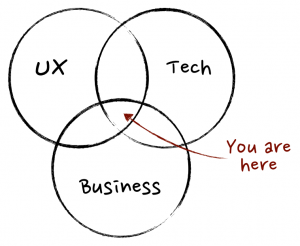
The five components of a product manager's job: help your team, serve the company, ship, build the right product, and do it for your users.
Help Your Team
The greatest product managers devote all of their attention to the highest-priority tasks that move their team forward. This breaks down into two core functions.
First is coordination: making sure the team is planning together, making decisions with a clear goal, and staying focused on what matters most. Second is communication: ensuring that everyone understands what is happening, when it is happening, and why it is happening, especially when plans change. The best PMs gather input from every team member, surface disagreements early, break ties when necessary, and build consensus so that the whole team commits to the plan.
This is not about being a boss. PMs rarely have direct authority over the people they work with. Their influence comes from clarity, trust, and the ability to keep a group of smart people pointed in the same direction.
Serve the Company
A product manager cannot operate in a vacuum. You need to understand the company's overall goals and objectives and how your team's work fits into the bigger picture. The best PMs see their team as serving the broader organization in collaboration with other teams, rather than pursuing their own vision of what matters.
This means understanding the business model, knowing what success looks like at the company level, and making sure that the work your team ships contributes to those outcomes. A feature that delights users but undermines the business is not a good product decision.
Ship
Nothing is more important than getting products into the hands of users. Great product managers understand the tension between getting it perfect and getting it out the door. They know how to make the right tradeoffs because they have a clear understanding of the user and what the user needs to accomplish. Shipping is not just about speed. It is about making informed decisions about scope, quality, and timing.
Build the Right Product
Shipping fast means nothing if you ship the wrong thing. The best PMs have strong instincts about what feels right or wrong, and they are effective listeners who synthesize early feedback from testers and users. More importantly, after a product ships, they can assess whether it was the right product and course-correct quickly when it is not.
This is where product discovery comes in. As Marty Cagan describes, product discovery is the process of finding a solution that is valuable (users want it), usable (users can figure it out), feasible (engineering can build it), and viable (it works for the business). This four-part test is the heart of product management.
Do It for Your Users
The hardest part of building any product is articulating the primary use case: who should use this, and why. The best PMs act as advocates for their users in every conversation about the product. This requires deep understanding of target users, their problems, their frustrations, and how the product should deliver value.
If a PM cannot clearly explain who their user is and what problem the product solves, everything else falls apart. User advocacy is not a nice-to-have skill. It is the foundation the entire role rests on.
The Product Management Triangle
One of the most useful mental models for understanding the PM role is the Product Management Triangle, described by Dan Schmidt. The central insight is that product management is about "filling white space" or "acting as the glue" between cross-functional teams. When you ship a product, many different people and functions are involved, and gaps naturally appear between their roles. The PM's job is to find and fill those gaps.
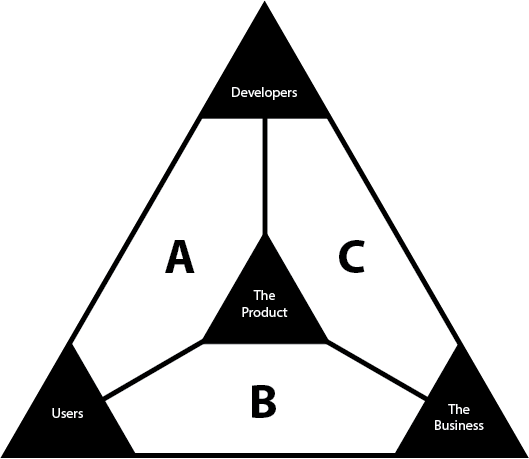
The Product Management Triangle shows three regions of white space between developers, users, the product, and the business.
The diagram shows a "Product Network" that maps the fundamental elements of a software product's context. In any company, there are missing links in this network, and when those links are filled, the product functions better and succeeds more reliably.
A product manager's responsibility is to keep all four regions of the Product Network healthy. That means recognizing which white spaces matter most and either acting as the link yourself or finding a way to fill them. This is why PMs need to be capable across many domains, from web analytics to project coordination to user research.
Region A: Between Developers, Product, and Users
Users and developers see the product in fundamentally different ways. Users interact through the interface. Developers see the code. This gap between mental models creates friction, and designers often help bridge it. But when there is no designer, or when the gap is about behavior rather than visuals, the PM steps in to translate between these two perspectives.
Region B: Between Users, Product, and Business
This is where the value users find in the product gets converted into revenue. Depending on the business model, this region can be simple (direct subscription) or extremely complex (marketplace with multiple stakeholder types). The PM needs to understand both sides: what users value and how the business captures that value.
Region C: Between Developers, Product, and Business
This region determines how the company allocates its resources and effort. Engineering capacity is finite, and the PM helps decide where that capacity goes. This requires understanding both the technical costs of building something and the business value of shipping it.
The Product Management Triangle explains why PM job descriptions seem impossibly broad. The role is broad by definition, because you are covering whatever gaps exist between the people who build the product, the people who use it, and the business that depends on it.
What Product Management Is NOT
One of the biggest challenges in product management is that many companies misunderstand what the role actually involves. Marty Cagan has written extensively about the most common misconceptions, and understanding what product management is not is just as important as understanding what it is.
Not Defining Business Cases
Some PMs spend their time building business cases and ROI projections. While this work has its place, it does not contribute directly to creating the product. Business cases exist so that management can make investment decisions. They are a communication tool, not a product management activity. A PM who spends most of their time on business cases is functioning as a business analyst, not a product manager.
Not Defining Market Requirements
Many organizations believe the PM's job is to define market requirements, which engineering then implements. This separation is dangerous because it creates a handoff that breaks the feedback loop. The person responsible for defining the product must talk directly to users and customers. And the goal is to find product-market fit, which requires understanding both market needs and technical capabilities simultaneously. Separating market requirements from product requirements is a false distinction.
Not Requirement Gathering
True product organizations understand that customers have problems that need to be solved, but customers cannot dictate product specifications. A customer requirement ("I need a way to track my team's progress") is not the same as a product requirement ("Build a Gantt chart"). Confusing the two leads to feature factories where the PM just takes orders instead of discovering the best solution.
Not Project Management
In some companies, the PM collects requirements, documents them, and organizes the work from conception through delivery. That is project management, and it is a legitimate, important discipline. But what separates product management from project management is product discovery: the process of finding a solution that is valuable, usable, feasible, and viable. Without discovery, you are just managing a delivery pipeline.
Not Product Marketing
Pricing, promotions, positioning, messaging, and launch activities are all critical functions. But they are the responsibility of product marketing, not product management. A PM is responsible for discovering a product that works. How that product gets positioned and sold in the market is a separate function, even though the PM needs to collaborate closely with the marketing team.
Core PM Skills by Seniority Level
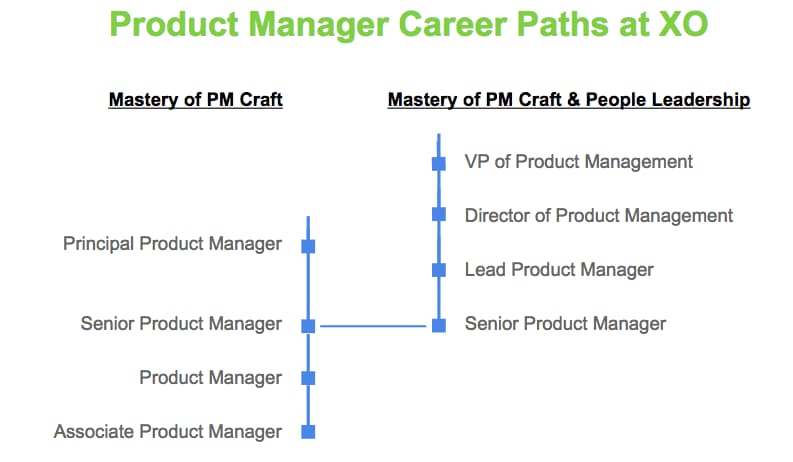
Product manager career paths for individual contributors (left) and managers (right). The skill requirements shift dramatically at each level.
The XO Group framework, detailed by Brent Tworetzky, breaks product management into seven skill areas, each of which evolves significantly as a PM advances in seniority. What makes this framework valuable is that it shows clearly how the same skill area demands fundamentally different things at the associate level versus the director level.
Skill 1: Strategic Thinking
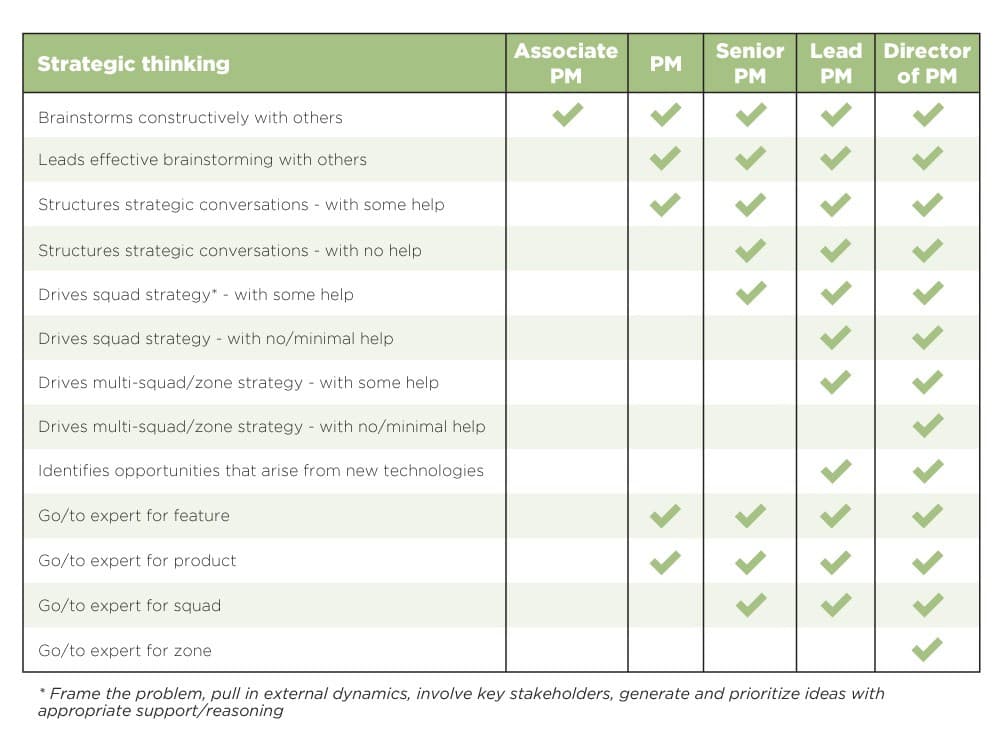
Strategic thinking requirements by PM seniority level.
Strategic thinking is the ability to lead to answers for increasingly large problem and product areas, with corresponding thought leadership. It includes brainstorming, structuring thinking, driving strategy, and becoming a go-to expert.
At the associate level, you need to brainstorm constructively with others. You are not expected to set strategy, but you need to show that you can think about problems in structured ways and empathize with users. At the senior level, you are expected to define strategy for your product area and build frameworks that others can use. At the director level and above, you set the strategic direction for entire product lines and influence company-wide priorities.
The jump from "contributes to strategy" to "defines strategy" is one of the hardest transitions in a PM career. It requires moving from understanding the problem to framing the problem, and those are very different cognitive skills.
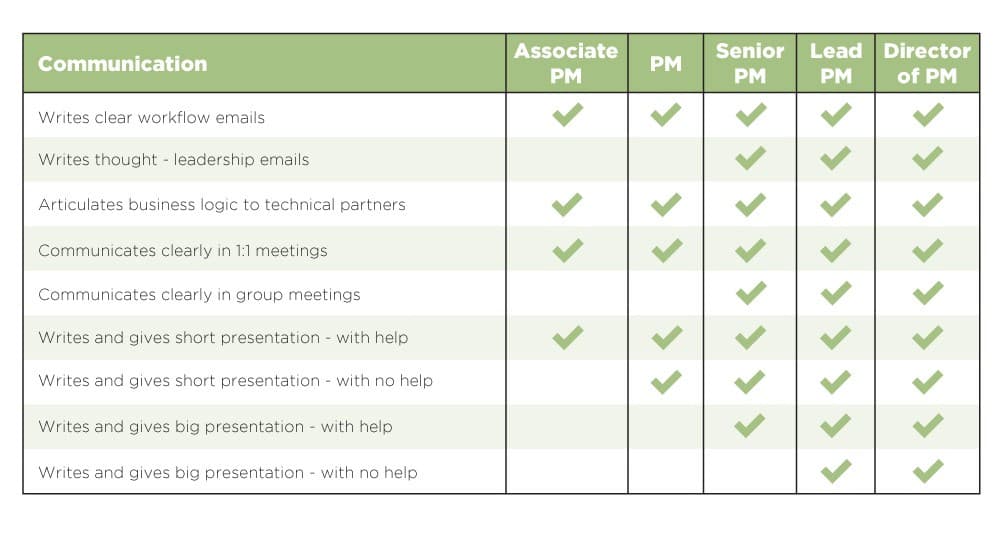
Skill 2: Communication
Communication requirements by PM seniority level.
Communication means clear written and oral communication to larger and higher-stakes audiences. This includes writing clear emails, communicating effectively in person, and creating and delivering presentations.
Communication is important at every level, but the stakes change dramatically. An associate PM needs to write clear specs and update their team. A senior PM needs to present to executives and align cross-functional stakeholders. A director needs to communicate vision to the entire organization and represent the product externally.
The most underrated communication skill for PMs is listening. The best PMs spend more time absorbing information than broadcasting it. They ask better questions, synthesize input from multiple sources, and make sure every voice on the team is heard before decisions get made.
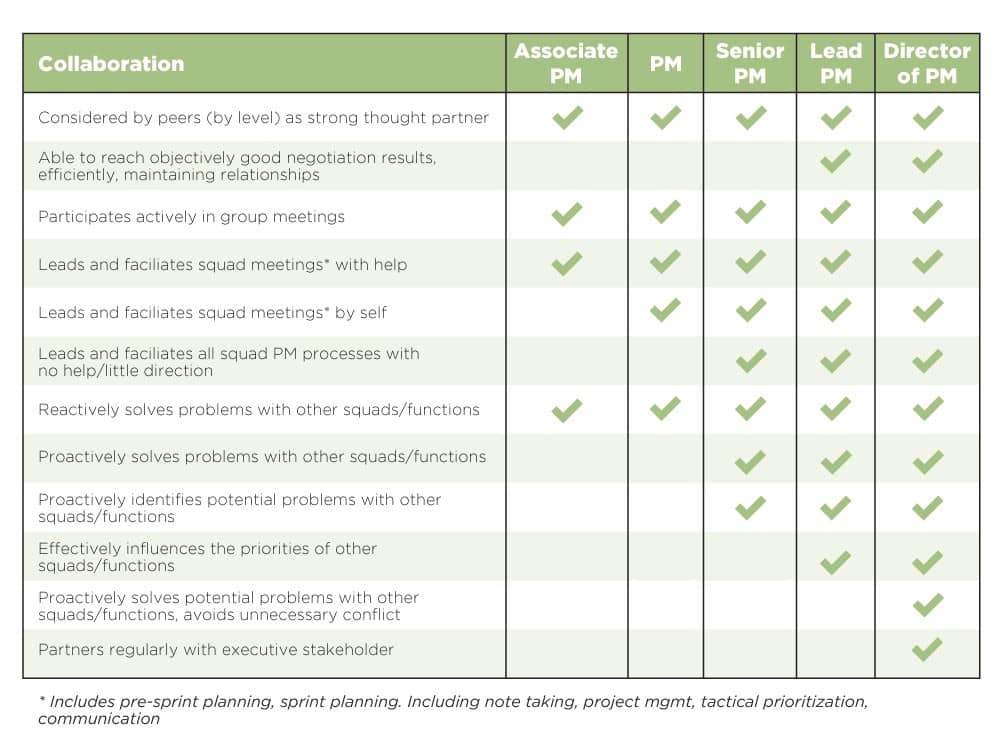
Skill 3: Collaboration
Collaboration requirements by PM seniority level.
Collaboration is increasingly more facilitation and getting things done with others within and across teams. This includes actively participating in meetings, leading meetings, running team processes, solving problems with other teams, and appropriately avoiding and diffusing conflict.
At the associate level, you participate. At the PM level, you lead. At the senior level and above, you facilitate collaboration across teams and with executives. The key shift is from being a collaborator within your team to being a connector across the organization.
Higher-level PMs need to be skilled at navigating organizational politics without becoming political themselves. This is a delicate balance: you need to understand how decisions get made and how influence flows, while maintaining the trust and transparency that make collaboration possible.
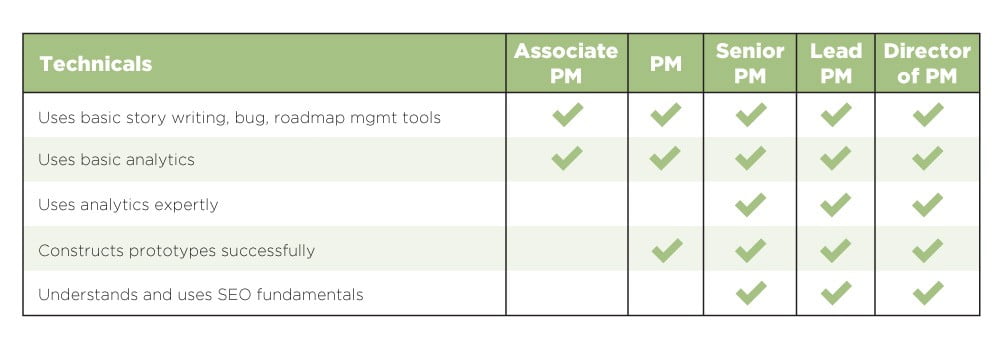
Skill 4: Technicals
Technical skill requirements by PM seniority level.
Technical skills mean using product management and partner function tools (engineering, design) to partner well across the team. This includes writing user stories, performing analytics, building prototypes, and understanding SEO.
Even at the mid-level, PMs are expected to build prototypes successfully. This does not mean writing production code, but it means being comfortable enough with the tools of design and engineering that you can communicate ideas concretely rather than abstractly.
The technical skill area also includes data literacy. Every PM needs to be comfortable with analytics tools, understand how to define and track metrics, and make data-informed decisions. As you advance, you need to understand system architecture well enough to have meaningful conversations about technical tradeoffs with engineering leads.
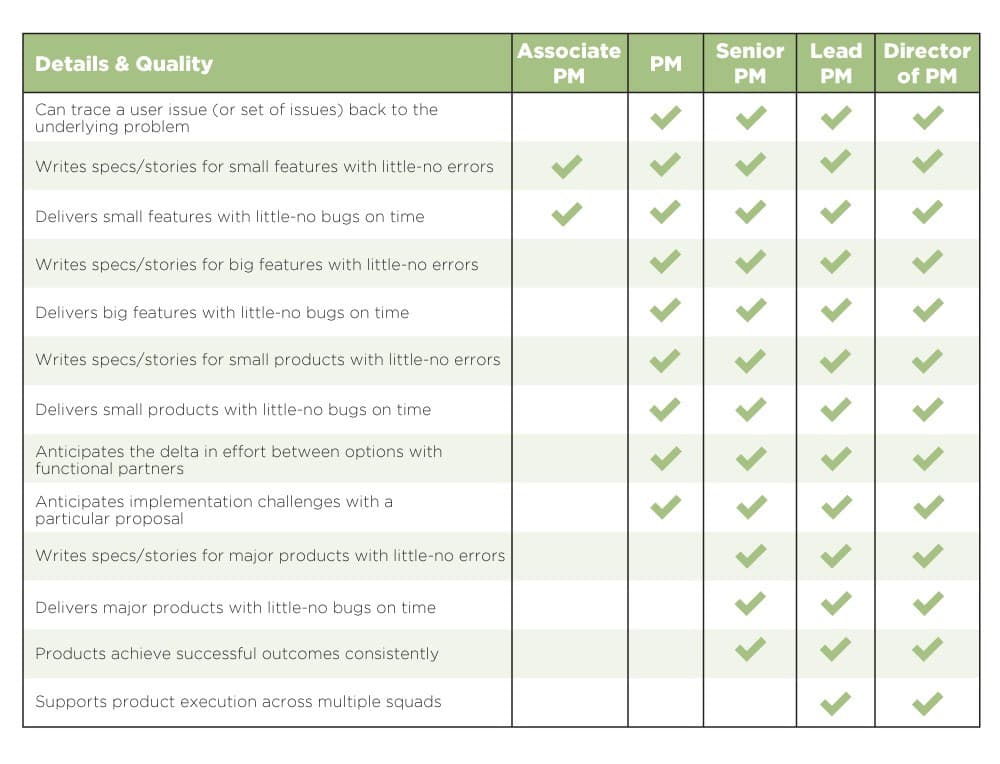
Skill 5: Details and Quality
Details and quality requirements by PM seniority level.
This skill area covers driving results and catching mistakes across increasing scope. It includes writing clear specs with use cases, delivering products on time and with few bugs, navigating options when obstacles arise, and achieving outcomes.
At the associate level, your scope is small. You write specs for individual features and deliver them. The quality bar is straightforward: does the feature work as specified? At the senior level, your scope expands to entire product areas. The quality bar shifts from "does it work" to "does it achieve the intended outcome." At the director level, you are responsible for quality across multiple teams and products, which means building systems and processes that maintain quality at scale.
Skill 6: User Science and Empathy
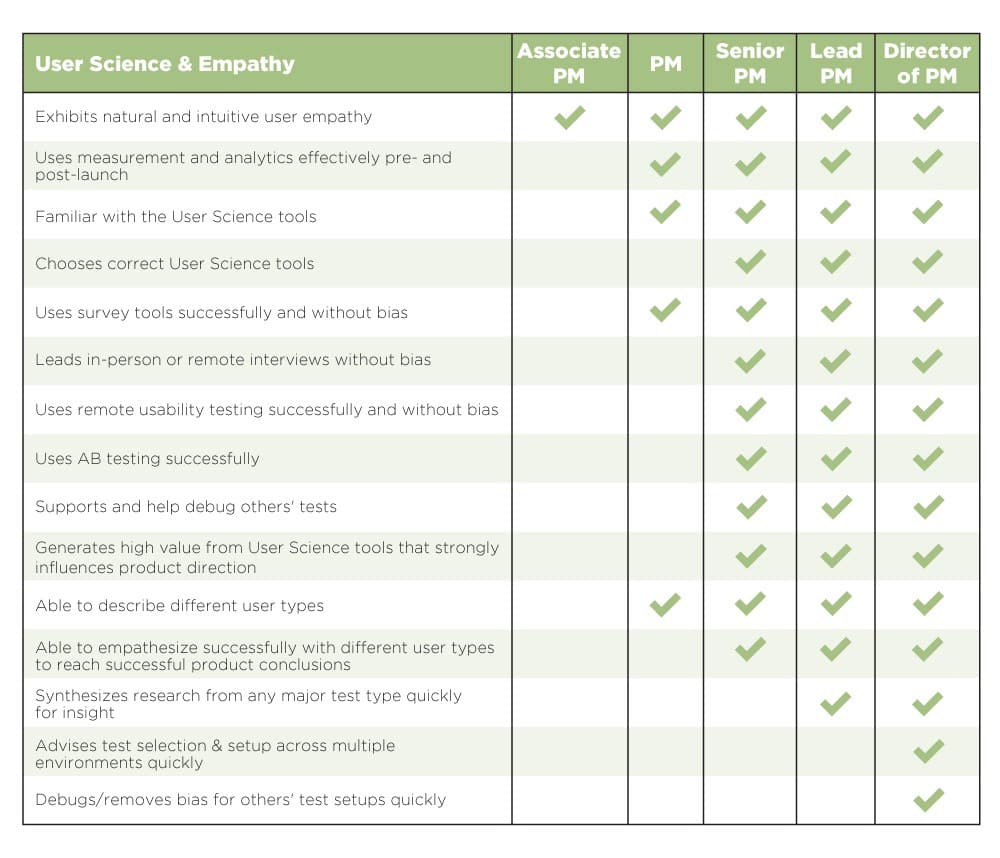
User science and empathy requirements by PM seniority level.
User science is about mastering the toolkit to better understand users and fit products to user needs and behaviors. This includes surveys, interviews, prototyping, A/B testing, analytics tools, understanding different user types, and synthesizing research into insight.
Empathy for the user is foundational at every level. It is the one skill that does not become less important as you advance. What changes is the sophistication with which you apply it. An associate PM talks to individual users and reports what they learned. A senior PM identifies patterns across user segments and translates them into product strategy. A director builds a culture of user-centricity across the product organization.
The best PMs treat user research as a continuous practice, not a phase in the product development process. They talk to users every week, not just when they are planning a new feature.
Skill 7: Management
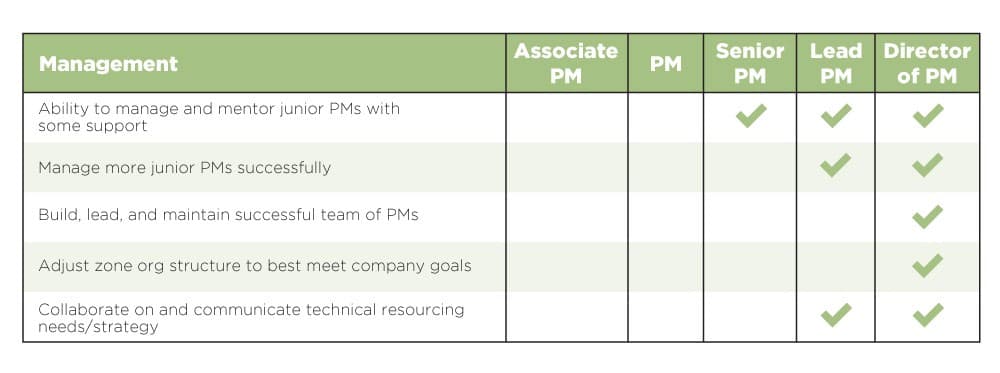
Management requirements by PM seniority level.
Management means growing people and organizations successfully. This includes mentoring, managing, growing teams, and growing organizations.
At the associate and PM levels, this skill is not required because you are not managing other PMs. Designers, engineers, and other team members do not report to you. But once you reach the senior level, you start mentoring junior PMs and may begin leading small teams. At the director level and above, management becomes a primary responsibility, and your impact is measured by the growth and output of the people you lead.
The transition from individual contributor to manager is particularly challenging for PMs because the skills that made you a great IC (deep product instincts, hands-on involvement, attention to detail) can become liabilities when your job is to develop those skills in others. For a detailed look at this career progression, see our guide to the product manager career path.
Do Product Managers Need Technical Skills
This is one of the most frequently asked questions from aspiring PMs, and the answer is more nuanced than most advice suggests.
You do not need a technical background to become a product manager. There are successful PMs who came from design, marketing, consulting, journalism, and dozens of other fields. The core of product management is understanding users and shipping solutions that work for both users and the business. That does not require a computer science degree.
But here is the nuance: technical literacy makes you a better PM. You do not need to write production code, but you do need to understand enough about how software works to have meaningful conversations with engineers. You need to understand what is easy, what is hard, and what is impossible. You need to know when an engineer says "that will take six weeks" whether they are padding the estimate or genuinely facing a complex problem.
Product management sits at the intersection of design, business, and technology. If you are strong in any one of those three areas and willing to learn the other two, you have a solid foundation. The key technical concepts that benefit PMs the most include:
- Data structures and APIs: Understanding how data flows through a system helps you make better product decisions and write clearer requirements.
- SQL and analytics: Being able to query data directly rather than waiting for an analyst gives you faster feedback loops and sharper instincts.
- Basic web technologies: Knowing how HTML, CSS, and JavaScript work helps you understand what the front end can and cannot do.
- System architecture: Understanding how services, databases, and infrastructure connect helps you evaluate technical tradeoffs.
Some PM roles, particularly Technical Product Manager positions, do require specific technical skills. But for the majority of PM roles, curiosity and willingness to learn matter more than existing technical credentials.
The relationship between PMs and technical skills is similar to the relationship between PMs and design skills. You manage a product that requires design work. You will not be doing the design yourself, but the deeper your understanding of design principles, the more effectively you collaborate with designers and the higher quality your contributions become.
Emotional Intelligence for Product Managers
Julia Austin's framework for evaluating product managers identifies three factors: core competencies, emotional intelligence (EQ), and company fit. Of these three, emotional intelligence is the most overlooked and arguably the most impactful.
Core competencies can be taught. Company fit can be evaluated. But emotional intelligence is the difference between a PM who can manage a roadmap and a PM who can inspire a team, navigate organizational complexity, and build products that genuinely resonate with users.
Daniel Goleman defined four key traits of emotional intelligence, and each maps directly to the PM role.
Relationship Management
This is arguably the single most important attribute of a successful PM. Product managers work entirely through influence. You do not have direct authority over engineers, designers, or data scientists. Your ability to motivate people and help them do their best work depends on building honest, trustworthy relationships with both internal and external stakeholders.
The best PMs invest in relationships before they need them. They build trust with engineers by respecting technical constraints, with designers by championing user experience, and with executives by delivering results consistently. When hard decisions come, and they always come, those relationships are what allow the PM to align the team and move forward.
Self-Awareness
PMs must be self-aware enough to stay objective and avoid projecting their personal preferences onto customers. This sounds simple, but in practice it is one of the hardest disciplines to maintain. Every PM has opinions about what the product should be, and those opinions can easily cloud judgment.
A PM who lacks self-awareness might push for a feature because they personally want it, not because users need it. If the feature does not perform well, it can damage the PM's credibility with engineers who invested time building something that was not validated. Self-awareness keeps you honest about the difference between "I think this is right" and "the evidence shows this is right."
Self-Management
The best PMs know how to push aggressively on the right priorities with urgency but without creating fear or stress. They also know when to step back and regroup. Product management is full of setbacks: features that fail, launches that get delayed, strategies that do not work. Self-management is what keeps you effective through those setbacks.
This also includes managing your own energy and focus. PMs are pulled in many directions every day, and the ability to prioritize ruthlessly and say no to low-value work is a form of self-management that compounds over time.
Social Awareness
Product managers need to understand the emotions and concerns of every stakeholder group: users who are frustrated with the product, salespeople who need to sell it, support teams who need to troubleshoot it, and engineers who need to build it. Social awareness means reading rooms accurately, understanding unspoken concerns, and adjusting your approach based on what each audience needs.
This skill connects directly to product-market fit. Socially aware PMs build products that address users' real jobs to be done, because they are attuned to what users actually feel, not just what they say in surveys. They also navigate internal dynamics more effectively because they understand how different teams experience the same product decisions.
Company Fit: How Context Shapes the PM Role
The same job title, "Product Manager," can mean wildly different things at different companies. Understanding how company context shapes the role is critical both for PMs choosing where to work and for organizations designing their product function.
PM-Engineering Dynamics
The relationship between product management and engineering is the single biggest factor in determining what a PM's day-to-day work looks like. There are three common models.
PM drives engineering. In this model, PMs gather requirements, write the product requirements document, and hand it to engineering to implement. This "throw it over the wall" approach creates clear ownership but often results in solutions that are technically suboptimal because engineering was not involved in discovery. PMs in this model spend most of their time on requirements and specifications.
Engineering drives product. In more technically focused companies (cloud infrastructure, data platforms, networking), engineers advance the technology and PMs design the front-end interfaces or go-to-market approach. PMs in this model need strong technical skills and the ability to translate complex technology into user-facing value.
PM-engineering partnership. This is the model that most modern product organizations aspire to. PM and engineering have a collaborative relationship with shared discovery, joint decision-making, and mutual accountability. Engineers join customer interviews. PMs attend sprint meetings to help unblock work and clarify requirements. This model produces the best outcomes but requires strong trust and communication on both sides.
Startup vs. Mature Company
The stage of the company fundamentally changes the PM role.
At a startup, the PM's scope is enormous. Beyond discovery, definition, and shipping, you may be responsible for pricing, marketing, support, and even sales. You thrive in ambiguity, are comfortable with frequent changes in direction, and accept that resources are limited. The upside is significant: you are more likely to be involved in company strategy, have access to senior leadership and the board, and have the freedom to take bigger risks with greater potential impact. The downside is equally real: there is little mentorship, few role models, and almost no established best practices.
At a mature company, the PM role is more defined. There are dedicated people handling pricing, go-to-market, and other functions. You are part of a larger product management team with more structure and support. The upside is better mentoring, clearer processes, and established best practices. The downside is that you may have limited visibility into company strategy, less influence over the product's direction, and more organizational politics to navigate.
The Founder Relationship
In early-stage companies, the founder, CEO, or CTO's involvement in product development is a critical factor. If the founder is deeply hands-on with product, the PM role may be more of a support function: helping flesh out the founder's ideas, validating concepts with customers, and managing execution rather than driving strategy.
This can be rewarding for PMs who enjoy collaborating closely with visionary founders. But it can be frustrating for PMs who want more ownership over product direction. And if technically-minded founders prefer to work directly with engineers, the PM can find themselves sidelined from the most important decisions.
Understanding this dynamic before you join a company is essential. Ask in interviews: How involved is the CEO in day-to-day product decisions? Who has final say on the roadmap? How much autonomy does the PM have to explore new directions?
Where to Go from Here
This guide covers the role and skills that define product management, but the career journey itself has its own set of challenges and opportunities. The transition from PM to Senior PM, the leap to product leadership, and the choice between individual contributor and management tracks all involve distinct decisions and skill shifts.
For a detailed look at the full career ladder from Associate Product Manager through Chief Product Officer, including how to break in, how to get promoted, and how to navigate the hardest transitions, read our companion guide: Product Manager Career Path: From APM to CPO.
Frequently Asked Questions
What does a product manager actually do day to day?
A product manager's daily work varies enormously, but it typically includes a mix of user research, data analysis, cross-functional meetings, roadmap planning, and spec writing. The unifying thread is decision-making: PMs spend their days gathering information from users, engineers, designers, and stakeholders, then synthesizing that information into clear product decisions. The best PMs structure their time to protect space for deep work (discovery, strategy, writing) while staying accessible enough to unblock their team and keep projects moving forward.
What is the difference between a product manager and a project manager?
The fundamental difference is discovery. A project manager coordinates the execution of a defined plan, managing timelines, resources, and deliverables to get something shipped on time and on budget. A product manager is responsible for figuring out what to build in the first place, through user research, market analysis, and iterative discovery. Product managers own the "what" and "why." Project managers own the "how" and "when." In practice, PMs often take on project management responsibilities, especially at smaller companies, but the core of the PM role is discovery and decision-making, not execution management.
What skills are most important for a new product manager?
For someone entering product management, the highest-leverage skills are user empathy, clear communication, and analytical thinking. You need to understand users deeply enough to identify real problems, communicate clearly enough to align a cross-functional team, and think analytically enough to measure outcomes and make data-informed decisions. Strategic thinking and management skills become more important as you advance, but early in your career, the ability to ship features that solve real user problems is what builds your credibility and opens up opportunities.
Do you need a technical background to be a product manager?
No, a technical background is not required for most PM roles. Successful product managers come from design, marketing, consulting, operations, and many other fields. However, technical literacy, meaning the ability to understand how software systems work at a conceptual level, makes you more effective. You do not need to write code, but you need to understand technical tradeoffs well enough to have productive conversations with engineers. Some specialized roles like Technical Product Manager positions do require specific technical skills, but these are a subset of all PM roles.
How is product management different from product marketing?
Product management focuses on discovering, defining, and shipping products that solve user problems. Product marketing focuses on positioning, messaging, pricing, and launching products in the market. The PM answers "what should we build and why," while product marketing answers "how do we communicate the value of what we built." In practice, the two functions work closely together: PMs provide product marketers with deep knowledge of the user and the product's value proposition, while product marketers help PMs understand market positioning, competitive dynamics, and go-to-market strategy.
Why is emotional intelligence important for product managers?
Product managers work entirely through influence. They do not have direct authority over engineers, designers, or other team members, which means their effectiveness depends on building trust, reading situations accurately, and motivating people without positional power. Emotional intelligence enables PMs to empathize with users during research, navigate disagreements within the team without creating resentment, maintain objectivity when their personal preferences conflict with user needs, and build the long-term relationships that make cross-functional collaboration work. A technically skilled PM with low EQ will struggle in ways that a technically average PM with high EQ will not.
How does the product manager role differ at startups versus large companies?
At startups, PMs wear many hats. You might handle product discovery, pricing, customer support, and even sales within the same week. The scope is broad, resources are limited, and the role is defined by what needs to happen rather than a formal job description. At large companies, the PM role is more specialized. There are dedicated teams for pricing, go-to-market, analytics, and other functions. You work within a larger product organization with established processes and career ladders. The tradeoff is clear: startups offer more autonomy and learning breadth at the cost of structure and mentorship, while large companies offer more support and specialization at the cost of scope and speed.
What makes the Product Management Triangle a useful framework?
The Product Management Triangle is useful because it reframes the PM role from a list of responsibilities to a structural function. Instead of asking "what does a PM do," it asks "where are the gaps between the people who build the product, the people who use it, and the business that depends on it." This framing explains why PM job descriptions seem impossibly broad: the role is defined by whatever white space exists in the organization. It also explains why the PM role looks so different across companies, because different organizations have different gaps. The framework helps PMs prioritize by identifying which gaps are most critical to fill at any given moment.