What Is Product Market Fit?
The concept of product market fit was originally created by Sequoia Capital founder Don Valentine and later popularized by Marc Andreessen in his widely cited 2007 essay. Andreessen's definition remains the clearest starting point:
Product/market fit means being in a good market with a product that can satisfy that market.
That definition is deceptively simple. It does not say "a great product." It does not say "a brilliant team." It says a good market and a product that satisfies it. The emphasis is deliberate. Before you worry about design, features, or growth tactics, you need to be certain that the problem you are solving is real, widespread, and painful enough that people will adopt an imperfect solution.
Michael Seibel of Y Combinator puts it even more directly: finding product market fit means focusing on the market first. The problem, meaning the market, is the real opportunity. You need to find problems so dire that users are willing to try half-baked, v1, imperfect solutions.
For startup founders, product market fit is the dividing line between survival and failure. Everything before it is searching. Everything after it is building.
Why Market Matters Most
Every startup consists of three elements: team, product, and market. Founders naturally obsess over the first two. They recruit talented engineers, polish their product, and refine their pitch. But multiple generations of startup investors and operators have converged on the same conclusion: market matters more than either team or product.
Andy Rachleff, co-founder of Benchmark Capital, formulated this as a set of laws:
- When a great team meets a lousy market, market wins.
- When a lousy team meets a great market, market wins.
- When a great team meets a great market, something special happens.
This isn't cynicism about talent. It's a recognition that even the most capable team cannot manufacture demand that doesn't exist. A great market, one with many potential customers experiencing a genuine problem, will pull a product forward almost on its own. A weak market will resist even the most polished solution.
Andrew Chen offers a practical way to test whether a market is real before you build anything:
- What keyword would someone search to find your product?
- Enter that keyword into a search volume tool.
- How many people search for it each month?
If the number is in the millions, you are looking at a large market with existing demand. For consumer internet products specifically, a strong market combines three qualities: a large number of potential users, high growth in the number of potential users, and ease of user acquisition.
The takeaway is not that team and product are irrelevant. It's that if you are before product market fit, the only thing that matters is getting there. As Andreessen wrote: do whatever is required to get to product market fit. Change your people, rewrite your product, move into a different market, tell customers no when needed. Nothing else matters until you get there.
What Product Market Fit Feels Like
One of the most common questions founders ask is: "How will I know when I have product market fit?" People who have been through it describe the experience in strikingly similar terms. It is not subtle.
Marc Andreessen described it this way: "The customers are buying the product just as fast as you can make it, or usage is growing just as fast as you can add more servers. Money from customers is piling up in your company checking account. You're hiring sales and customer support staff as fast as you can."
Michael Seibel's version is just as vivid: "You have reached product/market fit when you are overwhelmed with usage, usually to the point where you can't even make major changes to your product because you are swamped just keeping it up and running."
Steve Blank frames it around emotional response: "The real metric for both consumer apps and enterprise is, do someone's pupils dilate when they use your stuff? Do they say, 'You're not leaving' or 'Where have you been all of my life?'"
Andy Rachleff connects it directly to word of mouth: "You know you have fit if your product grows exponentially with no marketing. That is only possible if you have huge word of mouth. Word of mouth is only possible if you have delighted your customer."
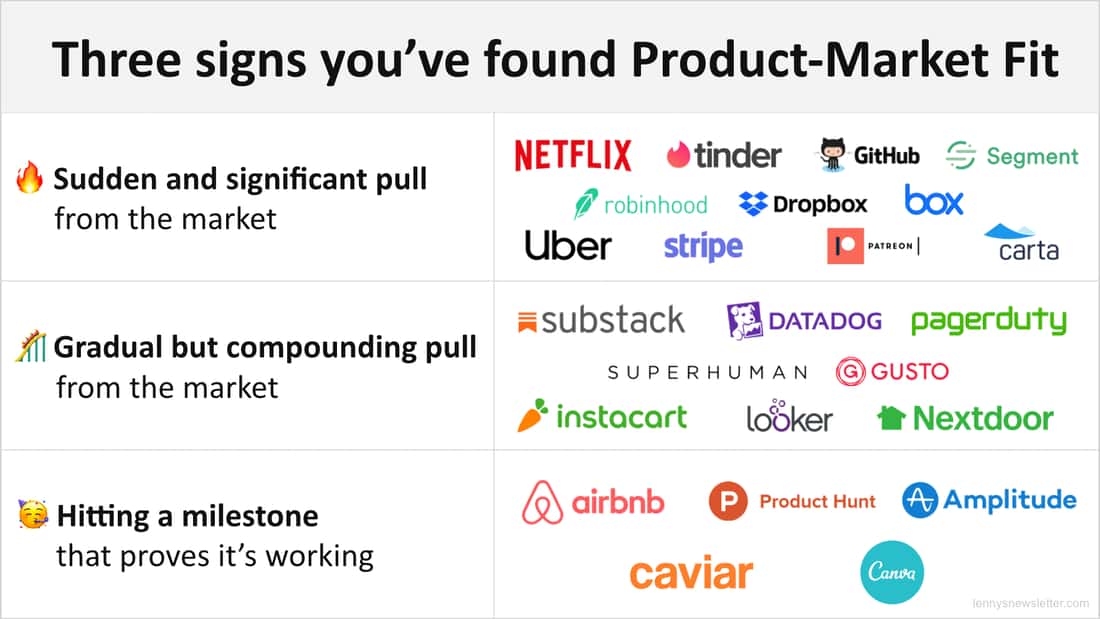
Signs of product market fit, from sudden pull to compounding growth. Source: Lenny Rachitsky
Lenny Rachitsky, in his research across dozens of startups, found three main patterns for how PMF shows up: (1) sudden and significant pull, (2) gradual but compounding pull, and (3) hitting a milestone that proves the model works. Market "pull" appears in many forms:
- An inflection in organic growth and word of mouth (Uber, Tinder, Stripe, PagerDuty)
- Customers complain loudly when your site goes down (Nextdoor, Carta)
- People keep using the product even when it is broken
- Customers ask to pay before you ask them to (GitHub)
The intensity of pull depends on how well your product solves the problem and the initial market size. Broad markets (Dropbox, Netflix, Tinder) tend to produce more explosive pull. Niche markets (Instacart, Superhuman, Substack) often produce quieter but equally strong signals.
It is also worth noting how long reaching PMF can take. Netflix needed 1.5 years. Airbnb took 2 years. Superhuman took 3 years. Amplitude needed 4 years. If you haven't found it yet, that does not mean you won't. The Startup Genome Report found that startups typically need 2-3 times longer to validate their market than founders expect. That underestimation drives premature scaling, and premature scaling is the leading cause of startup death.
Four Myths About Product Market Fit
Before diving into measurement, it is worth clearing up four persistent myths that Ben Horowitz identified. Each one can lead founders to make dangerous decisions.
Myth 1: Product market fit is always a discrete, big bang event. In reality, PMF often emerges gradually. Some founders wake up one day and realize they have it. Others inch toward it over months. There is no alarm bell.
Myth 2: It's patently obvious when you have product market fit. This follows from the first myth. If PMF can be gradual, it can also be ambiguous. You might have strong PMF in one segment but not in your broader target market. The signal can be clear for some companies and murky for others.
Myth 3: Once you achieve product market fit, you can't lose it. Markets move. Competitors arrive. User needs evolve. A product that had strong fit in 2020 may not have it in 2025. PMF requires ongoing attention.
Myth 4: Once you have product market fit, you don't have to sweat the competition. PMF reduces competitive risk but does not eliminate it. Strong fit gives you a head start, not permanent safety.
Reid Hoffman adds another critical insight: "Product/market fit requires you to figure out the earliest tells." In practice, that means you need to identify the leading indicators of fit before you have conclusive proof. Waiting for certainty means waiting too long.
Sam Altman emphasizes the operational implication: "Hiring before you get product/market fit slows you down, and hiring after you get product/market fit speeds you up. Until you get product/market fit, you want to (a) live as long as possible and (b) iterate as quickly as possible. Small teams for the win on both."
How to Measure Product Market Fit
If PMF is the single most important milestone for a startup, you need a way to measure progress toward it. The good news: several proven approaches exist. The challenging part: no single metric works for every company at every stage. Here is a map of the options, from qualitative surveys to quantitative retention analysis.
The Superhuman PMF Framework: The 40% Test
Rahul Vohra, CEO of Superhuman, adapted Sean Ellis's product market fit survey into a systematic, repeatable framework. The core idea: if you can measure PMF, you can optimize it.
The survey targets users who have used the product at least twice in the last two weeks. It asks four questions:
- How would you feel if you could no longer use the product? A) Very disappointed B) Somewhat disappointed C) Not disappointed
- What type of people do you think would most benefit from the product?
- What is the main benefit you receive from the product?
- How can we improve the product for you?
The headline metric is straightforward: if 40% or more of respondents answer "very disappointed" to question 1, you have product market fit. Below 40%, you have work to do. You start getting directionally correct results at around 40 respondents, and you should not survey the same users more than once.
The real power of the Superhuman framework is not just the score but the four-step process for improving it:
Step 1: Segment to find your supporters. Break down the Q1 responses by user type (role, company size, use case). Look for segments where the "very disappointed" percentage is highest. These are your high-expectation customers (HXC). Happy users almost always describe themselves in their Q2 answers.
Step 2: Analyze feedback to convert fence-sitters into fans. You need to understand (1) why people love the product, and (2) what holds others back. Put Q3 responses from happy users into a word cloud to find patterns. Then look at the "somewhat disappointed" group, but only those who resonate with the main benefit your happy users cite. Their Q4 answers reveal what's missing.
Step 3: Build your roadmap around it. Double down on what users love. Address what holds the "somewhat disappointed" group back. This gives you a roadmap that directly drives the PMF score upward.
Step 4: Repeat. Track the score over time. Be aware that early adopters tend to be more forgiving, so as you expand beyond them, the score may temporarily dip. Keep measuring, keep improving.
The underlying philosophy is worth internalizing: it is better to make something a small number of people want a large amount, rather than something a large number of people want a small amount. Narrowing your market to find intense love is the fastest path to product market fit.
Cohort Retention: The Best Quantitative PMF Metric
Surveys are leading indicators. They tell you what people say. Cohort retention tells you what people actually do.
Casey Winters, former growth lead at Pinterest and Grubhub, defines product market fit as the satisfaction that allows for sustained growth. His formula is clear:
PMF = flattened retention curve + month-over-month growth in new users
Product/market fit is not when customers stop complaining and are fully satisfied. They'll never stop complaining. They'll never be fully satisfied. Product/market fit is when they stop leaving.
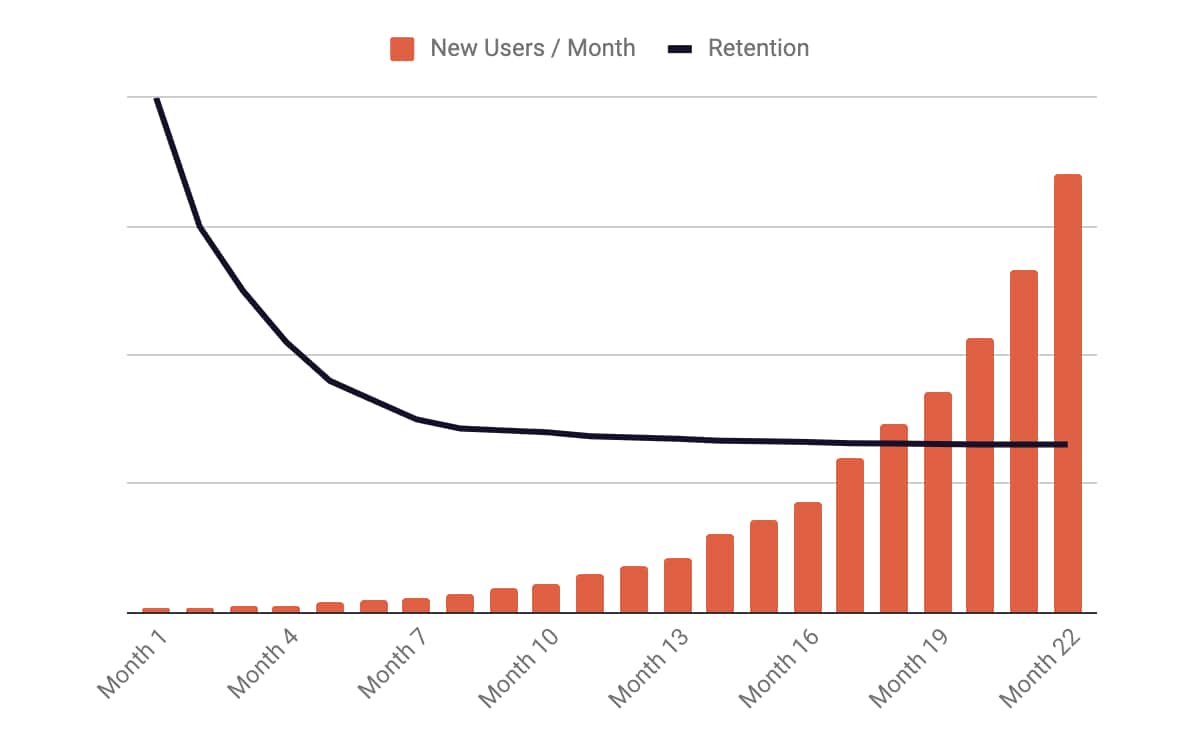
A flattened retention curve signals PMF. If the curve declines to zero, you don't have it yet. Source: Casey Winters
Jeff Chang, writing about quantitative PMF measurement, makes the case that cohort retention is the single best metric. Here is why other metrics fall short:
- NPS (Net Promoter Score): Some of the biggest tech companies in the world have terrible NPS scores but still grow to billions of users. NPS measures sentiment, not behavior.
- The 40% "very disappointed" survey: Response bias is a real problem. It is hard to get everyone to answer, and what people say they'd feel doesn't always match what they actually do.
Cohort retention avoids these problems:
- No response bias (you measure everyone, not just survey respondents)
- Full user lifecycle data
- Measures actual behavior, not stated intent
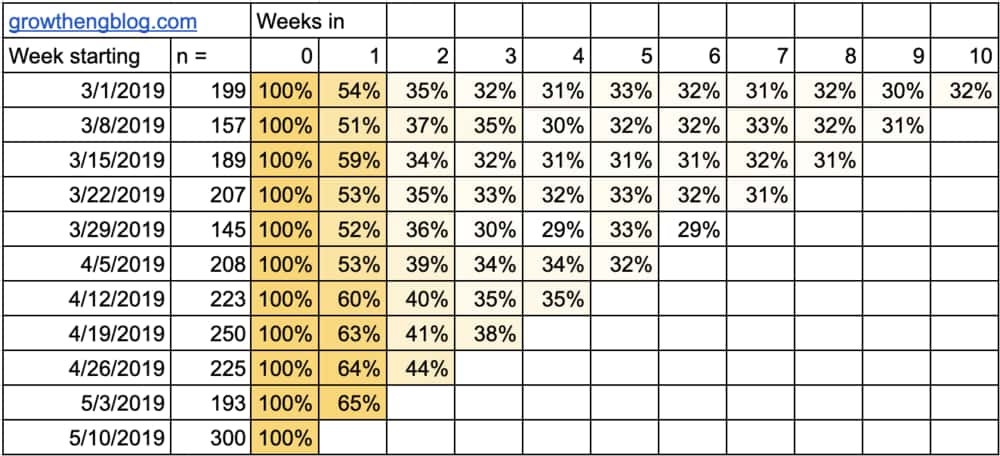
Cohort retention analysis breaks users into groups by sign-up date and tracks usage over time. Source: Jeff Chang
As a rule of thumb, for consumer products a retention rate of 25% or higher is a solid floor. For B2B SaaS products, aim for 70% or higher. But benchmarks vary by category, so the best approach is to find the retention rates of comparable products that have achieved significant growth and use those as your target.
Once you have a few cohorts that level off at an appropriate rate for your vertical, you have quantitative evidence of product market fit.
Brian Balfour's Four Checkpoints on the PMF Path
Brian Balfour, founder of Reforge, maps the journey to product market fit as a progression through four checkpoints. Knowing where you are on this path helps you decide when to shift from traction to transition to growth.
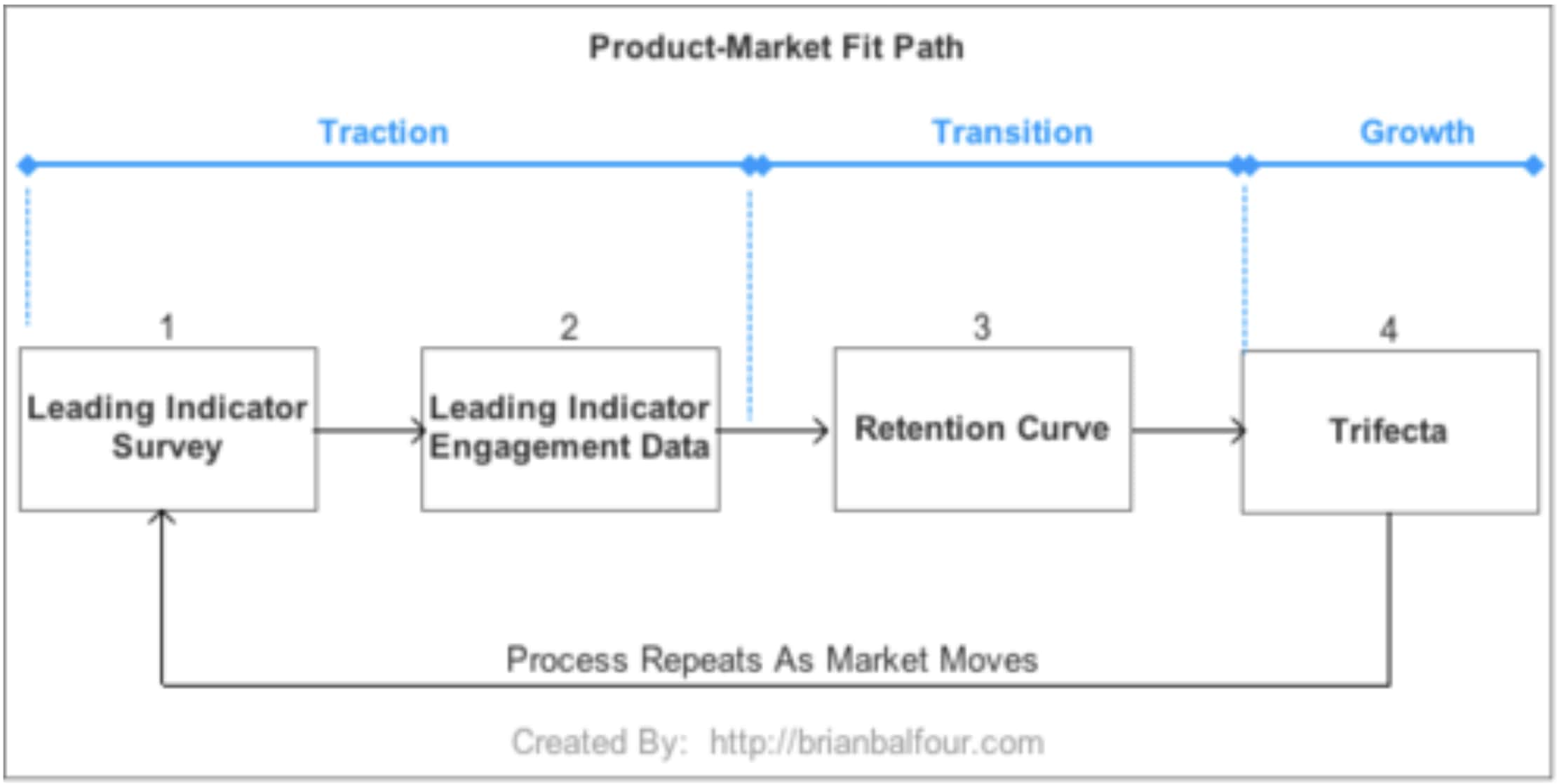
The product market fit path, from leading indicators to the trifecta. Source: Brian Balfour
Checkpoint 1: Leading Indicator Survey (what they say) This is the 40% test and NPS. These are the earliest signals, available even before you have enough users for meaningful retention data.
Checkpoint 2: Leading Indicator Engagement Data (what they do) Look at events and actions, not pageviews. Measure the behaviors that represent the core purpose of your product. For a messaging app, that might be messages sent. For a reading tool, it might be highlights created.
Checkpoint 3: Flattened Retention Curve (PMF for some audience) When your retention curve flattens, you have product market fit for at least some segment. The next step is to segment by demographics, time, and user source to identify exactly who those retained users are. Complement the data with qualitative surveys to understand why they stay.
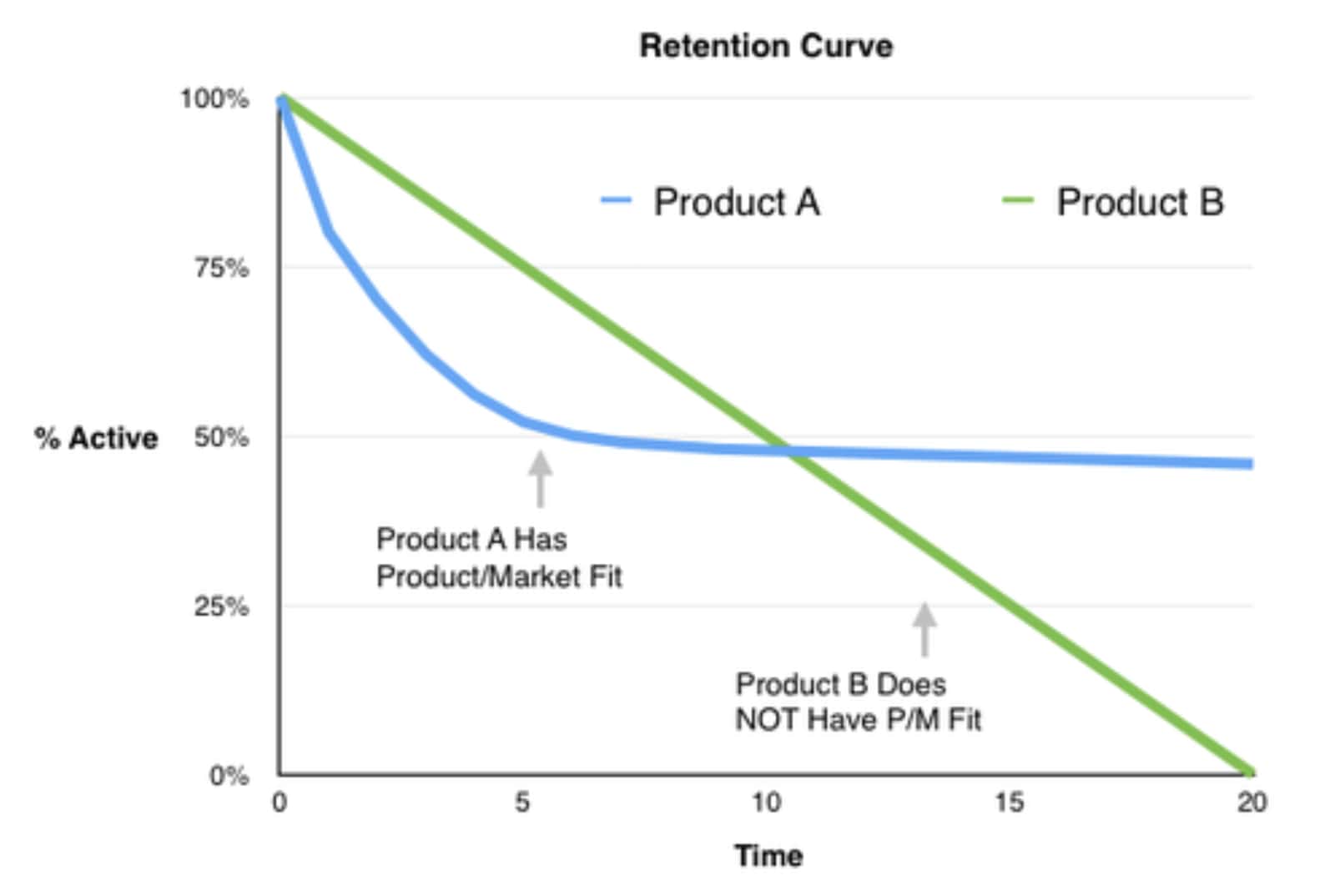
A retention curve that flattens indicates PMF for some segment. Segmentation reveals who. Source: Brian Balfour
Checkpoint 4: The Trifecta (full PMF in a meaningful market) The trifecta combines three signals: top-line growth, improving retention, and meaningful usage. When all three are moving in the right direction simultaneously, you have strong product market fit across a market large enough to build on.
How to Find Product Market Fit
Knowing what PMF is and how to measure it is one thing. Actually getting there is another. There is no single recipe, but two dominant schools of thought have emerged, along with a set of practical tactics that apply regardless of which approach you take.
Two Paths: Ries vs. Rabois
Casey Winters frames the choice between two models that represent opposite ends of a spectrum. Most successful founders borrow from both.

The Ries model starts with demand; the Rabois model starts with vision. Source: Casey Winters
The Eric Ries Model (demand first, then supply):
- Start with the market. Identify a painful, unsolved problem.
- Talk to customers obsessively. Let their feedback guide the product.
- Focus on a narrow customer segment initially.
- Iterate rapidly based on what you learn.
- Launch small to gather feedback from target users.
- Works well for: enterprise software (where users have concrete daily problems), marketplaces (where you can launch a minimum viable version quickly).
The Keith Rabois Model (supply first, then demand):
- Start with a product vision. Build what you believe should exist.
- Let the vision guide decisions more than user feedback.
- Build a complete experience before launching.
- Iterate less frequently but with bigger bets.
- Launch broadly to find where the product resonates.
- Works well for: consumer products (where you are creating new habits), hardware (where iteration cycles are long).
Casey's personal belief, and one backed by the track record of many successful companies, is that a strong vision combined with market feedback is the dominant combination. Even the famous pivots (Slack starting as a game, Instagram starting as Burbn) were guided by a strong new vision from the founders, not blind experimentation.
I think this is an area where despite all the news we hear about successful pivots, leaning more towards the Rabois model is a dominant strategy. Blindly trying out a bunch of startup ideas is like being in a dark room and feeling around for a door. A successful vision can turn on a light to that room so everyone can see the door and run toward it.
Minimize Your Time to Product Market Fit
Andrew Chen introduces a useful concept: TTPMF, or Time to Product Market Fit. The faster you reach PMF, the more runway you have to grow. One counterintuitive way to reduce TTPMF: study your predecessors and copy what already works.
This does not mean cloning a competitor. Pure clones have real weaknesses: they are uninspired, they can never be number one, they let a competitor define the market, and they cannot replicate network effects. The strategy is to keep the fundamentals the same (roughly 80%) while substantially reinventing 20% of the product. The key is choosing the right 20%.
Ideally, the differentiation is baked deeply into the core of the product, not on the edges. It should be something the end user can see and feel within the first 30 seconds.
The Superhuman Optimization Loop
If you have launched and have users but your PMF score is below 40%, the Superhuman framework gives you a systematic process to improve:
- Identify your high-expectation customers. Segment survey responses. Find where love is concentrated.
- Understand the gap. The "somewhat disappointed" users who value your core benefit are your best opportunity. Their improvement suggestions tell you exactly what to build.
- Double down and address. Build features that strengthen what fans love while removing the barriers that hold others back.
- Track the score. Resurvey after changes ship. The 40% number is your North Star.
This loop turns product market fit from a vague milestone into an engineering problem. You measure, you diagnose, you intervene, and you measure again.
Beyond Product Market Fit: The Four Fits Framework
Reaching product market fit is necessary but not sufficient for building a large, sustainable company. Brian Balfour argues that you actually need four interlocking fits, and they cannot be thought about in isolation because each one influences the others.
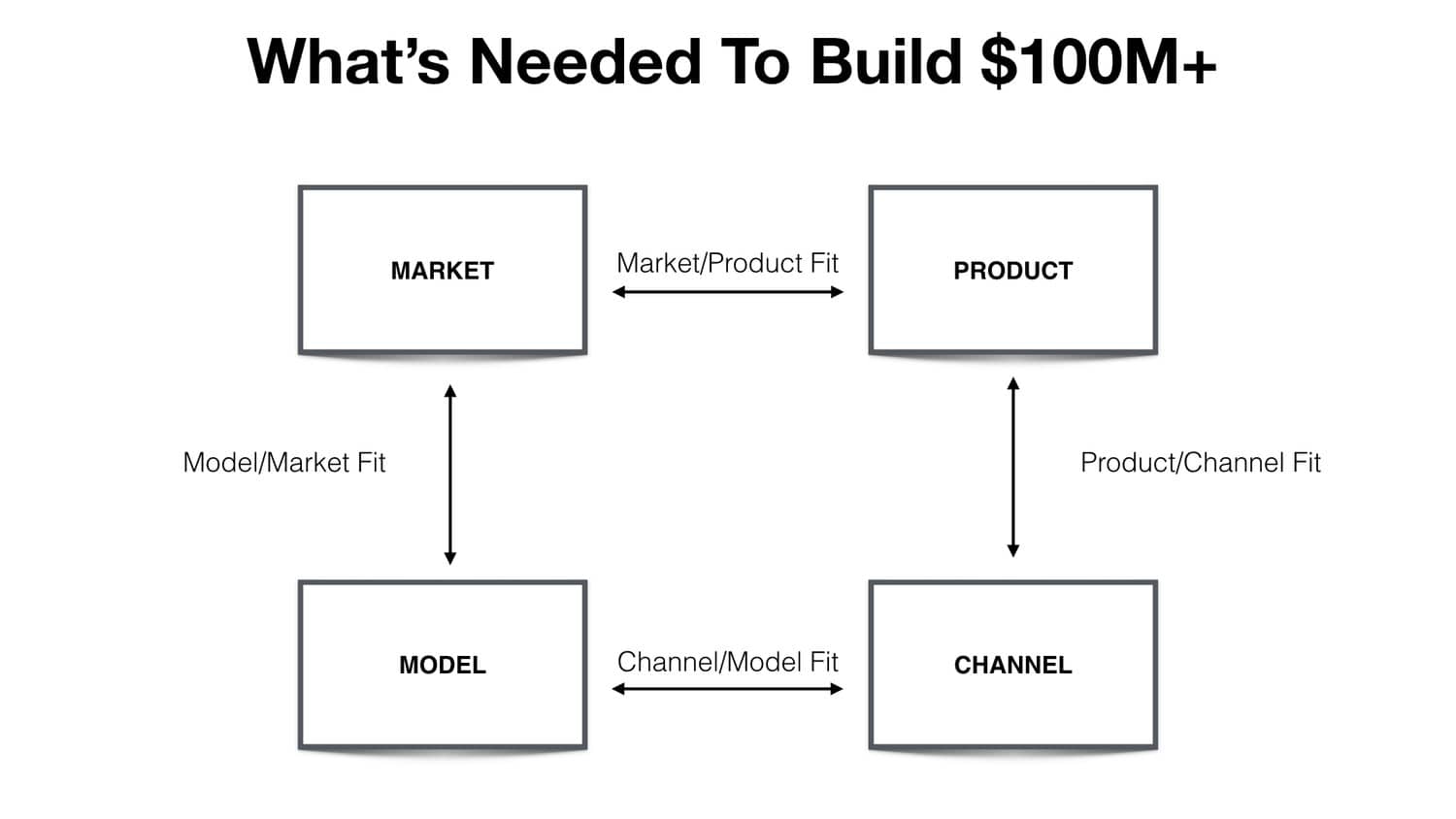
The Four Fits: Market-Product, Product-Channel, Channel-Model, Model-Market. Source: Brian Balfour
Market-Product Fit: Does your product solve a real problem for a large enough market? This is the classic PMF discussed throughout this article.
Product-Channel Fit: Does your product work with the channels available to reach your market? Some products lend themselves to virality. Others need sales teams. A product designed for viral sharing but distributed through enterprise sales will struggle, and vice versa.
Channel-Model Fit: Does your distribution channel support your business model? High-touch sales channels require high average revenue per user (ARPU) to justify the cost of acquisition. Viral or organic channels can support lower ARPU products. Getting this wrong puts you in what Balfour calls the "ARPU-CAC danger zone."
Model-Market Fit: Does your business model match the spending patterns and willingness to pay in your market? A freemium model works when the market is large and conversion rates are predictable. An enterprise model works when deal sizes justify long sales cycles.
These four fits form a loop. Change one, and the others shift. A pivot to a new market may require new channels, which may require a new business model. Building a $100M+ company means getting all four right, not just the first one.
Brian Balfour also emphasizes that this process never ends: "Your market doesn't sit still. It is always moving. As your market moves, your product needs to move with it, making product/market fit a pulse that you need to constantly keep your thumb on."
Ben Horowitz agrees: "Product market fit isn't a one-time, discrete point in time that announces itself with trumpet fanfares. Competitors arrive, markets segment and evolve, and stuff happens."
The companies that endure are the ones that treat product market fit not as a box to check but as a continuous discipline. They keep measuring, keep listening, and keep adapting.
Frequently Asked Questions
What is product market fit in simple terms?
Product market fit means you have found a market with a real problem and built a product that solves it well enough that people use it, come back, and tell others about it. It is the point where you stop pushing your product and the market starts pulling it forward.
How do you know if you have product market fit?
The most reliable signals are quantitative: a retention curve that flattens rather than declining to zero, and a Sean Ellis survey score above 40% (meaning 40% of active users say they'd be "very disappointed" without your product). Qualitative signals include organic word of mouth, customers complaining when the product goes down, and demand outpacing your ability to deliver.
What is the 40% test for product market fit?
The 40% test comes from Sean Ellis and was systematized by Rahul Vohra at Superhuman. You survey active users and ask: "How would you feel if you could no longer use this product?" If 40% or more answer "very disappointed," you have product market fit. Below 40%, you have a clear signal to improve. You need at least 40 responses for directionally useful results.
How long does it take to find product market fit?
It varies widely. Some companies find it within months of launch. Others take years. Research from the Startup Genome Project found that startups typically need 2-3 times longer to validate their market than founders expect. Notable examples: Netflix (1.5 years), Airbnb (2 years), Superhuman (3 years), Amplitude (4 years).
What is the best metric for product market fit?
Cohort retention is considered the strongest quantitative metric because it measures actual user behavior over time, has no response bias, and captures the full user lifecycle. For consumer products, a floor of around 25% retention is a useful benchmark. For B2B SaaS, aim for 70% or higher. Pair retention data with the Sean Ellis survey for a complete picture.
What is the difference between the Eric Ries model and the Keith Rabois model?
The Ries model starts with the market: identify a problem, talk to customers, iterate quickly based on feedback. The Rabois model starts with a product vision: build what you believe should exist, then find the market it fits. In practice, the most successful founders combine strong vision with active market feedback. Enterprise and marketplace companies tend to lean toward the Ries model; consumer and hardware companies lean toward Rabois.
Can you lose product market fit after achieving it?
Yes. Markets evolve, competitors enter, and customer needs change. A product that had strong fit five years ago may not have it today. Brian Balfour describes PMF as a pulse you need to keep your thumb on continuously. Companies that stop measuring and adapting risk losing the fit they worked so hard to build.
What comes after product market fit?
Product market fit is necessary but not sufficient. To build a large company, you need four interlocking fits: Market-Product Fit, Product-Channel Fit, Channel-Model Fit, and Model-Market Fit. Each influences the others, and getting all four right is what separates companies that plateau from companies that scale to $100M and beyond.