Growth Mindset and Psychology
Before diving into frameworks and metrics, you need to develop the right mindset. Too many founders skip straight to "20 best growth hacking ideas" without understanding why growth actually works. The reality is simpler and harder than any hack: growth comes from relentless experimentation, deep empathy for users, and the willingness to do things that don't scale.
Do Things That Don't Scale
Do Things that Don't Scale by Paul Graham
Startups take off because founders make them take off. The most common unscalable thing founders have to do at the start is recruit users manually. Nearly all startups have to. You can't wait for users to come to you. You have to go out and get them.
It's not the product that should be insanely great, but the experience of being your user. The product is just one component of that. For a big company it's necessarily the dominant one. But you can and should give users an insanely great experience with an early, incomplete, buggy product, if you make up the difference with attentiveness.
I have never once seen a startup lured down a blind alley by trying too hard to make their initial users happy.
As long as you can find just one user who really needs something and can act on that need, you've got a toehold in making something people want, and that's as much as any startup needs initially.
I should mention one sort of initial tactic that usually doesn't work: the Big Launch. [...] Why do founders think launches matter? A combination of solipsism and laziness. They think what they're building is so great that everyone who hears about it will immediately sign up.
This essay remains one of the most cited pieces of startup advice for good reason. The core insight is that the transition from doing things manually to building systems is itself a growth strategy. What you learn from individual users informs everything you build later.
The Psychology of Startup Growth
The Psychology of Startup Growth by James Currier
Growth is not a one-time gimmick. To get 1000% growth, there is no silver bullet. Growth comes from adopting the right psychology:
- Language first: Your language defines you. It tells users how you are relevant to their life. The common mistake is that companies build features first and then "put language on it." Language should come first.
- Empathy for users: The great founder spends more time thinking about how the user thinks and feels. About their psychology. The question you have to ask every day is, "What is your product to them so that it deserves a place in their complex lives?"
- Always be moving: Move constantly. Make more moves than anyone else. To grow, you have to run quicker experiments. Iterate faster. Never stop.
- Data love: Measure everything. Test, measure, and iterate.
- Sustain the pain of failure: Success is going from failure to failure with no loss of enthusiasm. Move on from the losses.
The key takeaway here is that growth is a mindset before it is a strategy. Teams that internalize these principles make better decisions at every stage of the funnel.
Growth Frameworks
With the right mindset in place, you need a mental model for how growth actually works. Growth is fundamentally about compound effects: what one user does should increase value for other users, so that more activity creates more value for everyone. The following frameworks will help you answer the most important question for any product: How does your product grow?
The AARRR Framework (Pirate Metrics)
AARRR Framework by Melanie Balke
The AARRR metrics were coined by Dave McClure in 2007 (see his original slideshare). These are five metrics for measuring your company's growth while being simple and actionable.
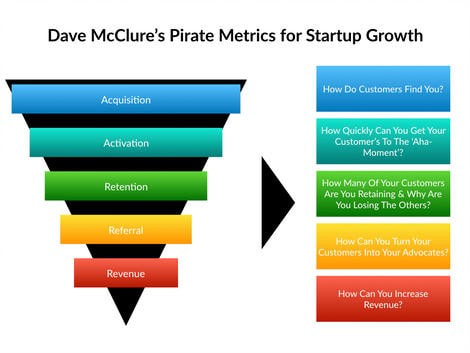 Source: AARRR Framework - Metrics That Let Your StartUp Sound Like A Pirate Ship
-
Acquisition: Where are your users coming from? Understand the customer's journey, optimize it, and then find the marketing channel of largest-volume (#), lowest-cost ($), and best-performing (%). A single channel is enough, as Peter Thiel said:
It is very likely that one channel is optimal. Most businesses actually get zero distribution channels to work. Poor distribution, not product, is the number one cause of failure. If you can get even a single distribution channel to work, you have great business. If you try for several but don't nail one, you're finished. So it's worth thinking really hard about finding the single best distribution channel.
-
Activation: How good is the user's first experience? Do lots of landing page tests and A/B tests. Guess and iterate quickly to figure out the "Aha Moment." Get your user to the aha moment and let them realize the real value in your product so they keep coming back. Famous examples:
- Facebook: 7 friends in 10 days
- Twitter: following 30 people
- Dropbox: upload at least 1 file
-
Retention: Do people regularly come back to use your product? Why are others leaving? Your most unhappy customers are your greatest source of learning.
- Acquisition Rate > Churn Rate = Growth
- Acquisition Rate < Churn Rate = Leaky Bucket
-
Referral: How can you turn your customers into your advocates? Only encourage users to refer after they have a "happy" user experience (8/10 score) or have a systematic process with incentives (e.g., Dropbox's referral program). Pay attention to your Viral Coefficient: the number of users a customer refers to you.
-
Revenue: How can you monetize and increase revenue? Increase Customer Lifetime Value (CLV) and decrease Customer Acquisition Cost (CAC). A healthy ratio is CLV:CAC = 3:1.
The AARRR framework is a strong starting point for organizing your growth thinking. However, it has a significant limitation: it presents growth as a linear funnel rather than a compounding system. That is where growth loops come in.
Growth Loops: The Compound Engine
Growth Loops are the New Funnels by Andrew Chen, Kevin Kwok, Casey Winters, and Brian Balfour
The AARRR metrics framework is a good starting point but misses the larger picture of the loop itself. "How does your product grow?" is simply the most important question to be able to answer. Focus on how the output of one cycle leverages the next cycle to get more output (compound effect), not short-term bumps.
 Source: Growth Loops are the New Funnels, Reforge
- (Input) New User: A new or returning user is created by reinvesting the output of the loop. (e.g., in the case of Pinterest, sign up or returns)
- Action/Step: A series of actions that generate the output. (e.g., save content, repin, etc., which creates quality signals for search engines)
- Output: The steps produce output that can be directly reinvested in the input. (e.g., find content via search engines, sign up or return)
Why Growth Loops Matter:
- Sustainable Compounding Growth: The fastest-growing products are powered by 1-2 major loops that evolve over time. Measuring and understanding the health of your loops is critical to knowing where to focus.
- More Defensible: Loops combine how your product, channel, and monetization model work together in a single system, making it hard for others to replicate.
Think of growth loops as the engine that makes each of the AARRR stages work together rather than in isolation. The best growth teams optimize the loop as a whole, not individual stages.
The Hook Model: Building Habit-Forming Products
The Hook Model: How to Manufacture Desire in 4 Steps by Nir Eyal
The Hook Model is a 4-step process for building habit-forming products: Trigger, Action, Reward, and Investment. As the user goes through these phases, they build habits in the process. (See also Nir Eyal's slideshare and his book Hooked: How to Build Habit-Forming Products.)
The first-to-mind solution wins. Frequency and attitude change matter.
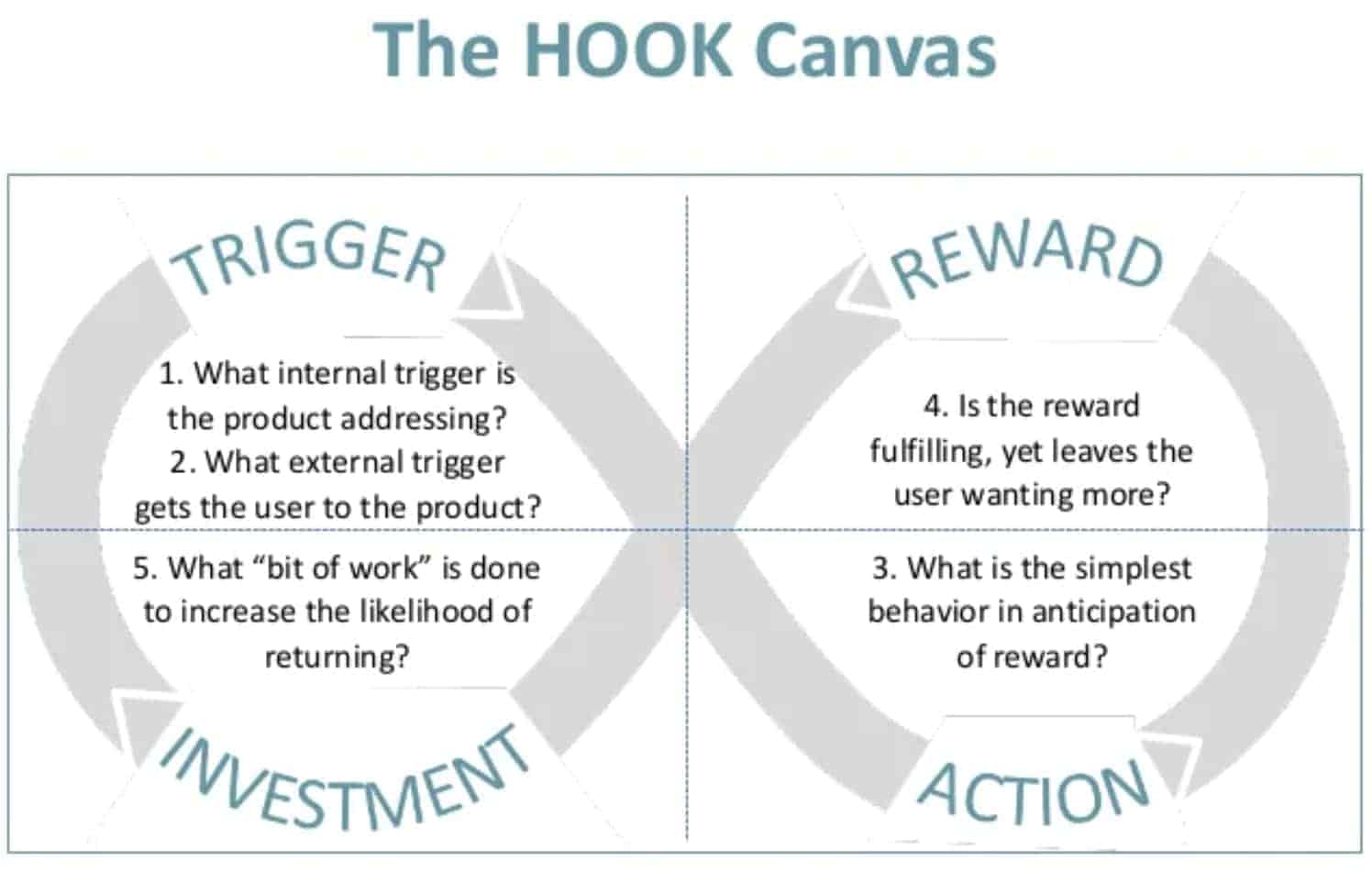 Source: The Hook Model: How to Manufacture Desire in 4 Steps
-
Trigger: Starts with external triggers, then shifts to internal triggers.
- External: What gets the user to the product? The information for what to do next is within the trigger (e.g., email, ads, notification).
- Internal: The information for what to do next is informed through an association in the user's memory (e.g., emotions, routines, situations). Negative emotions are powerful triggers (e.g., lonely, bored, inferior).
-
Action: What is the simplest action in anticipation of reward (e.g., scroll, search, play)? Behavior = Motivation + Ability + Trigger.
- 6 Factors in Motivation: seeking pleasure, avoiding pain, seeking hope, avoiding fear, seeking acceptance, avoiding rejection.
- 6 Factors in Ability: time, money, physical effort, brain cycles, social deviance, non-routine.
-
Variable Reward: Is the reward fulfilling, yet leaves the user wanting more? The unknown is fascinating and increases behavior.
- Social Rewards: empathetic joy, partnership, competition, recognition, and cooperation.
- Resources: materials, information, inspirations.
- Self-achievement: mastery, competency, completion.
-
Investment: What bit of work increases the likelihood of the user returning?
- Load the Next Trigger: message, comment, follow, save.
- Store Value: content, data, followers, reputations. We value things more when we put work into them. We seek to be consistent with past behaviors.
The Hook Model is complementary to growth loops. While growth loops describe how users flow into and through your product, the Hook Model explains why individual users come back. A product with strong hooks has better retention, which strengthens every growth loop it touches.
Acquisition and Activation
Now you have the big picture of how growth works. Next is to optimize each stage. After you set a goal as a team, you should identify which channels to leverage based on your existing users. But acquiring users to your platform is meaningless if users don't see value in your product. Both distribution and conversion matter.
Identifying Your Growth Channel
How to Set Up, Hire and Scale a Growth Strategy and Team by Anu Hariharan
Most products find 1-2 relevant channels early on that really work for them. 70% of experts say that referrals were the top channel within the first year. Identify the growth channel that works for your startup based on existing user behavior. Ask two key questions:
- How do customers find solutions or solve this issue today?
- How do your best users use your product today? Can you do something to get more such users to discover the product quickly?
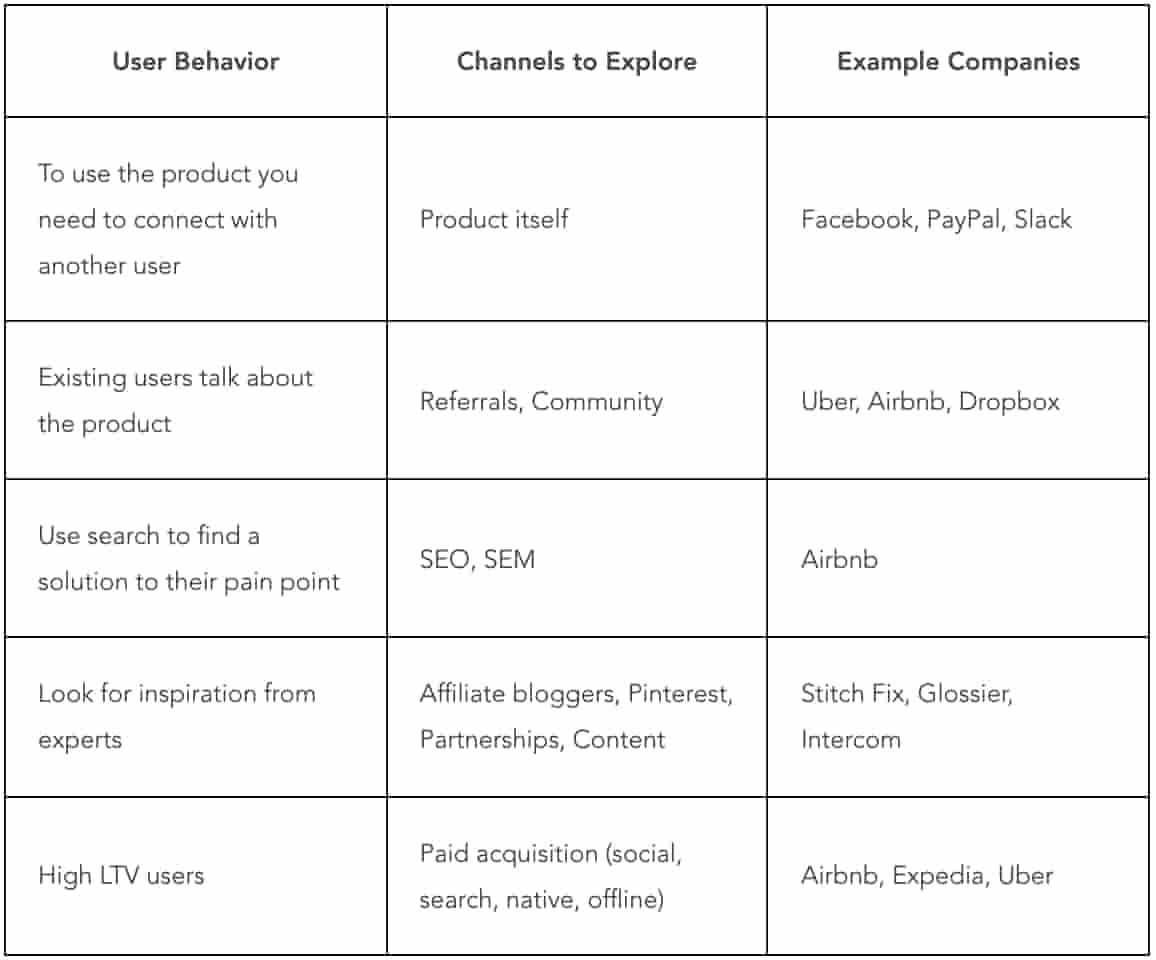 Source: How to Set Up, Hire and Scale a Growth Strategy and Team
Succeeding at Unpaid Channels
The Growth Marketing Handbook by Julian Shapiro
This handbook digs into the growth channel mixture you should use based on your business type:
- Product-led growth: Does your product grow virally from users inviting other users? This is one of the healthiest and fastest ways to grow. (e.g., Dropbox, Slack, Zoom, PayPal)
- Content and SEO: Are people already googling your topic? Then SEO is potentially viable. Build distribution pipelines around your content beyond Google (e.g., webinars, newsletters).
- Word-of-mouth and referrals: Build an amazing product with low friction and good referral programs.
- Sales: Will you have significant profit margins (typically $1,000+)? Then attract sales leads through ads, content, warm intros, and conferences.
Channel Mixture by Business Type:
| Business Type | Primary Channels |
|---|---|
| B2C ecommerce | Instagram/FB Ads, organic social, influencers, sponsorships |
| B2C mobile app | Instagram/FB Ads, Apple Search |
| B2C SaaS app | FB Ads, Content, product-led growth, Google Ads |
| Brick and mortar | Instagram/FB Ads, Yelp Ads, PR |
Content-Driven Growth
Content-driven Growth by Lenny Rachitsky
The landscape of content-driven growth divides along two axes: SEO vs. virality, and user-generated content (UGC) vs. editorially-generated content.
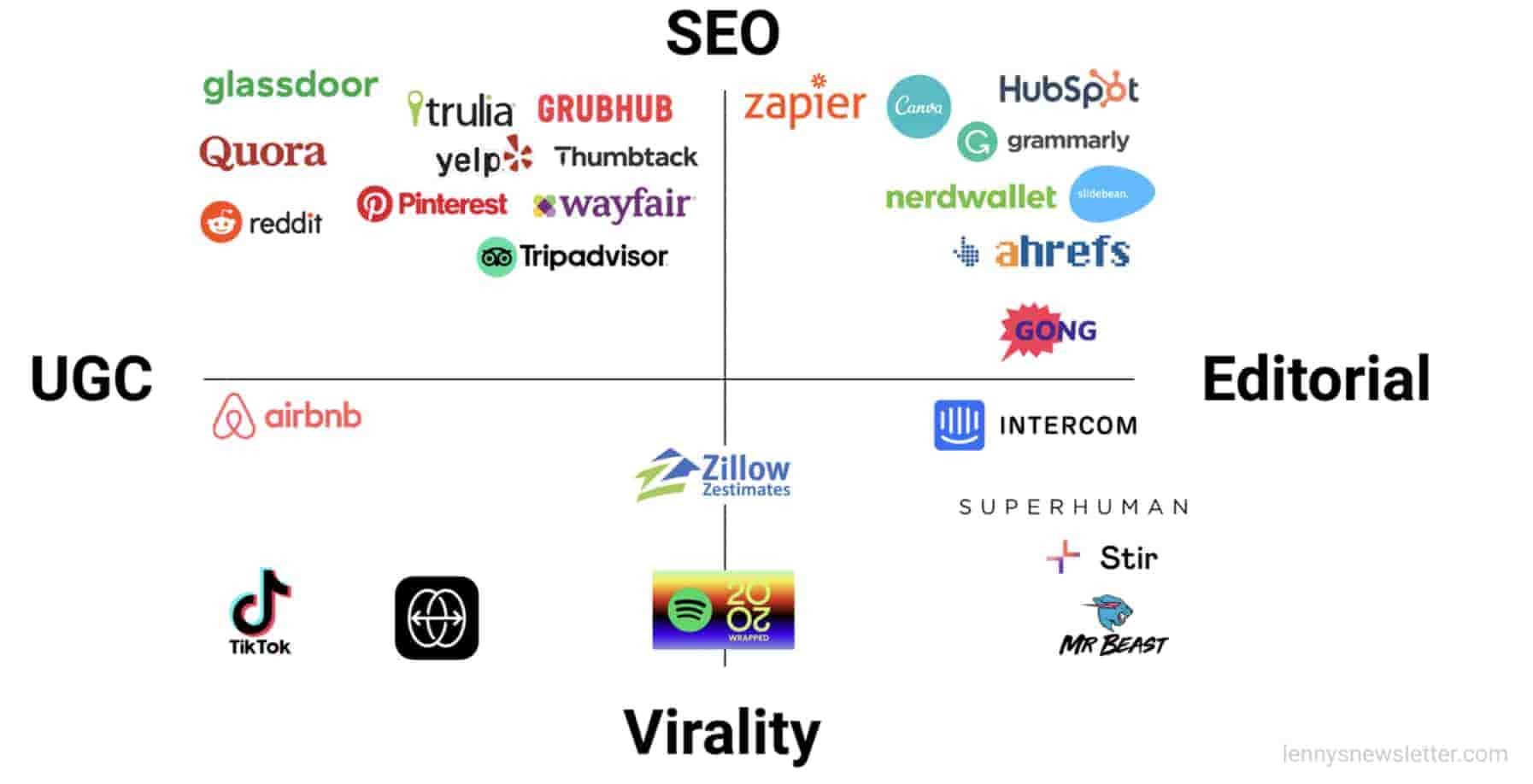 Source: Content-driven Growth
5 Content-Driven Growth Strategies:
- UGC x SEO: Leverage user-generated content to be surfaced in organic search (e.g., Quora, Glassdoor, Reddit).
- Editorial x SEO: Focus on keywords and create content to rank higher (e.g., HubSpot, Ahrefs, Slidebean).
- UGC + Editorial x SEO: Combine both (e.g., Thumbtack, Zapier, Yelp, TripAdvisor).
- UGC x Virality: Motivate users to share what they create with their friends (e.g., TikTok, Airbnb listings).
- Editorial x Virality: Create one-off viral content that spreads through word-of-mouth (e.g., Mr. Beast, Superhuman).
High-level Takeaways:
- Start Small: Play around with platform, topic, and style until you find something that works.
- Align on a Clear Goal: Is it to drive SEO, drive virality, or build your brand?
- Hunt for Opportunity: Figure out topics that are underserved and create content to satisfy them.
- Give the Reins to Passionate Ones: Let a passionate person, whether founder or employee, produce content.
- Think Long-term and Be Patient: Content marketing takes years to see significant payoff.
Distribution and Conversion for Consumer Startups
Investor Field Notes: Distribution and Conversion Models for Consumer Startups by Talia Goldberg and Alexandra Sukin
Success or failure for internet businesses depends on Distribution and Conversion.
Distribution alone is not enough. Distribution without conversion is like being eight feet-tall on the basketball court but missing every layup. [...] Startup founders often fetishize monetization, when really, the focus should be conversion.
9 Distribution Tactics:
- Virality via social proof: We trust groups of people and friends. Linktree leveraged the public pages of celebrities as social proof.
- The Etsy Effect: When a seller promotes their own content from a marketplace, it brings new consumers to the entire marketplace.
- Influencers enable disintermediation: Tap into audiences of influencers. Experiment with newer, less crowded platforms.
- New platforms: New platforms = new opportunities. Leverage mega platform shifts (e.g., AI, blockchain) and breakout social platforms.
- Group purchasing: Users share deals with networks for discounts (e.g., Pinduoduo).
- Niche markets unlock massive markets: Build for underserved communities first (e.g., Amazon started with books).
- Standing on the shoulders of giants: Benefit from codependent relationships with larger platforms.
- First-order irrational, second-order rational: Do something that seems irrational but creates an exceptional business model (e.g., Robinhood's free trading).
- FOMO and the velvet rope: Leverage scarcity and invite systems (e.g., Clubhouse, early Pinterest).
7 Conversion Tactics:
- A/B testing: Split audiences between current and updated versions.
- Auctions: Leverage competitive desire for scarce goods.
- Entertainment as conversion: Capture attention through entertaining content.
- Community-driven conversion: Engaged communities drive high conversion (e.g., Peloton).
- Gamification: Points, badges, leaderboards, and meaningful stories (e.g., Duolingo streaks).
- Gambling psychology: The unknown is fascinating (e.g., Twitter's feed refresh, Tinder's swipe).
- Scarcity: Artificially engineer scarcity to create demand (e.g., limited product drops).
Referral and Virality
Once you figure out the growth channel and user activation process, you should let users advocate your product and invite their friends. Referral and virality cannot happen if you do not understand the psychology behind why people share. Humans are status-seeking creatures: we want to be valued, appreciated, trusted, respected, and understood. You need to show the benefits of sharing your product and reduce the friction to do so.
Why People Share: The Psychology Behind "Going Viral"
Why People Share: The Psychology Behind "Going Viral" by James Currier
The foundation of viral growth is rooted in motivational psychology and language. Virality is not the same as network effects, but thinking through how to make your product viral helps give it network effects.
Baseline Viral Thinking:
- Pack Animal Psychology: As a pack animal, we are constantly thinking about our status, how we are perceived, where we fit in.
- Reduce the Friction to Sharing: Minimize the effort and thinking required to share.
- Make a Product Broken unless People Share: If a user cannot get the utility they want alone, they will look for ways to share.
- Make Language about the User, Not You: Transcend your own self-interest in favor of your users' self-interest.
What People Consider Before Sharing (Benefit vs. Cost):
- How might sharing this benefit me (the sharer) or you (the recipient) via utility or via status/reputation?
- How much time and effort (friction) will I have to spend to share this?
8 Clusters of Motivation That Trigger Sharing:
- Status: Access to something scarce or exclusive motivates people to share because they gain status from it.
- Identity Projection: People want to show who they are and seek validation. We share to signal that we belong or to find our tribe.
- Being Helpful: We share useful things to be perceived as helpful and nurturing. Clear, pithy, compelling language will 10x word of mouth.
- Safety: Perceived threats to safety are powerful sharing triggers (e.g., Nextdoor, Citizen).
- Order: People share to bring others into the same organizational system.
- Novelty: We are attracted to things that are new enough to not be stale, but not too new to be strange.
- Validation: People share to be validated and boost their self-esteem.
- Voyeurism: Vicarious enjoyment and schadenfreude drive sharing. People share to let others live through them.
Understanding these motivations is not just academic. Each one suggests specific product design choices. For example, if your product helps people project identity (like Glasp does with reading highlights), make that projection easy and beautiful to share.
The Mechanics of Viral Growth
Lessons Learned: Viral Marketing by David Skok
Two key parameters drive viral growth:
The Viral Coefficient (K) is the number of new customers that each existing customer successfully converts. K = (number of invitations) x (conversion rate %). The Viral Coefficient must be greater than 1 for true viral growth. Below 1, growth will plateau.
The Viral Cycle Time (ct) is the time it takes for the invitation-to-invitation cycle to complete. Shorter is dramatically better. Customer growth is exponentially affected by a shorter cycle time. Understand the user flow and reduce friction to share.
The most viral products are those that only work if they are shared. Ask yourself: does your product work better when people share it?
The Five Types of Virality
The Five Types of Virality by Josh Elman
The goal of all viral efforts is to insert an idea of what a product can do into someone else's head and get them excited enough to try it.
- Word-of-mouth virality: A product so good that people cannot help telling their friends. Make sure your product is easy to find later. Is the name easy to remember and spell? Is it easy to describe?
- Incentivized word-of-mouth virality: Word-of-mouth with an added incentive for referrals (e.g., Dropbox storage, Uber refer bonus).
- Demonstration virality: The product is simple and cool enough that people show it off (e.g., Instagram, Pinterest).
- Infectious virality: People invite others because it makes the product better for both of them (e.g., Snapchat, Nextdoor).
- Outbreak virality: People spread something because it is fun, popular, or cool (e.g., Pokemon Go).
If your product is about creating content or having experiences that are easy to show off, focus on demonstration virality. If your product costs money and has value, focus on incentivized word of mouth.
60 Ideas to Boost Your Growth
60 Ideas to Boost Your Growth by Lenny Rachitsky and Ali Abouelatta
To get people's attention, you need to do something special. Something remarkable. Seven types of strategies to boost your business:
- Viral Video: A video that tells your story, demos your product, or delights people so much they share it.
- Mini-product (aka "drop"): Launch a non-core product that gets attention and reflects it toward your brand (e.g., Calm's "do nothing for 2 minutes").
- Limited-time Offer: A promotion giving people a reason to act now.
- Influencers: Partner with influencers to promote your product (e.g., Reddit and Paul Graham, Spanx and Oprah).
- Co-marketing: Collaborate with another company (e.g., Red Bull x GoPro).
- Offline Experience: In-person experiences that fire people up about your product.
- Picking a Fight: Take a stand against a competitor, creating controversy and attention (e.g., Hey vs. Apple).
Retention and Engagement
Everything ultimately comes back to retention. Even if people are arriving at your platform and inviting friends, without real value it is a leaky bucket. To increase user retention, your product needs to be sticky. To be sticky, users should be engaging with your product. Focus on the user's core action and the virtuous loops of how that action moves the flywheel forward. What a user does should increase not only their own value but also the value for other users.
The Hierarchy of Engagement
Hierarchy of Engagement, Expanded by Sarah Tavel
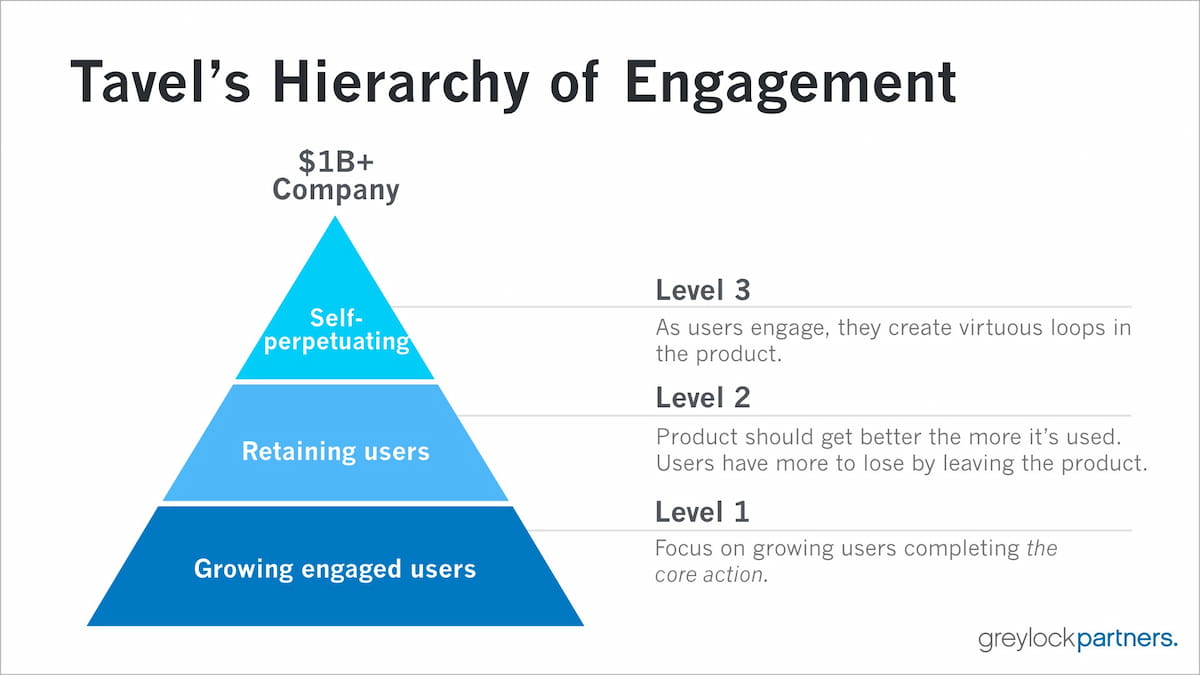
How do you maximize your chances of building an enduring billion-dollar company? It comes down to maximizing engagement.
 Source: Hierarchy of Engagement, Expanded
Level 1 - Growing Engaged Users: Focus on growing users who complete the core action, the action that forms the foundation of your product and correlates with retention (e.g., Facebook: friending, Pinterest: pinning, Snapchat: snapping, YouTube: subscribing). Other features support the core action as a ladder of engagement.
Level 2 - Retaining Users: The product should get better the more it is used. Users have more to lose by leaving.
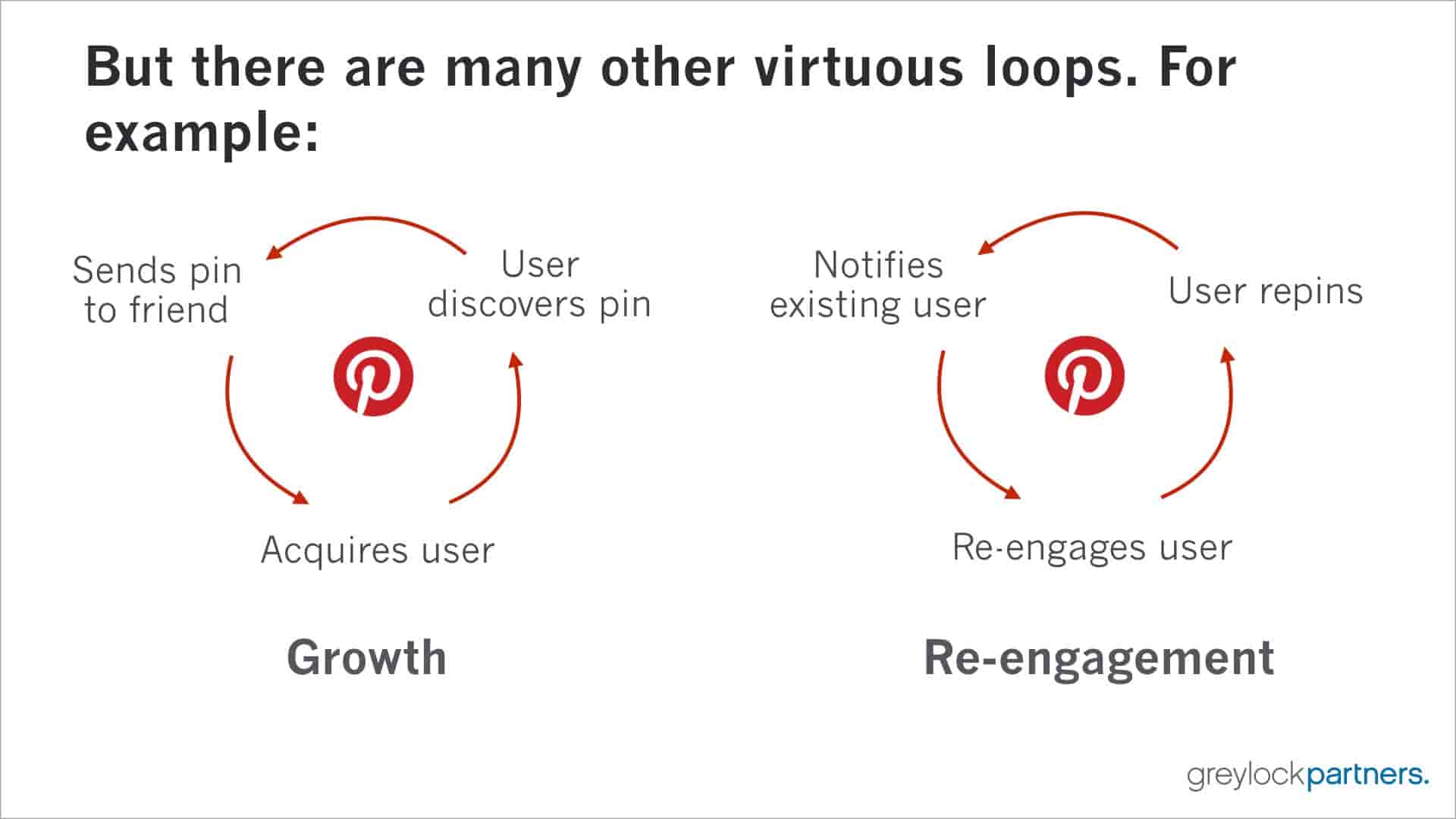
- Accruing Benefits: The more I use the product, the better it gets. (e.g., Pinterest: personalized feed and recommendations)
- Mounting Loss: The more I use the product, the more I would lose if I left. (e.g., Pinterest: bookmarks, followers, identity)
Level 3 - Self-perpetuating (Virtuous Loops): Create virtuous loops as users engage. These loops convert user engagement into fuel that powers your company forward. The strongest form is a network effect. (e.g., more users pin leads to richer interest graph leads to better discovery)
 Source: Hierarchy of Engagement, Expanded
The Ultimate Metrics:
- Cohorts show: Growth (size of each cohort), Engagement (ratio of users performing the core action), and Retention (cohort performance over time).
- Cohort Performance is the clearest way to see engagement: the number of weekly users completing the core action, and the percentage of weekly active users completing it.
The Chain from Engagement to Growth
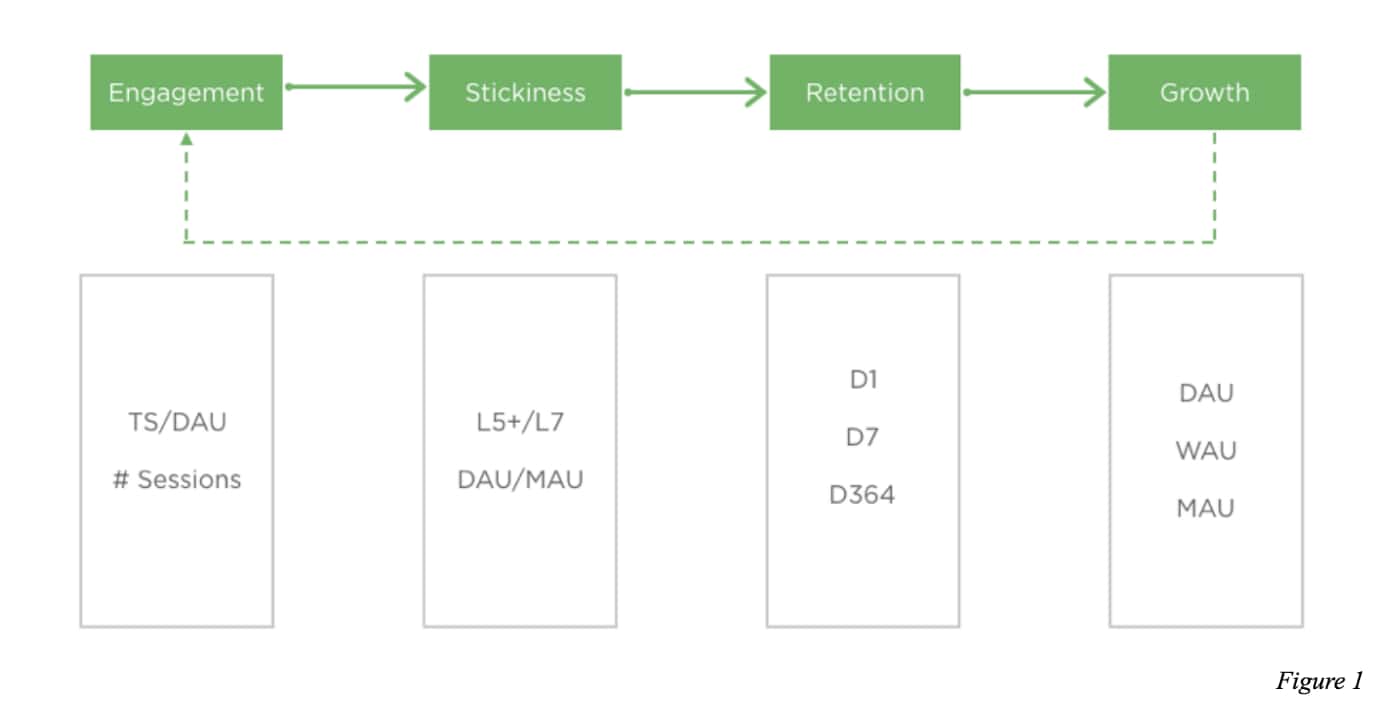
Engagement Drives Stickiness Drives Retention Drives Growth by Sequoia Capital
If a product truly adds value for you, you will engage with it more deeply. If it makes you happy, you visit it more frequently and become an active user.
Retention is simply about users returning to your product; stickiness is about them returning of their own volition. Stickiness helps reduce your dependency on tactics such as push notifications.
Fundamentally, if a user finds value in your product, they will return. The greatest growth lever is creating magical moments in which users recognize that value (the "Aha moment"). A great company focuses on sustainable growth through the chain of engagement, stickiness, and retention.
- Engagement Drives Stickiness: Not all daily active users are equal. Some engage a lot, some less. Measure "Lness," the number of days visited per week. The number of sessions can serve as an early predictor of stickiness.
- Stickiness Drives Retention: The more a user engages with a product, the more sticky it becomes, and the more likely they are to retain. Measure D1, D7, etc.
- Retention Drives Growth: A decrease in DAU is an early indicator of a decrease in WAU and MAU. The fate of the user and platform differs drastically based on engagement, stickiness, and retention.
 Source: Engagement Drives Stickiness Drives Retention Drives Growth
Gamification: The Octalysis Framework
Octalysis: Complete Gamification Framework by Yu-kai Chou
Gamification can attract new users and retain existing ones, but it should never replace your product's core value. At its best, gamification is human-focused design that optimizes feelings, motivations, and engagement.
 Source: Octalysis: Complete Gamification Framework
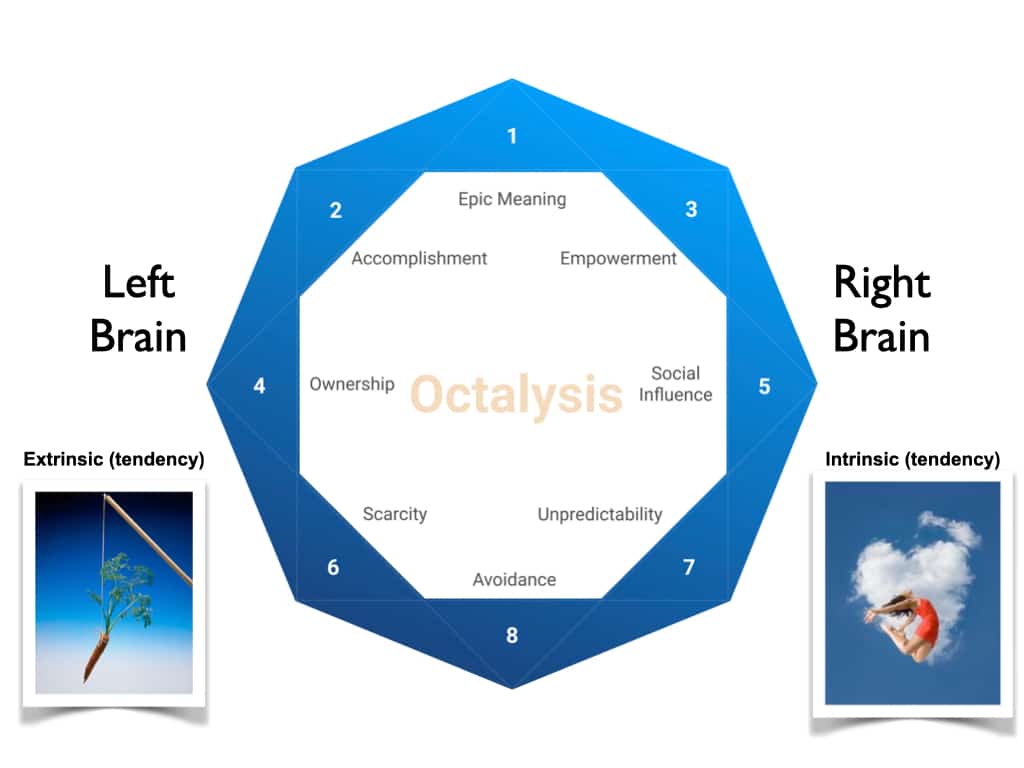
Octalysis: 8 Core Drives of Gamification:
- Epic Meaning and Calling: The user believes they are doing something greater than themselves (e.g., Wikipedia, open-source projects).
- Development and Accomplishment: The drive to make progress, develop skills, and overcome challenges. A badge without a challenge is not meaningful.
- Empowerment of Creativity and Feedback: People want to see results of their creativity and receive feedback. This can create Evergreen Mechanics that sustain engagement without new content.
- Ownership and Possession: When people feel ownership, they want to improve and expand what they own. The more effort we put in, the more ownership we feel.
- Social Influence and Relatedness: Mentorship, acceptance, social responses, competition, and envy. When your friend has something extraordinary, you are driven to reach the same level.
- Scarcity and Impatience: Not being able to get something right now motivates thinking about it all day (e.g., early Facebook, Clubhouse invite system).
- Unpredictability and Curiosity: The unknown is fascinating. This is the primary factor behind gambling addiction and is often misunderstood as the driver behind points and leaderboards.
- Loss and Avoidance: People want to avoid negative outcomes, such as losing previous work or missing an opportunity.
Left Brain vs. Right Brain Core Drives:
- Right Brain (Intrinsic): creativity, self-expression, social aspects. The activity itself is rewarding.
- Left Brain (Extrinsic): logic, calculations, ownership. The goal is to obtain something.
White Hat vs. Black Hat Gamification:
- White Hat: utilizes the top core drives (meaning, accomplishment, creativity). Feels empowering.
- Black Hat: utilizes the bottom core drives (scarcity, unpredictability, loss). Creates urgency but can feel manipulative.
The best products use a combination of both, but lead with White Hat gamification for long-term sustainable engagement.
Putting It All Together
Growth is not a department or a single hack. It is a system that connects mindset, frameworks, channels, virality, and retention into a reinforcing loop. Here is how these pieces fit together:
- Start with psychology. Develop the growth mindset. Embrace failure, move fast, and deeply understand your users.
- Map your growth loops. Use AARRR as a diagnostic checklist, but think in loops, not funnels. Identify the 1-2 loops that will power your growth.
- Build hooks into your product. Use the Hook Model to design for habit formation. The transition from external to internal triggers is what makes a product indispensable.
- Find your channel. Most products succeed with 1-2 channels. Identify yours based on how users already behave, not how you wish they would.
- Design for virality. Understand why people share and make sharing a natural extension of using your product.
- Obsess over retention. Engagement drives stickiness drives retention drives growth. Without retention, everything else is a leaky bucket.
Don't just read these frameworks. Apply them. Take notes. Highlight what resonates. Glasp makes it easy to highlight and revisit the best ideas from the resources linked throughout this handbook, so you can build on them over time.
Frequently Asked Questions
What is the difference between growth hacking and product growth?
Growth hacking refers to short-term, often scrappy tactics to acquire users quickly. Product growth is a broader discipline that encompasses the entire user lifecycle, from acquisition through retention, using systematic experimentation and data analysis. Modern growth teams focus on product growth because sustainable growth comes from making the product better, not from tricks.
Which growth framework should I start with?
Start with AARRR to understand where your biggest leaks are (most startups have a retention problem, not an acquisition problem). Then map your growth loops to understand how your product compounds. Use the Hook Model to design for habit formation at the individual user level.
How do I know if my product has product-market fit?
The clearest signal is retention. If users come back without being pushed (no aggressive push notifications or email campaigns needed), you have some degree of product-market fit. Sean Ellis' survey question, "How would you feel if you could no longer use this product?" with 40%+ answering "very disappointed," is another useful benchmark.
How long does it take to see results from growth efforts?
It depends on the channel. Paid acquisition can show results in days. SEO and content marketing typically take 3-6 months to gain traction. Viral loops depend on reaching a critical mass of users. The most important thing is to measure early and iterate fast rather than waiting for large results.
What is a good viral coefficient?
A viral coefficient (K) greater than 1 means each user brings in more than one additional user, leading to exponential growth. In practice, K values above 0.5 are considered strong, as they significantly reduce your customer acquisition cost even if they don't drive purely viral growth. Very few products sustain K > 1 for long periods.