What Are Network Effects?
A network effect exists when a product or service becomes more valuable as more people use it. The concept is straightforward in principle: a messaging app with one user is worthless, with ten friends it is useful, and with your entire social graph it becomes indispensable. But the mechanics behind this dynamic, and the strategies required to create and sustain it, are anything but simple.
The formal definition holds that a network effect is a phenomenon in which each additional user increases the value of the product for every existing user. This is fundamentally different from simple growth. A company can grow its user base without network effects. What makes network effects special is that growth itself becomes a product feature, creating a compounding advantage that competitors cannot easily replicate.
Consider the telephone as the canonical example. A single telephone is a paperweight. Two telephones connected create one possible conversation. But as each new phone joins the network, the number of possible connections grows exponentially. This principle extends far beyond hardware into every digital product that connects users, content, data, or transactions.
NFX, the venture firm that has studied network effects extensively, identifies 13 distinct types of network effects, ranked from strongest to weakest: Physical (landline telephones), Protocol (Ethernet), Personal Utility (iMessage, WhatsApp), Personal (Facebook), Market Network (HoneyBook, AngelList), Marketplace (eBay, Craigslist), Platform (Windows, iOS, Android), Asymptotic Marketplace (Uber, Lyft), Data (Waze, Yelp), Tech Performance (BitTorrent, Skype), Language (Google, Xerox), Belief (currencies, religions), and Bandwagon (Slack, Apple).
Why Network Effects Matter
Network effects can explain roughly 70% of all value created by technology companies since 1994. Among the four forms of defensibility available to digital businesses (network effects, brand, embedding, and scale), network effects produce the strongest and most durable competitive moats.
The comparison between the most valuable companies in 2004 and those in the 2020s makes this visible. In 2004, only one of the top twelve most valuable companies had significant network effects. By the early 2020s, eight of the top twelve did, including Apple, Microsoft, Google, Amazon, Meta, and Tencent.
The value dynamics are driven by the relationship between cost and connections. Adding users to a network increases costs linearly, since each user requires some amount of infrastructure, support, and acquisition spending. But the value of the network grows at a rate proportional to the square of connections (under Metcalfe's Law) or even faster (under Reed's Law). This gap between linear costs and exponential value creation is what makes network-effects businesses so powerful once they reach scale.
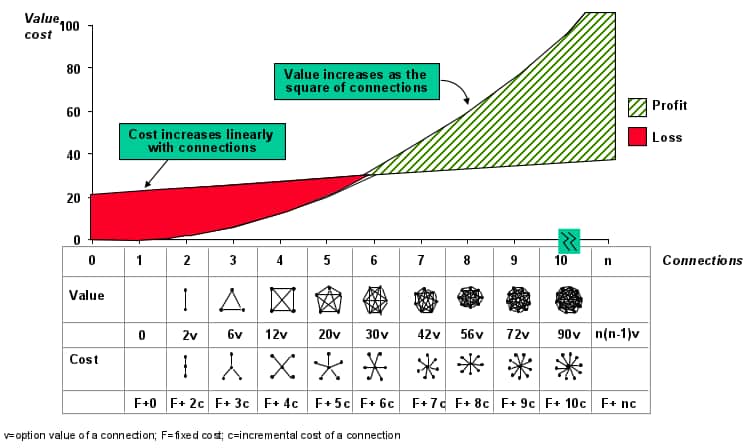
The value curve illustrates how each additional user creates disproportionate value for the network while costs scale linearly. This relationship, based on Metcalfe's Law, explains why network-effects businesses become increasingly profitable at scale.
Traditional moats like brand recognition, supply-side economies of scale, intellectual property, and regulatory capture still exist. But in the digital economy, these defenses are increasingly under pressure. Brands can be built quickly through social media. Scale advantages can be replicated by cloud infrastructure. Patents expire or get designed around. Network effects, by contrast, are self-reinforcing: the larger the network, the harder it is to leave, and the harder it is for competitors to replicate.
Network Laws: Sarnoff, Metcalfe, and Reed
Three mathematical models describe how network value scales with size. Each applies to different network architectures and offers different predictions.
Sarnoff's Law
Sarnoff's Law states that the value of a network grows in direct proportion to the number of users (proportional to N). This model accurately describes broadcast networks where a small number of core nodes transmit to a large number of passive receivers. Think of a television network: each additional viewer adds value roughly equal to the value of any other viewer. There is no interaction between viewers, so the network's value scales linearly.
While useful for understanding media companies and one-directional information flows, Sarnoff's Law substantially underestimates the value of interactive networks. It served as a starting point but was quickly superseded by more sophisticated models.
Metcalfe's Law
Metcalfe's Law is the most widely cited network law. It states that the value of a communications network grows in proportion to the square of the number of users (N squared). The logic is that each node can potentially connect with every other node, so the total number of possible connections is N times (N minus 1) divided by 2, which grows approximately as N squared.
Robert Metcalfe originally formulated this to describe Ethernet networks. When he founded 3Com and convinced DEC, Intel, and Xerox to adopt Ethernet as a standard protocol, the value of the network compounded as adoption grew. Each new Ethernet-compatible device made the standard more attractive, crowding out competing proprietary protocols regardless of their technical merits.
The well-known critique of Metcalfe's Law is that it assigns equal value to all connections. In reality, your connection to your closest friend is vastly more valuable than your theoretical connection to a stranger on the other side of the network. The affinity between participants and the quality of interactions matter enormously. Despite this limitation, Metcalfe's Law remains the most practical framework for estimating network value at scale.
Reed's Law
Reed's Law extends the analysis to group-forming networks, where users can create subgroups. Reed proposed that in such networks, value grows at a rate of 2 to the power of N, because the number of possible subgroups within a network of N members is 2 to the N (each member can either be in or out of any given group).
This model applies to networks that support community formation: messaging groups, forums, interest-based communities, and collaborative platforms. Since most internet networks naturally support group formation, Reed argued they would grow in value significantly faster than either Sarnoff's or Metcalfe's formulas predicted.
In practice, Reed's Law serves more as an upper bound than a precise prediction. Not all possible subgroups actually form, and not all groups create meaningful value. But the insight is important: networks that enable group formation possess a structural advantage over those that only support one-to-one connections.
Properties of Networks
Before examining the types of network effects, it is essential to understand the structural properties that determine how networks behave.
Nodes and Links
Networks consist of nodes (individual participants) and links (connections between them). Nodes can be buyers, sellers, consumers, devices, or any other type of participant. Within a single network, different types of nodes can play very different roles.
Not all nodes are equal. A central node with many connections is far more valuable than a marginal node with few links. Furthermore, the value of any node is influenced by the strength and importance of the nodes it connects to. A marginal node connected to a few highly influential nodes can be more valuable than a central node connected to many low-value participants.
Links, similarly, vary in strength, directionality, and activity level. The endurance, closeness, and frequency of interaction between two nodes all determine link strength. Understanding this heterogeneity is critical for product decisions about which connections to prioritize and which user segments to cultivate.
Network Density
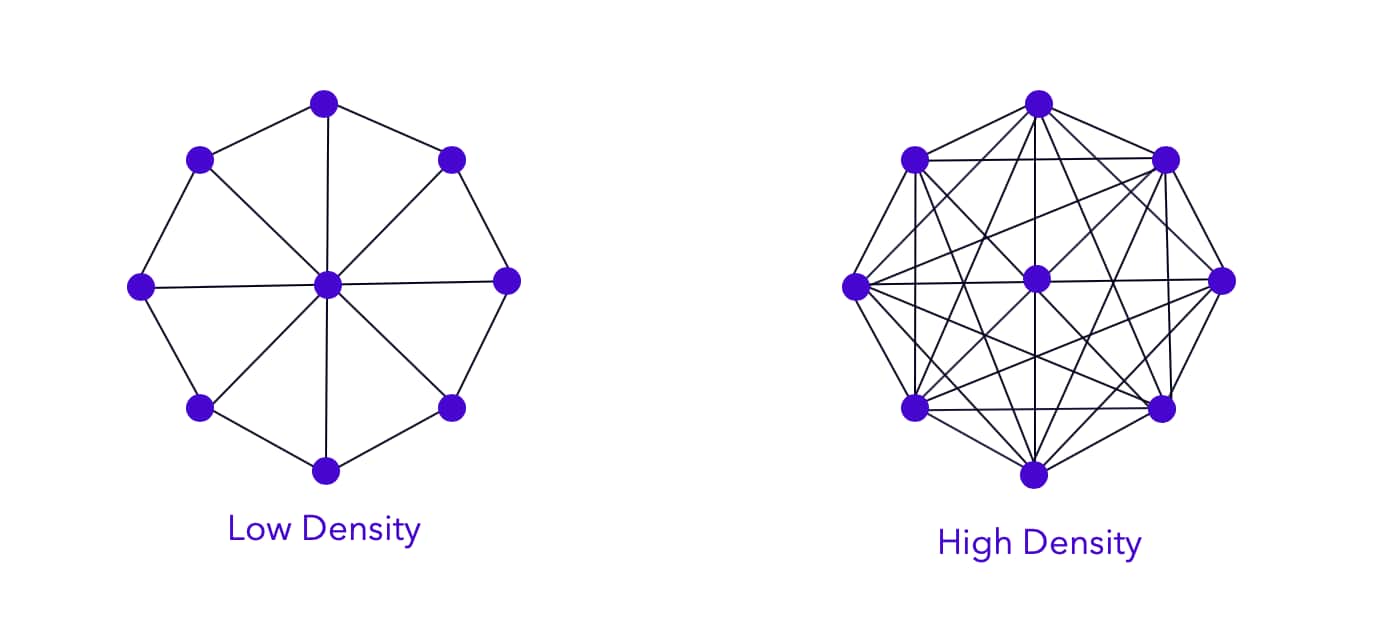
Network density, the ratio of actual connections to possible connections, directly determines the strength of network effects. Denser networks create stronger reinforcement loops.
The density of a network is the ratio of existing connections to the total number of possible connections. Higher density generally means stronger network effects, because the interconnectivity between links reinforces and amplifies the value of each connection.
Density is almost never distributed evenly across a network. Certain regions will have significantly higher activity and interconnection than others. The most strategically important concept here is the "white-hot center," the densest, highest-activity cluster within your network. Smart product teams identify this center and build features that amplify it, because activity radiates outward from dense clusters far more effectively than from sparse ones.
Directionality
Links between nodes can be directed (unidirectional) or undirected (bidirectional). This distinction shapes the nature of the network and its effects.
Twitter is the classic directed network. Information flows primarily in one direction, from accounts with large followings to their audiences. The relationship is asymmetric: a celebrity with millions of followers does not follow most of them back.
WhatsApp and Facebook Messenger, by contrast, are undirected networks. Every conversation is reciprocal. The flow of information moves in both directions between connected nodes. Undirected networks tend to produce stronger network effects because the mutual engagement creates deeper switching costs.
One-to-One vs. One-to-Many
Node relationships can be one-to-one or one-to-many. One-to-many connections are typically directed with unidirectional information flow (a broadcaster to an audience). One-to-one connections tend to be reciprocal and interactive, creating deeper engagement and stronger lock-in.
Most successful networks contain a mix of both relationship types. Instagram, for example, supports both one-to-many broadcasting (posting to followers) and one-to-one direct messaging.
Clustering
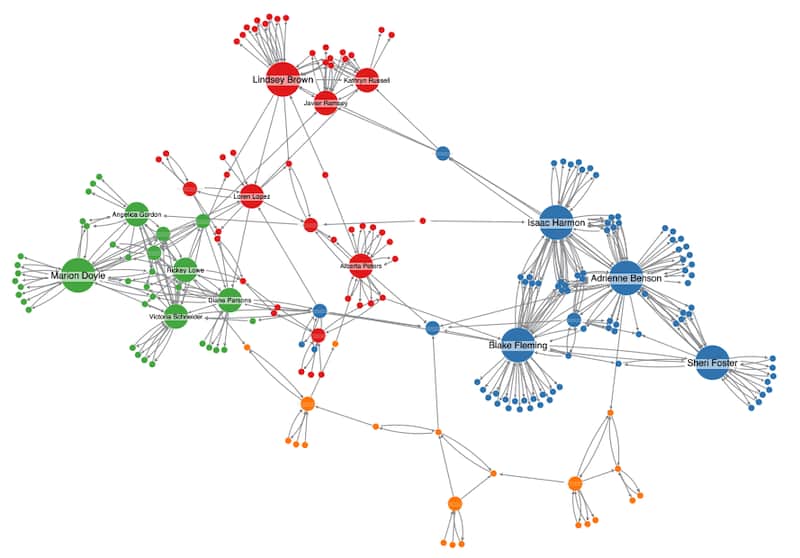
In real networks, nodes rarely distribute evenly. They form clusters, tightly knit local groups with higher internal density than the broader network.
In practice, nodes are rarely dispersed evenly. They tend to form clusters: subgroups with denser internal connections than the network as a whole. When two clusters connect through a single link with no other connections between them, that link is called a bridge.
Clustering is visible in messaging platforms like Facebook Messenger, where people form active subgroups (family chats, work teams, friend groups) that are more engaged than the broader network. Networks with high clustering coefficients can produce very powerful network effects because value compounds within clusters before spreading to the network at large.
Critical Mass
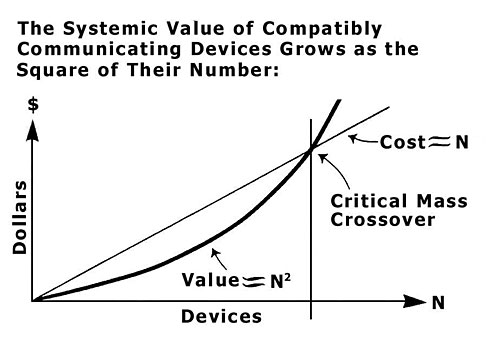
Critical mass is the point where the value generated by the network exceeds both the standalone product value and the value of competing alternatives. Before this point, the network is vulnerable. After it, the network becomes self-sustaining.
Critical mass is the point at which the value produced by the network exceeds the value of the product itself and of all competing products. It is the tipping point where the network becomes self-sustaining, where growth feeds on itself rather than requiring external push.
Different types of networks reach critical mass at different scales. A physical direct network like the telephone can reach critical mass with just two users, because even a two-person phone network provides more value than having no phone at all. A marketplace like eBay requires thousands of buyers and sellers before the matching dynamics generate enough value to be self-sustaining.
Before reaching critical mass, products with network effects are extremely vulnerable. The value they provide to early users may be minimal, creating a bootstrapping problem: how do you convince the first users to join a network that has no network? This is the central challenge addressed in the bootstrapping section below.
Asymmetry
In multi-sided networks, particularly marketplaces, asymmetry describes the unequal difficulty of acquiring users on different sides. Some marketplaces are "demand-side," where attracting buyers is the hard part and sellers follow naturally once buyers are present. Others are "supply-side," where building the seller base is the bottleneck.
Uber exemplifies a supply-side marketplace: the majority of its paid acquisition spend goes toward recruiting drivers. OpenTable spent seven years painstakingly acquiring restaurants one by one before it had enough supply-side density to attract meaningful demand from diners.
A second form of asymmetry exists within each side. Not all supply is equal, and not all demand is equal. On any marketplace, certain nodes will be 1,000 times more valuable than others. Identifying and acquiring these high-value nodes early is often the difference between a network that reaches critical mass and one that stalls.
Asymptotic Network Effects
Not all network effects continue strengthening indefinitely. In asymptotic networks, the value gains from additional users begin to flatten after a certain scale. The classic example is ride-sharing: once a rider can reliably get a car within four minutes, adding more drivers provides diminishing value. The demand-side benefit asymptotes toward zero even as the supply side continues to grow.
Asymptotic network effects make a business more vulnerable to competition because the defensive moat stops deepening. This is why riders often use both Uber and Lyft simultaneously, choosing whichever offers the better price or shorter wait at any given moment.
Types of Network Effects
Direct Network Effects
Direct network effects occur when increased usage of a product directly increases its value for all users. Each new node adds connections to every existing node, so the total number of possible connections grows as N squared. The value of the network is proportional to its density, and density grows geometrically with each additional participant.
There are five subtypes of direct network effects:
Physical networks involve tangible nodes (telephones, cable boxes) connected by physical links (wires, cables). These are the most defensible because they combine network effects with scale effects and high switching costs. Competing against a physical network requires massive capital investment. Roads, railroads, broadband internet, and utilities all exhibit physical network effects. The fact that many physical network monopolies provide mediocre service while remaining dominant is the strongest evidence of their defensibility.
Protocol networks emerge when a communication or computational standard becomes widely adopted. Ethernet, Bitcoin, and TCP/IP are examples. Once a protocol gains critical mass, the volume of compatible products and services creates a compounding advantage that crowds out technically superior alternatives. VHS beat Betamax not because it was better technology, but because it won the protocol adoption battle through superior marketing and distribution strategy.
Personal utility networks connect users through their real identities for daily practical needs. iMessage and WhatsApp are examples. These networks are characterized by real identity attachment and integration into daily personal and professional life. Opting out creates real friction, making switching costs exceptionally high.
Personal networks link users through identity and reputation but are not strictly necessary for daily tasks. Facebook, Twitter, and LinkedIn fall into this category. Each new user is simultaneously a potential audience member and content provider. These networks are less sticky than personal utility networks because you can stop using them without significant disruption to your daily life.
Market networks combine the identity and communication features of personal networks with the transactional focus of marketplaces. HoneyBook and AngelList are examples. They typically digitize and improve existing offline networks of professionals, combining relationship management with deal-making infrastructure.
2-Sided Network Effects
Two-sided networks have distinct supply-side and demand-side user classes. Each side comes to the network for different reasons, but each adds value to the other. Academic literature often calls these "indirect network effects," but this label is misleading because two-sided networks can exhibit both direct and indirect effects simultaneously.
Marketplace network effects connect buyers and sellers. Successful marketplaces like Craigslist and eBay are notoriously difficult to displace because you must offer a better value proposition to both sides simultaneously. The network, not the application itself, provides the majority of the value, which is why platforms like eBay and Craigslist can go years without significant redesigns and still retain their user base.
Platform network effects connect developers (supply side) with users (demand side) through a central platform. Unlike marketplaces, the products created by the supply side exist exclusively within the platform ecosystem. Windows, iOS, and Android demonstrate platform effects: more developers attract more users, and more users attract more developers. Platforms are distinct from marketplaces in that the platform itself provides significant utility independent of the network.
Asymptotic marketplace effects represent the weakened form where value gains from additional supply flatten beyond a certain threshold. Uber is the canonical example. After wait times drop below four minutes, additional drivers provide negligible incremental value to riders. This makes asymptotic marketplaces more vulnerable to multi-tenanting and competitive entry.
Indirect Network Effects
Indirect network effects arise when one type of node benefits another type without directly benefiting nodes of its own type. In a marketplace like eBay, a new seller does not directly help existing sellers. In fact, an additional seller increases competition. But more sellers mean a larger product catalog, which attracts more buyers, which indirectly benefits all sellers through increased demand.
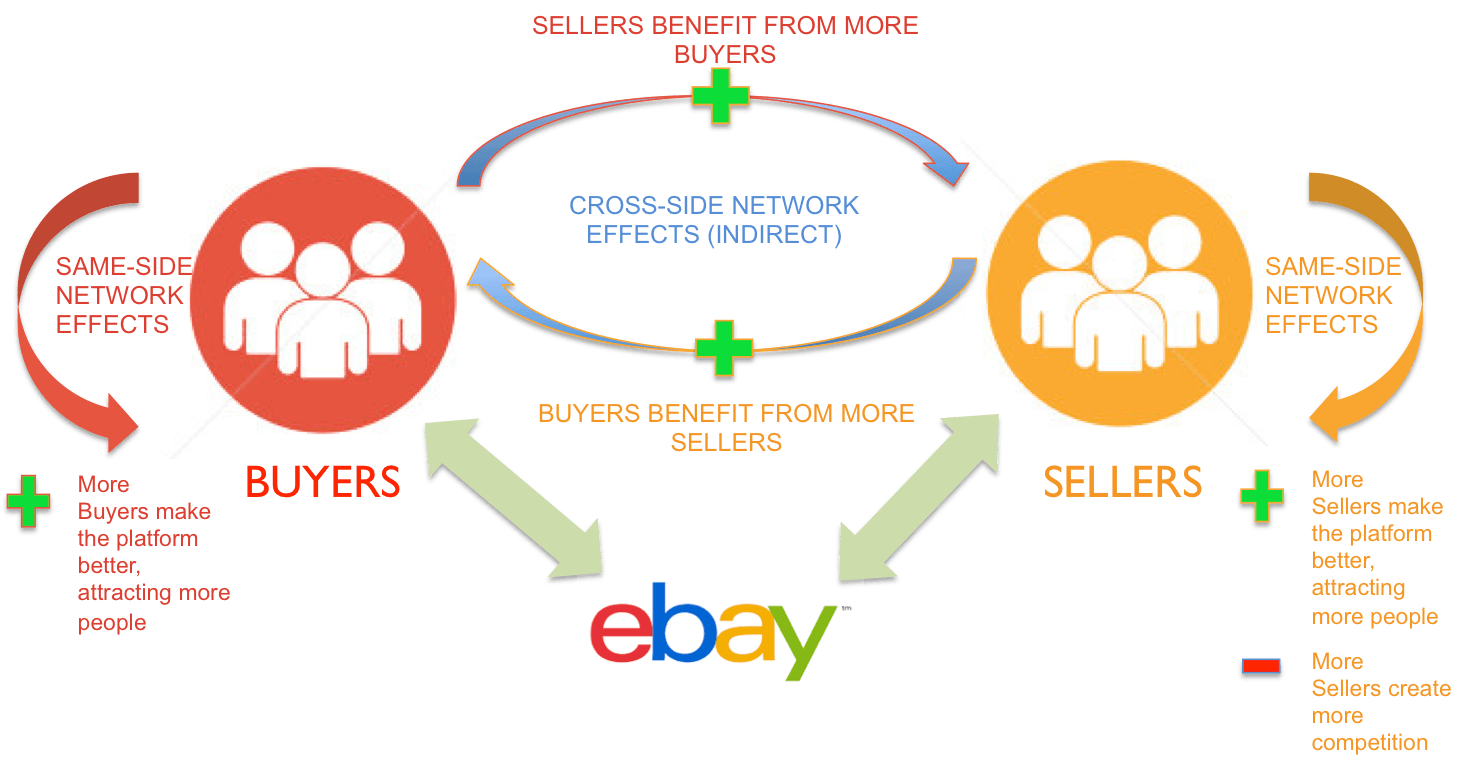
In two-sided networks, each side benefits the other indirectly. More sellers on eBay attract more buyers, which in turn makes selling on eBay more attractive, creating a reinforcing loop.
Operating systems illustrate the same dynamic. New Windows developers do not directly help other developers. But a larger library of Windows applications attracts more Windows users, expanding the potential customer base for all developers.
Data Network Effects
A data network effect exists when the value of a product improves as more data is collected through usage, and this improved product in turn attracts more users who generate more data. The key distinction from a simple scale effect is that more usage must produce more meaningful data that directly improves the product experience.
Waze is a strong example. Nearly every user contributes real-time traffic data, and because the data is consumed in real-time, it requires constant refreshment. The larger the network, the more accurate any individual road's data will be at any given moment. Waze's data network effects are less asymptotic than most because more data continues to improve accuracy almost indefinitely.
The critical test: if more usage does not produce more meaningful data, or if the data does not measurably improve the product, you have a scale effect, not a data network effect.
Tech Performance Network Effects
Tech performance network effects occur when the underlying technology improves as more users join. More devices or users make the product faster, cheaper, or easier to use. BitTorrent is the clearest example: each additional peer in a swarm makes downloads faster for everyone.
This is distinct from a technological advantage. A technological advantage is temporary because competitors can replicate or surpass it. A tech performance network effect is structural because the technology itself gets better with scale in a way that cannot be replicated without matching the network's size.
Social Network Effects
Social network effects operate through psychology and human social dynamics. They leverage the invisible networks of influence, identity, and belonging that connect people.
Language network effects emerge when a term, concept, or brand name becomes synonymous with a category. Throughout history, language has shown winner-take-most dynamics. Startups can leverage this in two ways: by creating and naming a new business category (Bitcoin becoming synonymous with cryptocurrency) or by making the company name a verb ("Google it," "grab an Uber").
Belief network effects operate in systems like gold, Bitcoin, and religions. When more people believe in something, others become more inclined to believe as well. There are significant social costs to not believing what your community believes, and even greater costs to abandoning a shared belief. The more believers a system has, the more valuable it becomes for each individual believer.
Bandwagon network effects occur when social pressure creates a feeling that joining is necessary to avoid being left out. Apple is a master of this dynamic, generating buzz and FOMO with each product launch. Google benefited from bandwagon effects in its early days when using Google carried a signal of being technically sophisticated.
Content Network Effects
Content network effects emerge when user-generated content becomes the primary source of value on a platform. YouTube's videos, Pinterest's pins, and Instagram's photos are all examples. Content platforms can reach the point of providing value to new users more quickly than connection-based networks, because a new user does not need to already know someone on the platform. They can immediately consume the existing library of content.
Content network effects also offer a solution to the chicken-and-egg problem. Instead of requiring users to build a social graph before getting value (the Facebook and Twitter early model), content-first platforms like Pinterest and Behance let users create and consume content immediately. The network effects emerge as the content library grows large enough to become the primary draw.
Hidden Network Effects
Some companies have network effects that are not immediately visible. These hidden networks are frequently undervalued in the short term but prove disproportionately powerful in the long term.
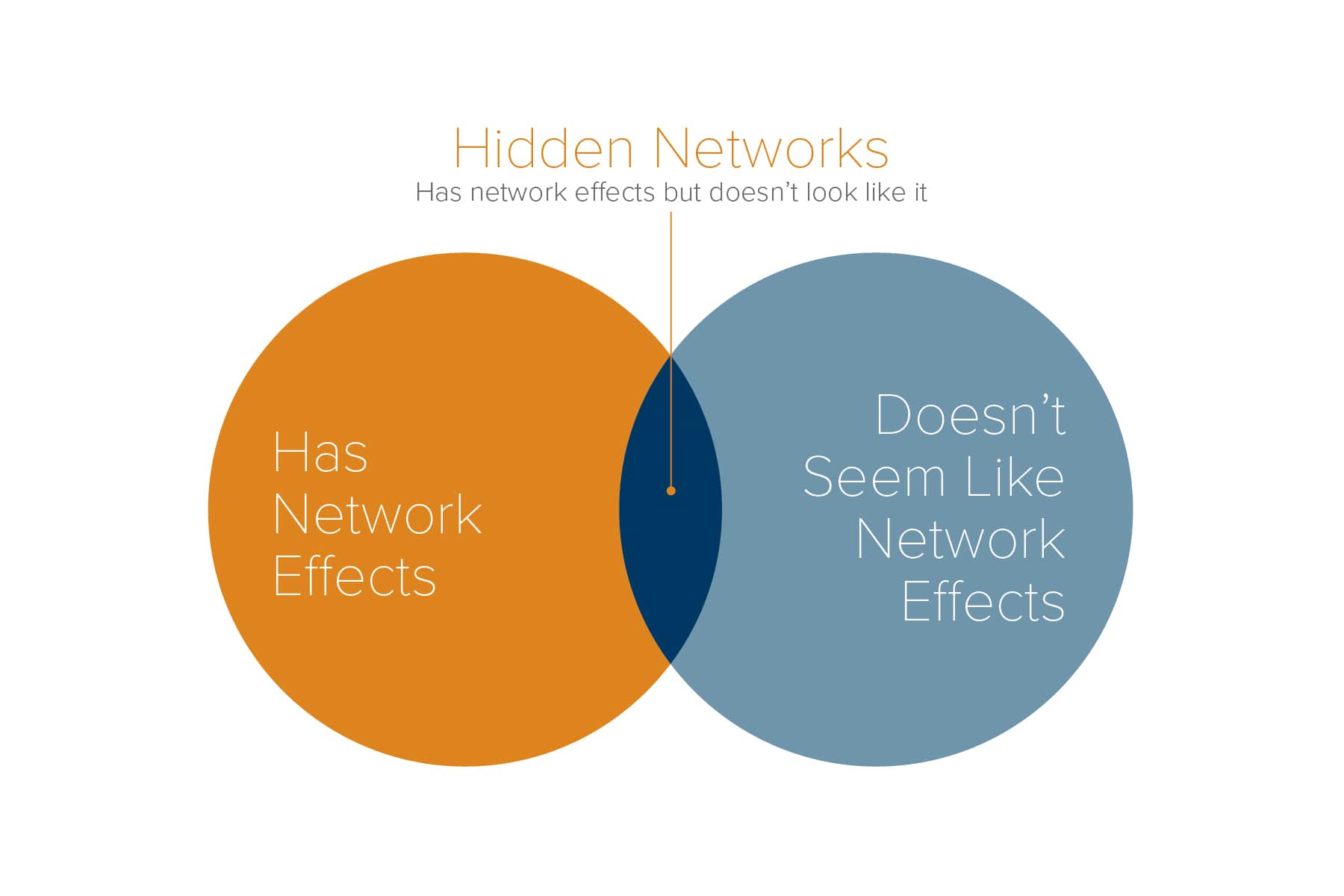
Hidden network effects come in four forms: slow networks, unfinished networks, throttled networks, and latent networks. Each disguises its network effects through a different mechanism.
Slow Networks
Slow networks have long product consumption cycles or infrequent usage cadences that delay the visibility of network effects. Even when the company is growing rapidly, it may take years for the network effects to manifest in measurable outcomes.
Coding bootcamps illustrate this pattern. The network effects are conceptually clear: more and better students should attract more employers seeking to hire graduates, and a growing alumni network should provide mentorship and job referrals for new graduates. But the value loops take years to complete because each student needs time to graduate, find a job, build a career, and then begin hiring from or mentoring newer cohorts. The network effects are real, but they operate on a timescale that makes them easy to overlook.
Unfinished Networks
An unfinished network is temporarily incomplete due to a product decision or strategic constraint, but once the missing piece is added, network effects become immediately apparent.
OpenTable followed this trajectory. In its early years, it looked like a SaaS company, charging restaurants $200 per month for online reservation management. The OpenTable widget was embedded on individual restaurant websites. It was only after OpenTable accumulated enough restaurant supply that it could invest in a consumer-facing product (its website and apps for diners to discover restaurants). Once the network was completed by connecting both sides, the flywheel began: more diners attracted more restaurants, which attracted more diners.
Throttled Networks
A throttled network deliberately limits the size or participation of its network, disguising the true strength of its network effects. Facebook is the most famous example. It initially required a Harvard email address to join, then expanded to other .edu addresses, and finally opened to the general public. The throttling was a strategic choice that built density and social proof within each expansion wave before opening to the next one.
Latent Networks
Latent networks begin with a community or audience and later add a product that activates network effects. The challenge is distinguishing between a genuine network (where members value their connections to each other) and a mere audience (where members value only their connection to a central figure).
This distinction matters enormously. A true network scales with network effects dynamics, while an audience scales linearly like a media or direct-to-consumer business. Many entrepreneurs have mistakenly believed they built a network of people who valued each other, only to discover they had built an audience that valued access to the central figure. When the product launches, the difference becomes starkly apparent.
How to Bootstrap a Network
The fundamental bootstrapping challenge is the chicken-and-egg problem: users will not join a network without other users, but you cannot have other users without the first users. Three primary strategies have emerged to solve this.
Come for the Tool, Stay for the Network
The most proven approach is to build a standalone utility tool that provides value to individual users without any network, then layer network functionality on top once you have a user base.
Instagram is the textbook example. It launched as a photo filter app at a time when mobile phone cameras produced mediocre images. Hipstamatic offered similar filters but charged for them and did not support sharing. Instagram made filters free and made it easy to share photos to Facebook and Twitter. Users came for the tool (filters). Over time, Instagram built its own social network, and users stayed for the network (the feed, followers, and engagement).
Content-first platforms represent a variation of this strategy. Instead of requiring users to build a social graph before finding value (Facebook's "add 7 friends in 10 days" approach), platforms like Pinterest and Behance let users create and browse content immediately. The network effects develop organically as the content library grows.
Token Incentives
Web3 introduced a new bootstrapping mechanism: using financial token rewards to compensate early users for the lack of network utility. The core idea is that during the bootstrapping phase, before network effects have kicked in, token rewards provide financial value that substitutes for the missing network value.
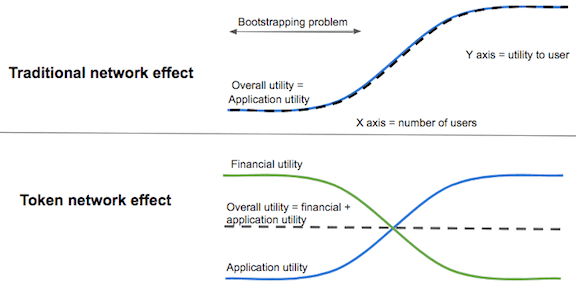
In the Web3 model, token incentives provide financial utility during the bootstrapping phase when network effects have not yet materialized. As the network grows and native utility increases, token incentives can decrease.
This model differs from the centralized Web2 approach because early contributors can own a piece of the network they helped build. The token value appreciates as the network grows, aligning incentives between the platform and its earliest, most valuable users.
Seeding and Constrained Launch
A third strategy involves artificially seeding the network or constraining the launch to build density before scaling. Reddit famously seeded its early community with fake accounts posting content to make the site appear active. Facebook's campus-by-campus expansion ensured that each new market had immediate density among a tightly connected social group.
The key principle across all bootstrapping strategies is the same: find a way to deliver value before network effects kick in, then ensure that the transition from standalone value to network value happens smoothly enough that users stay through the transition.
Measuring Network Effects
Believing your product has network effects and proving it are different things. Sixteen metrics across five categories can help you validate and quantify network effects.
Acquisition Metrics
Organic vs. paid users. If your product has genuine network effects, the proportion of organic users relative to paid users should increase over time. A growing network creates value that pulls people in without advertising spend.
Traffic sources. As network effects strengthen, more traffic should originate from within the network itself rather than from external sources. When users discover value internally (finding content on the platform rather than through external search), it signals that the network is becoming self-referencing.
Paid CAC trends. Customer acquisition costs should decrease over time as the network effects flywheel accelerates. In practice, this is influenced by many factors (market saturation, competitive spending, channel costs), but a persistently rising CAC in the presence of claimed network effects should raise questions.
Competitive Metrics
Multi-tenanting prevalence. How many of your users also use competing services? High multi-tenanting rates suggest weak switching costs and network effects that are not strong enough to command exclusivity.
Switching costs. How easy is it for users to join a competitor's network and immediately find value? Frictionless onboarding and immediate cold-start value at competitors promote multi-tenanting and eventual switching.
Engagement Metrics
User retention cohorts. Users who join later should retain better than earlier cohorts, because network effects mean later joiners enter a more valuable network. If newer cohorts retain at the same rate or worse, your network effects may not be strengthening.
Core action retention. Beyond simple login retention, are users performing the core value-creating action more frequently in newer cohorts? This is a more precise signal of network effect strength.
Dollar retention. For subscription products, newer cohorts should show higher revenue retention, reflecting their willingness to pay for a more valuable network.
Geographic retention. For products with local network effects, the oldest and most established markets should show the best retention, since those markets have had the longest time to build network density.
Power user curves. L7 and L30 charts show the distribution of user engagement frequency. In a product with strengthening network effects, users should shift rightward over time, indicating higher-frequency engagement as the network becomes more valuable.
Marketplace Metrics
Match rate. How successfully can the two sides of the marketplace find each other? The match rate reveals whether the network is creating the connections it promises. Low match rates, despite network size, suggest structural problems.
Market depth. Is there sufficient supply variety to meet diverse demand? Deep markets attract and retain users, but excessive supply without curation can create discovery problems that produce negative network effects.
Time to match. How long does it take for supply and demand to connect? Faster matching directly increases value for both sides.
Supply and demand fragmentation. Marketplaces with highly fragmented supply and demand (no single participant accounting for a disproportionate share) are more defensible and sustainable. Concentrated marketplaces risk losing significant volume if a major participant leaves.
Economic Metrics
Pricing power. Participants in a valuable network are willing to pay for access. If your users resist price increases, the network may not be providing enough incremental value to justify the cost.
Unit economics. Improving network effects should flow through to better unit economics over time: lower incentive costs, higher take rates, and increased pricing power.
Threats to Network Effects
Even strong network effects can be undermined. Understanding the threats is as important as understanding the effects themselves.
Multi-Tenanting
Multi-tenanting occurs when users simultaneously use competing platforms. Riders use both Uber and Lyft. Sellers list on both eBay and Etsy. Users post the same content across Instagram, TikTok, and Snapchat.
Multi-tenanting reduces a network's defensibility by ensuring that no single network captures the full value of a user's participation. The antidote is building enough unique value or lock-in, particularly on the supply side, that participants find multi-tenanting costly or unnecessary.
While multi-tenanting attenuates network effects, the larger network still holds an advantage: it has greater visibility to potential new users and is more likely to retain existing users, even when those users occasionally engage with competitors.
Disintermediation
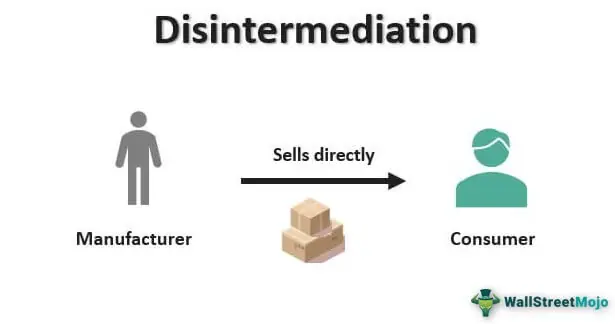
Disintermediation occurs when users who initially transact through a marketplace take future transactions off-platform, cutting out the intermediary and its fee structure.
Disintermediation happens when users who discover each other through a marketplace or market network take future transactions off-platform. A freelancer found on Upwork establishes a direct relationship with the client. A tenant found through a rental marketplace negotiates directly with the landlord for renewal.
This threat is particularly dangerous for transactional networks where retention and recurring transactions are primary sources of revenue. Combating disintermediation requires building enough ongoing value (escrow, dispute resolution, discovery, reputation management) that users prefer staying on-platform even after the initial match.
The Evaporative Cooling Effect
The evaporative cooling effect describes a dynamic where high-value members leave a community because they no longer derive sufficient value from it, which lowers the community's overall quality, which causes more high-value members to leave, creating a downward spiral.
As communities grow, new members tend to have lower average quality than existing members. Without active management, this dilution eventually drives away the members who made the community valuable in the first place.
Three strategies can mitigate evaporative cooling. First, social gating: requiring some minimum threshold for participation, whether that is knowledge, reputation, an invitation, or a fee. Second, conferring high status on valuable contributors, giving them incentive to stay. Third, carefully managing the balance between openness (which drives growth) and curation (which maintains quality). Communities with maximum openness grow fastest but are most vulnerable to evaporative cooling.
The Network Death Spiral
Metcalfe's Law has an inverse. If the value of a network grows as N squared, then the value of a network also shrinks as N squared when users leave. This inverse has been called "Eflactem's Law" (Metcalfe spelled backward): as you lose users, the value of your network decreases exponentially.
The analogy is a party where popular people start leaving. Their departure makes the party less fun, which causes more people to leave, which makes it even less fun, and so on.
A death spiral occurs when a platform reaches its maximum addressable user base (N = max), but the network value (N squared) is less than what participants expected. Retention drops, users begin leaving, and the exponential decline in value accelerates departures.
The defense against death spirals is ensuring that at least some local clusters within the network have independently reached critical mass. Even if the broader network contracts, a dense local cluster can sustain itself. This is why the "white-hot center" strategy matters for long-term network health, not just initial growth.
Confusing Concepts: What Network Effects Are Not
Virality
People frequently confuse viral effects with network effects. They are distinct phenomena. Network effects are about retention and defensibility: each user makes the product more valuable for other users. Viral effects are about acquisition: each user brings in additional users through sharing or invitation.
A product can be viral without having network effects. BuzzFeed quizzes spread virally but created no lasting network value. Conversely, a product can have strong network effects with minimal virality. Many B2B platforms grow slowly through sales teams but build formidable network effects once they reach scale.
Linear Growth vs. Exponential Growth
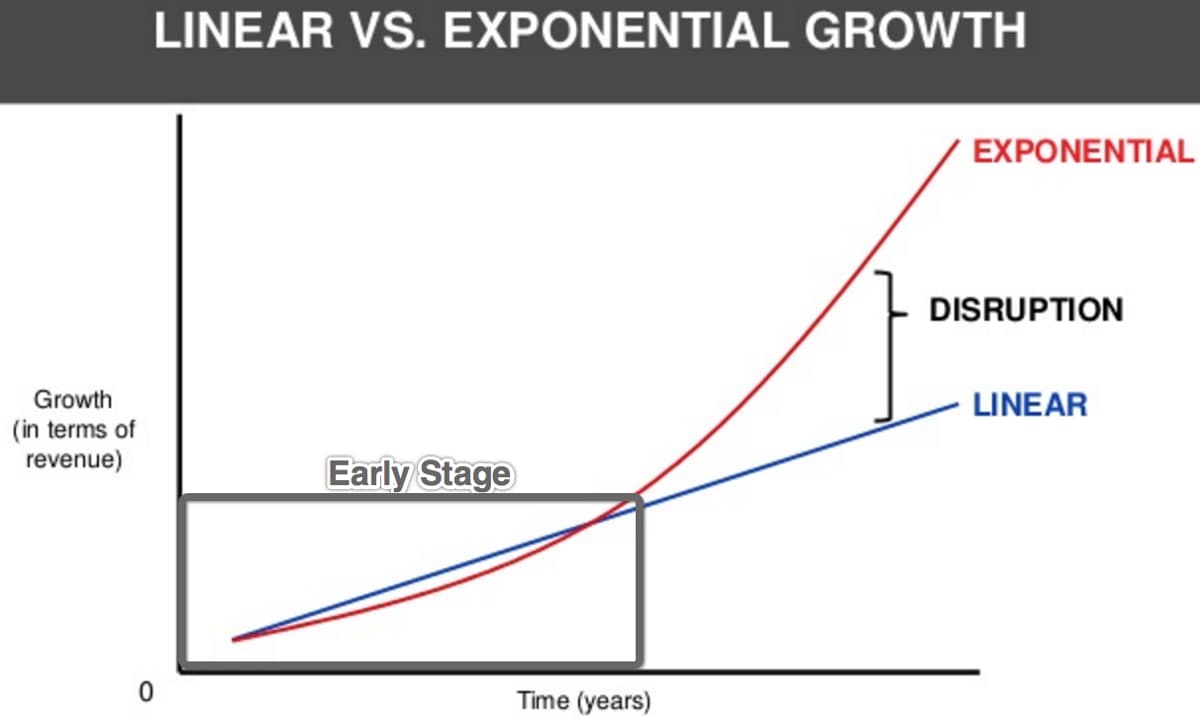
Products without network or viral effects tend to grow linearly. Products with network effects can achieve exponential growth once they pass critical mass.
Products without viral or network effects grow linearly: each unit of effort produces a roughly proportional unit of growth. Products with network effects can achieve non-linear growth once they reach critical mass, either because their value proposition becomes strong enough to attract organic users at scale or because they generate enough revenue to outspend competitors on acquisition.
Economies of Scale
Economies of scale are cost advantages from increased production volume. Network effects are value advantages from increased usage. They are related but distinct. A factory benefits from scale effects (lower per-unit costs) but not network effects (users do not make the product more valuable for each other). Many digital products benefit from both, which is why the concepts are often conflated.
Brand and Embedding
Brand (the psychological switching cost of moving away from a known entity) and embedding (the operational switching cost of replacing deeply integrated software) are both forms of defensibility but are not network effects. They can reinforce network effects, and network effects can strengthen them, but they operate through different mechanisms. A company with strong brand, deep embedding, and powerful network effects has the most durable competitive position available.
Frequently Asked Questions
What is the simplest way to explain network effects?
A network effect means a product becomes more valuable as more people use it. The telephone is the simplest example: one phone is useless, but every additional phone on the network makes every existing phone more useful. This same dynamic applies to social media platforms, marketplaces, messaging apps, and any product where users create value for each other. The key distinction from ordinary growth is that the growth itself improves the product, creating a self-reinforcing cycle.
How do network effects differ from virality?
Virality is about how quickly a product spreads to new users. Network effects are about how valuable the product becomes as usage grows. A viral product might attract millions of users through sharing mechanics but retain none of them if there is no network value. A product with strong network effects might grow slowly but become nearly impossible to displace once it reaches critical mass. The most powerful products combine both, using virality to reach critical mass quickly and network effects to retain users permanently.
What is critical mass and how do you know when you have reached it?
Critical mass is the inflection point where the value generated by the network exceeds the standalone value of the product and the value offered by competitors. You know you have reached it when organic growth begins to outpace paid acquisition, when retention rates improve for newer cohorts, and when users resist switching even when competitors offer feature-equivalent products. Quantitatively, look for the point where your organic-to-paid user ratio begins a sustained increase.
Can network effects weaken over time?
Yes. Network effects can weaken through several mechanisms. Asymptotic effects flatten as the network grows beyond the point where additional users add meaningful value. Multi-tenanting dilutes engagement across competing platforms. Negative network effects (congestion, spam, low-quality content) can reduce value as the network scales. The evaporative cooling effect can drive away the highest-value members. And death spirals can cause rapid exponential decline if the network value falls below user expectations.
What is the chicken-and-egg problem and how do startups solve it?
The chicken-and-egg problem is the bootstrapping paradox: users will not join a network without other users, but you cannot have other users without the first ones. The three most common solutions are building a standalone tool that provides value without a network and then layering network features on top ("come for the tool, stay for the network"); using token or financial incentives to compensate early users for the missing network value; and seeding the network through constrained launches that build local density before expanding. Instagram used the first approach with photo filters, while crypto projects typically use the second.
What types of companies benefit most from network effects?
Marketplaces, social platforms, communication tools, data aggregation services, and protocol-level technologies benefit most from network effects. Any product where user interactions create value for other users has the potential for network effects. However, not all technology companies can build them. Products that are consumed individually without user-to-user interaction (a single-player productivity tool, a content subscription with no community features) operate on scale effects rather than network effects.
How do you measure whether your product actually has network effects?
The strongest signals are improving retention rates for newer user cohorts, a rising organic-to-paid acquisition ratio, decreasing customer acquisition costs over time, low multi-tenanting rates among your users, and increasing engagement frequency shown by rightward shifts in power user curves. For marketplaces specifically, improving match rates, decreasing time to match, and increasing pricing power are key indicators. If these metrics are flat or deteriorating despite user growth, you may have scale effects rather than true network effects.
What is the biggest threat to a company with strong network effects?
The biggest threat depends on the type of network, but multi-tenanting and disintermediation are the most common and immediate dangers. Multi-tenanting (users splitting their activity across competing platforms) slowly dilutes your network's value advantage. Disintermediation (users taking transactions off-platform after initial discovery) directly attacks the revenue model. The evaporative cooling effect is perhaps the most insidious long-term threat because it erodes network quality gradually and is often not recognized until the highest-value members have already left.