The Product Manager Career Ladder
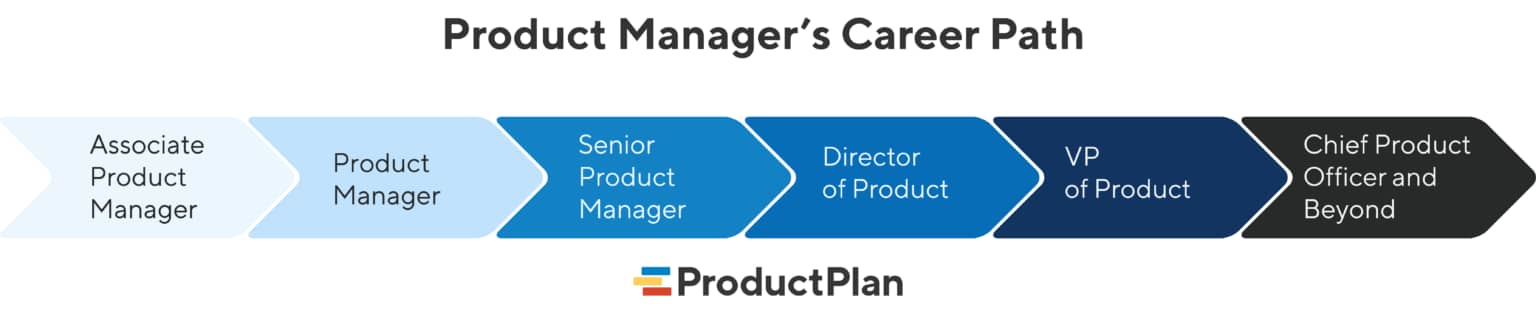
The product manager career ladder, from Associate PM through Chief Product Officer. Source: ProductPlan
The product manager career path follows a general ladder, but what makes it tricky is that each rung does not simply add more responsibility. Each level requires a different way of thinking. Here is what each level looks like in practice.
Associate Product Manager (APM)
The associate product manager does everything a PM does, but at a smaller scale. You will not be defining the product strategy or building multi-year roadmaps. Instead, your job is to execute well on scoped problems.
At this level, the most important things you can demonstrate are empathy for users and the ability to find and define problems clearly. Hiring managers are looking for genuine curiosity about users and the ability to collaborate across teams. Most APMs hold a bachelor's degree in computer science, business, or a related field, but what matters more is how you think about problems.
An APM continually answers the question: "This is what we are doing and why we are doing it." You rely on metrics to determine success, and you keep all relevant stakeholders informed about the status of your product area.
Product Manager
At this level, you become the "go-to" resource for your team. People come to you for tactical decisions, process questions, and relationship advice. You should be fluent in data and have established strong working relationships with engineering, UX, marketing, and other functions.
The key to advancing beyond this level is demonstrating that your product delivers clear value to customers. You need to connect specific user problems to product metrics and business goals. If you can show that your product area runs smoothly and that you spend more time making strategic decisions than firefighting, you are on track.
Senior Product Manager
Senior PMs handle the same core duties as PMs but own higher-impact, higher-visibility products. They take a broader view of the product process and can lead other PMs.
What distinguishes a Senior PM is the ability to think independently and make accountable, data-driven decisions that account for interdependent factors. Senior PMs communicate product strategy to dependent teams, executives, and key stakeholders. Deep product knowledge and market understanding are table stakes at this level.
Director of Product
The jump to Director represents a real shift. You move from owning a product area to owning the people and processes around multiple product areas.
A Director of Product focuses on creating better processes, increasing overall team performance, and building consensus across the organization. You meet regularly with people throughout the company to explain what is happening and why. You conduct extensive market research on trends, competitor moves, and best practices.
The Director role has two core requirements. First, become an important source of advice for other product managers. Second, become an advocate for the product teams to senior leadership. You are a mentor now, and your job is to find each PM's strengths and put them to work.
VP of Product
The VP of Product is a high-level resource for the entire product organization. You are responsible for the product vision and how it fits into the broader business.
Your job includes budgeting for the product organization, ensuring strategic product decisions align with business goals, and protecting the team from internal politics. Most of your time is spent thinking about what the team will need a year from now and organizing people to get there.
This role typically requires 10+ years in product management, with at least 5 years managing development teams, designers, and engineers.
Chief Product Officer (CPO)
The Chief Product Officer sits at the top of the product organization. In some companies, the CPO manages multiple VPs of Product. In others, it is an expanded version of the VP role.
The CPO oversees the product portfolio, ensuring budget, staffing, and research investments are allocated to maximize ROI. You make strategic decisions on a 3-to-5-year timeframe and set product goals that inspire the entire organization. You are responsible for mentoring and motivating people across every product team.
Experience requirements vary widely, but typically range from 10 to 20+ years.
Four Types of Product Managers

The four types of product work and their corresponding PM specializations. Source: Adam Fishman and Keya Patel via Reforge
One of the biggest misconceptions in product management is that all PM roles are the same. This belief causes real problems at every level of the organization.
When companies treat PM roles as interchangeable, five things go wrong. First, tools don't transfer: PMs apply the same approach to every problem, even when it does not fit. Second, slow and steady struggle: PMs who enter unfamiliar product areas start falling behind. Third, focus fatigue: without clear specialization, PMs are unsure where to invest their learning. Fourth, talent turmoil: companies hire PMs based on prior achievements without checking whether those achievements map to the role. Fifth, competing colleagues: managers compare PMs against each other using the wrong criteria.
Core Skills Every PM Needs
Before diving into specializations, every PM needs a baseline set of skills:
- Technical and data comfort: Analyzing dashboards, interpreting metrics, setting goals, and working comfortably with developers and data scientists.
- Communication and collaboration: Motivating cross-functional teams toward a goal and getting buy-in from stakeholders and executives.
- Problem-solving: Breaking down ambiguous product and customer needs into experiments and iterations.
- User understanding: Empathizing with customers, listening deeply, and identifying pain points.
- Strategic thinking: Keeping sight of organizational, user, and investor goals while managing many moving parts.
The Four Specializations
Core PM (Feature Work)
Most PMs start here. Core PMs focus on solving customer pain points through feature development. This is the foundational PM discipline, and it teaches you the mechanics of shipping: writing specs, working with engineering, running user tests, and iterating based on feedback.
Growth PM (Growth Work)
Growth PMs focus on the customer journey through the lens of business metrics: acquisition, CAC, sign-ups, trial starts, conversion rates, monetization, ARPU, and retention. Growth work is about capturing more of an existing market by optimizing how users discover, adopt, and stick with the product.
Platform PM (Scaling Work)
Platform PMs focus on internal customers and scaling infrastructure. Their job is to ensure the product organization maintains the ability to ship new things across feature, growth, and product-market fit expansion work. As companies grow, the complexity of internal systems can become a bottleneck, and Platform PMs keep things running.
Innovation PM (Product-Market Fit Expansion)
Innovation PMs are focused on identifying and experimenting with new opportunities to reach and expand product-market fit. This means exploring adjacent markets, adjacent products, or both. It is the highest-risk, highest-reward specialization.
Understanding which type of product work you are best at is critical for career planning. The best PMs build deep expertise in one area before broadening. Trying to be a generalist too early can slow your growth.
How to Break Into Product Management
There are two main paths into product management: joining from outside your current company, or transitioning from within.
The External Path
If you are coming from outside, here is a proven sequence:
1. Research the role and talk to current PMs. Connect with product managers on LinkedIn or watch them explain their roles on YouTube. Get a concrete picture of what the job actually requires before you apply.
2. Take a product management course. The PM role looks complicated from the outside, and structured learning helps you build vocabulary and frameworks. A certificate also helps your resume stand out.
3. Start a side project and document it. Managing a product from inception to launch is the single best thing you can do. Document the entire process, including failures. Showing how you solved problems and what you learned from mistakes demonstrates real product thinking.
4. Work on communication and storytelling. Product management requires the ability to convey ideas concisely while delivering high impact. Practice presenting, writing product briefs, and telling the story of why something matters.
5. Build a technical background. You do not need to be a developer, but having rudimentary technical knowledge shows future employers that you can work alongside engineers and learn new technical concepts when needed.
6. Apply for an APM program. Associate Product Management programs are designed for fresh graduates and early-career professionals. Many large tech companies run them, and they often lead to permanent positions. These programs are competitive but provide excellent training and mentorship.
7. Apply directly for PM roles. If you did not get into an APM program or are further along in your career, apply directly. Starting with smaller companies can be easier, and the experience you gain there is valuable when moving to larger organizations later.
The Internal Path
If your company already has a product management team, the internal path is often more accessible than people realize.
1. Find a project you can own end-to-end. This could be a side project at work, something from a PM course, or even a personal business. The key is to work on a problem set where you can try new ideas and learn from failure.
2. Volunteer to solve problems as side projects. Most companies, from startups to large organizations, welcome people who want to tackle difficult problems. Identify an issue, discuss it with your team or manager, and take on the work of researching, testing, and implementing a solution alongside your regular responsibilities.
3. Build a track record. Keep records of the projects and experiments you work on. Document your findings and share what you learn with your product team. If you are seeking a PM role outside your current company, track your accomplishments on a personal blog or LinkedIn.
4. Apply for an internal PM opening. With a record of cross-functional collaboration, project ownership, customer empathy, and data-driven results, you will have a strong case. The interview is where you demonstrate that you can talk with customers comfortably, analyze key results, and own a product area.
The PM to Senior PM Transition
The jump from PM to Senior PM is where many careers stall. Jackie Bavaro, via Lenny Rachitsky's newsletter, describes three differentiators that separate Senior PMs from the rest. These are not just "nice to have" qualities. They are the specific skills that promotion committees and hiring managers evaluate.
Strategy
Senior PMs prioritize work based on how much it advances the product's long-term strategy, not just the next sprint. A strategy has three components: a vision (where you want to go), a strategic framework (how you will get there), and a roadmap (what you will build and when). You can start building any of these first, but eventually all three need to be in place.
Mid-level PMs are often good at execution but weak at connecting their work to a larger strategic picture. The shift to Senior PM requires you to zoom out consistently and articulate why your team's work matters in the context of the company's direction.
Autonomy
Great Senior PMs seek feedback and advice actively, but they can lead their team, manage stakeholders, resolve issues, and ship great products without their manager's constant involvement. They know when to challenge the direction they have been given rather than accepting it blindly.
Autonomy is not just about being capable. It also means winning the trust necessary to operate independently. This requires proactive communication and a track record of successful launches. You need to share your work with your manager deliberately so they feel confident giving you more room.
Nuance
The more senior you get, the more decisions you face where the honest answer is "it depends." Senior PMs recognize these judgment calls and reason through them systematically. They handle ambiguity and difficult tradeoffs without freezing.
Because of their deep product expertise and mental models, Senior PMs can lay out their reasoning in minutes. They quickly identify the most critical challenges in a confusing problem space. The best way to develop this skill is to take your coworkers' and stakeholders' concerns seriously and look for the underlying complexities. Ask yourself: under what conditions would they be right?
Crossing the Canyon: Senior PM to Product Leader
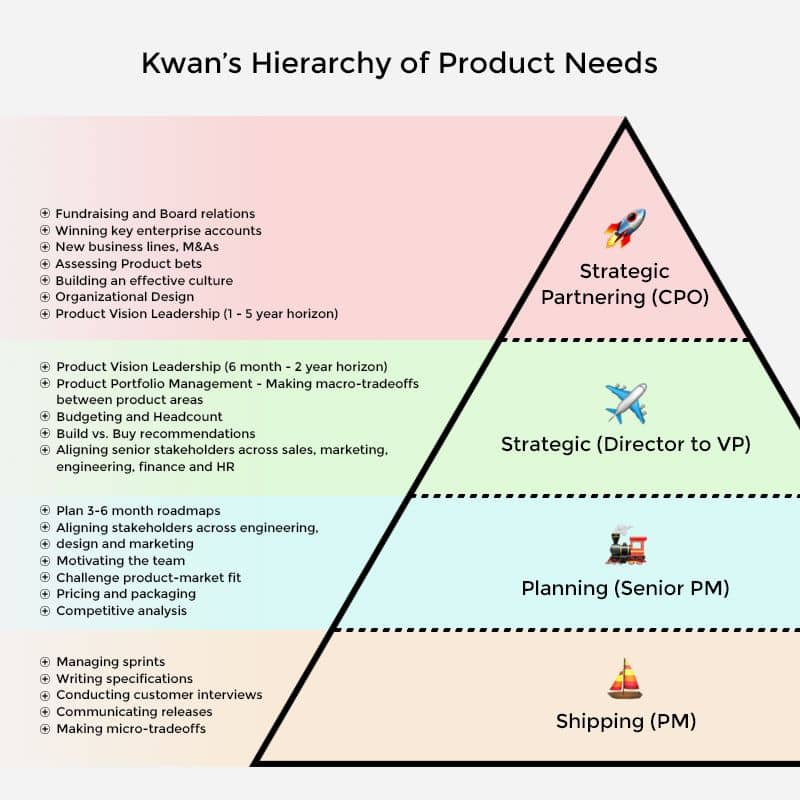
Kwan's Hierarchy of Product Needs maps the four levels of PM decision-making, from shipping features to strategic partnerships. Source: Connie Kwan via Heavybit
Fareed Mosavat and Casey Winters at Reforge describe a "canyon" between Senior PM and Product Leader. Many careers stall at this exact point because the transition requires fundamentally different skills. Being an excellent Senior PM does not automatically make you a good Director or VP. In many ways, it is a different job entirely.
From APM to Senior PM, the progression is relatively linear. You keep solving similar problems, but they get harder. The canyon appears because the leap to Product Leader changes what you are evaluated on and how you create value.
From Depth to Breadth
As a Senior PM, you build deep expertise in one of the four product work types: feature, growth, scaling, or PMF expansion. As a Product Leader, you need breadth across multiple types.
A Product Leader must have a wider vision of product problems, maximize ROI across different types of product work, and shift from an "I-shaped" expert to a "T-shaped" leader. You still have your depth, but you need working knowledge of areas outside your specialization.
From Doing to Teaching
As a Product Leader, your value is measured by the total output of your team, not your personal output. This means your primary job shifts to training others to be good at their work.
Here is the trap: your natural strengths are the hardest things to teach. And the most common failure mode is keeping the most important projects for yourself instead of delegating them. Reforge calls this the "manager death spiral." You stay busy with high-impact work while your team stagnates, and the organization never scales beyond what you can personally handle.
From Solving to Allocating
Senior PMs solve problems with the resources they have. Product Leaders solve problems by allocating resources and influencing others across the organization. This is a new skill because influencing up and across requires different tactics than leading a direct team. And the evaluation criteria change: you are no longer judged solely on your team's success, but on how well you enable the broader organization.
From Growing Scope to Creating Scope
This might be the most counterintuitive shift. As a Product Leader, you need to reduce your personal scope by shedding parts of your responsibility to enable new teams. Your job is to create systems that give you enough context to identify problems, course correct, or escalate, without being involved in every decision.
The PMs who struggle most with this transition are the ones who were successful precisely because they were hands-on. Letting go of that identity is the hardest part.
Kwan's Hierarchy of Product Needs
Connie Kwan offers another lens for understanding PM levels through her Hierarchy of Product Needs. The idea is simple: the higher the risk of the decisions you make, the more experience you need. This maps cleanly to four levels of product management.
Level 1: Shipping (PM)
The most fundamental need a PM satisfies is shipping features. At this level, you debate specs with design, test features against customer needs, work with engineers daily, and release products successfully. This is where everyone starts, and there is no shortcut past it. If you cannot ship reliably, nothing else matters.
Level 2: Planning (Senior PM)
The planning-level PM continuously challenges product-market fit and manages a team around a 3-to-6-month vision. This role requires drawing out the customer's real needs (not just their stated requests), creating a product vision from multiple inputs, and rallying the team around that vision. You are no longer just executing; you are deciding what to execute.
Level 3: Strategic (Director to VP)
The strategic PM takes the company's vision and makes pathways to big, hairy, audacious goals visible. They validate each pathway and find ways to test and reduce risk. At this level, you are thinking about the portfolio of bets the company is making and which ones deserve investment.
Level 4: Strategic Partnering (CPO)
A company needs a CPO when it is growing rapidly and the complexity of its product organization exceeds what a VP can handle alone. The CPO helps set and reinforce the company's product culture. They bring partnership opportunities with external companies alongside the CEO and CFO. They craft and communicate the product story for the team, board, and users, and help sustain the company's revenue and fundraising momentum.
Frequently Asked Questions
What is the typical product manager career path?
The standard product manager career ladder goes: Associate Product Manager (APM), Product Manager, Senior Product Manager, Director of Product, VP of Product, and Chief Product Officer (CPO). Each level takes roughly 2 to 4 years, though this varies widely by company and individual. The total path from APM to CPO typically spans 15 to 20+ years.
How do I become a product manager with no experience?
The most accessible entry point is an Associate Product Management (APM) program at a large tech company. You can also build experience through side projects, product management courses, and volunteering to own cross-functional projects at your current company. Documenting your work and building a portfolio of product thinking is more important than having the exact right degree.
What skills do all product managers need?
Every PM needs five core skills regardless of specialization: technical and data comfort, communication and collaboration, problem-solving, user understanding, and strategic thinking. The weight of each skill shifts as you advance. Early-career PMs lean heavily on execution and communication, while senior PMs need stronger strategic thinking and organizational influence.
What are the different types of product managers?
There are four main PM specializations based on the type of product work: Core PM (feature development), Growth PM (user acquisition and retention metrics), Platform PM (internal tooling and scaling infrastructure), and Innovation PM (new market and product-market fit expansion). Each requires different skills, tools, and mental models.
How long does it take to go from PM to Senior PM?
The PM to Senior PM transition typically takes 2 to 4 years, but timing depends on three factors identified by Jackie Bavaro: your ability to think strategically, your level of autonomy, and your capacity for nuanced judgment. Tactical execution alone will not earn the promotion. You need to demonstrate that you can own strategy, operate independently, and navigate ambiguity.
What is the difference between a VP of Product and a CPO?
A VP of Product owns the product vision and manages the product organization, typically with 10+ years of experience. A CPO sits above the VP level, overseeing the entire product portfolio across multiple product lines or business units. The CPO also takes on external responsibilities like strategic partnerships, board communication, and shaping product culture across the company. Some companies use these titles interchangeably, but in larger organizations the CPO is a distinct executive role.
Why do PM careers stall at the Senior PM level?
The transition from Senior PM to Product Leader (Director+) requires a fundamentally different set of skills. Senior PMs succeed through personal execution, deep expertise, and direct problem-solving. Product Leaders succeed through teaching others, allocating resources, influencing across the organization, and creating scope for new teams. Many excellent Senior PMs struggle because the habits that made them successful become liabilities at the leadership level.
Is product management a good career in 2025?
Product management remains one of the most in-demand roles in tech. The field continues to evolve with AI, data science, and new go-to-market models creating new specializations. The career offers strong compensation, diverse exit options (founding a company, moving into general management, VC), and the opportunity to shape products that millions of people use. The key is to build real depth in a specialization rather than staying a generalist.