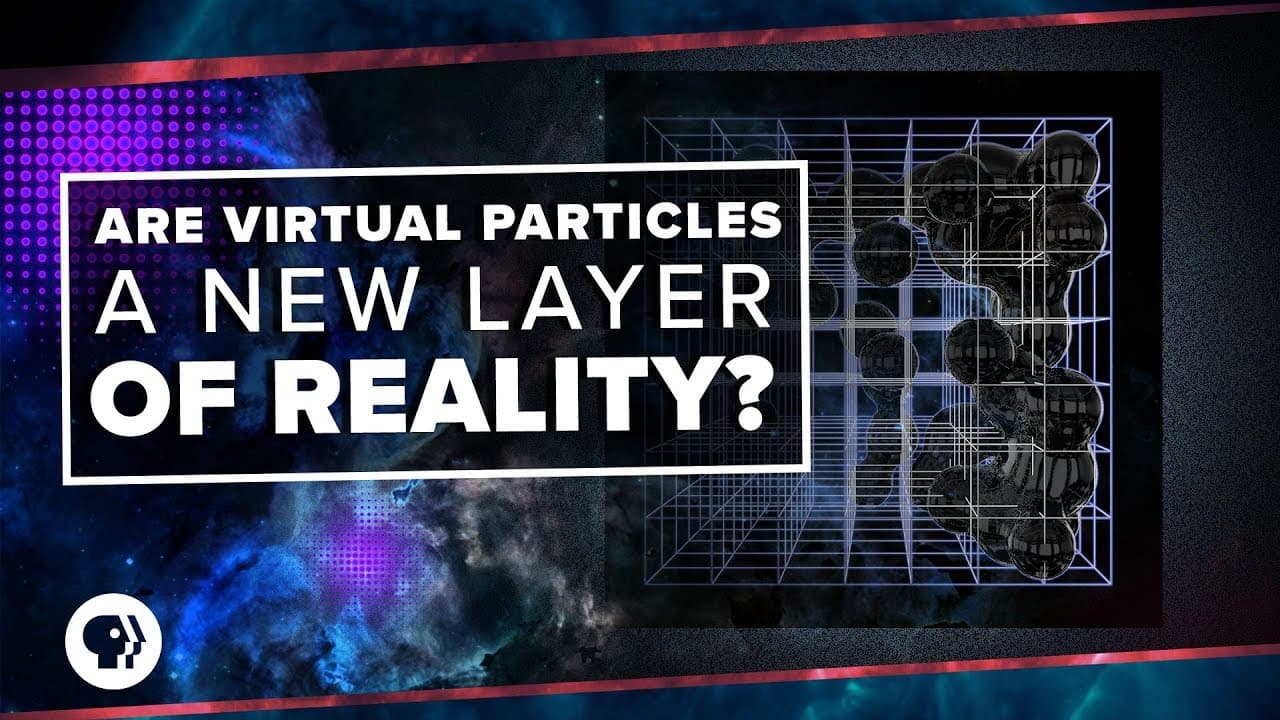
Are Virtual Particles A New Layer of Reality?
TL;DR
Virtual particles are mathematical constructs, not real entities.
Transcript
Let me tell you a story about virtual particles. It may or may not be true. Out there in the emptiest places of the universe, phantom particles appear and vanish again out of nowhere. They borrow the energy for their existence so briefly that they cheat the watch fly of the universe. Near black holes, virtual matter and antimatter pairs are separat... Read More
Key Insights
- Virtual particles are mathematical tools used in quantum field theory to approximate complex interactions between particles, not physical entities.
- They originated as a trick to solve difficult calculations in quantum field theory, similar to how Max Planck's quantization trick revealed the quantum nature of photons.
- In particle interactions, virtual particles mediate interactions by representing intermediate states of the quantum fields involved.
- Feynman diagrams are used to track these intermediate states, distinguishing between real particles and virtual particles within calculations.
- Virtual particles can defy physical laws, such as traveling faster than light, because they are not bound by the same physics as real particles.
- In a vacuum, virtual particles represent potential excitations of quantum fields, existing in a superposition of states until measured.
- Hawking radiation, the Casimir effect, and other phenomena involving vacuum fluctuations do not require virtual particles to exist independently.
- Lattice field theories offer a version of quantum field theory that does not rely on virtual particles, suggesting they are mathematical artifacts.
Install to Summarize YouTube Videos and Get Transcripts
Explore YouTube Video Summarizer or Get YouTube Transcript Extractor
Questions & Answers
Q: What are virtual particles?
Virtual particles are mathematical constructs used in quantum field theory to simplify and approximate the complex interactions between particles. They are not real entities but rather useful tools for calculations, representing intermediate states in particle interactions.
Q: How do virtual particles relate to Feynman diagrams?
Feynman diagrams are visual representations used to track the intermediate states in particle interactions. In these diagrams, virtual particles are depicted as entities that mediate interactions, distinguishing them from real particles that enter or leave the diagrams.
Q: Can virtual particles travel faster than light?
Yes, virtual particles can defy conventional physical laws, such as traveling faster than light, because they are not bound by the same physics as real particles. This behavior is a result of their nature as mathematical constructs rather than physical entities.
Q: Do virtual particles exist in a vacuum?
In a vacuum, virtual particles represent potential excitations of quantum fields, existing in a state of uncertainty. They do not pop in and out of existence independently but are rather a way to describe what might happen if something interacts with the vacuum.
Q: What role do virtual particles play in Hawking radiation?
In Hawking radiation, virtual particles were initially used as an intuitive way to describe radiation emitted by black holes. However, the actual mathematical derivation involves vibrational modes of the quantum vacuum being disturbed, not the independent existence of virtual particles.
Q: Are virtual particles real or just a mathematical tool?
Virtual particles are primarily a mathematical tool used to approximate the behavior of quantum fields. They do not exist independently outside of the mathematical framework, as evidenced by lattice field theories that achieve similar results without using virtual particles.
Q: How do virtual particles mediate attractive forces?
Virtual particles mediate attractive forces by allowing for the possibility of interactions that defy classical expectations. For instance, in the interaction between an electron and positron, virtual photons can create an attractive force despite seemingly traveling in the wrong direction.
Q: What is the significance of zero point energy in a vacuum?
Zero point energy refers to the non-zero average energy present in a vacuum due to the Heisenberg uncertainty principle. This energy implies that quantum fields have potential excitations, represented by virtual particles, even in the absence of external interactions.
Summary & Key Takeaways
-
Virtual particles are key components in quantum field theory, serving as mathematical constructs to simplify complex particle interactions. They are not real entities but rather tools to approximate the behavior of quantum fields.
-
Feynman diagrams illustrate the role of virtual particles in particle interactions, showing them as mediators of forces between particles. Despite their depiction, they do not travel through space like real particles.
-
The concept of virtual particles extends to vacuum fluctuations, where they represent potential energy states of quantum fields. However, these fluctuations do not imply the independent existence of virtual particles.
Read in Other Languages (beta)
Share This Summary 📚
Summarize YouTube Videos and Get Video Transcripts with 1-Click
Try YouTube Summary with ChatGPT & Claude or YouTube Transcript Generator
Explore More Summaries from PBS Space Time 📚
Summarize YouTube Videos and Get Video Transcripts with 1-Click
Try YouTube Summary with ChatGPT & Claude or YouTube Transcript Generator