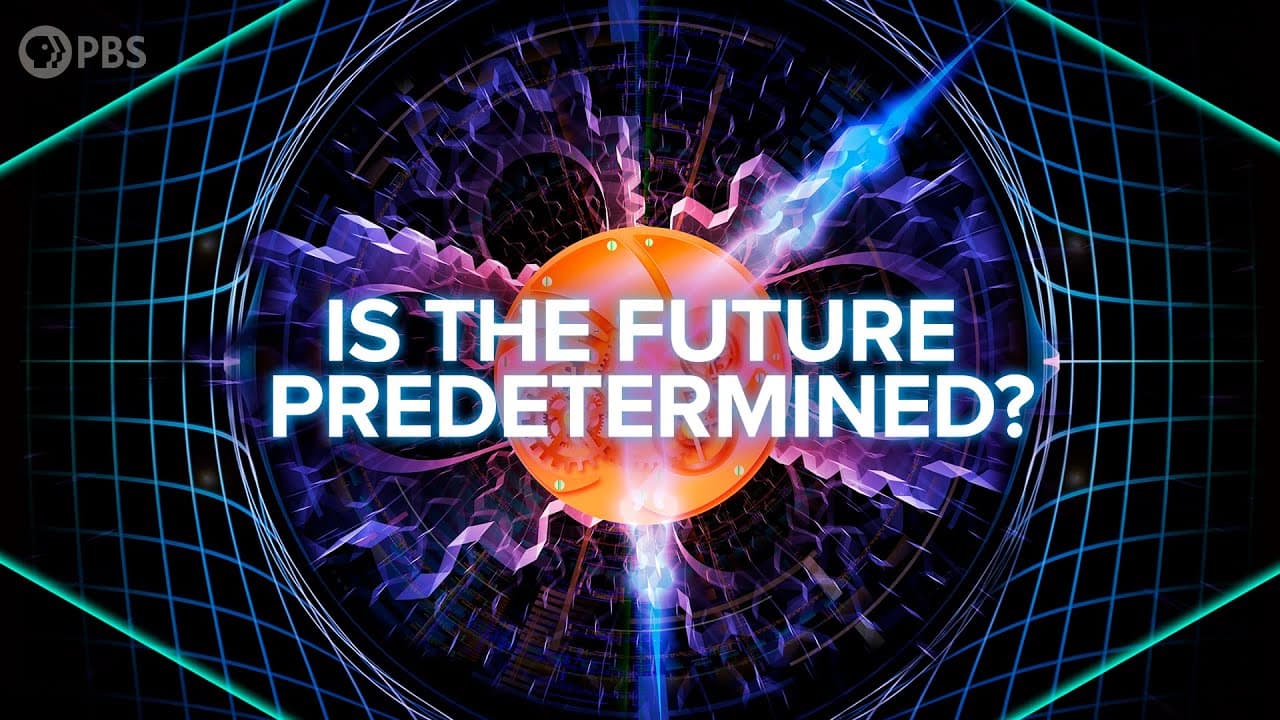
Is The Future Predetermined By Quantum Mechanics?
TL;DR
Explores if quantum mechanics implies a predetermined future.
Transcript
- Einstein's Special Theory of Relativity combines space and time into one dynamic unified entity, spacetime. But if time is connected to space, can the universe be anything but deterministic? And does that mean that the future is predestined? ("PBS Space Time" theme song) In the last episode, we saw that we could think of the unified spacetime in ... Read More
Key Insights
- Einstein's theory of relativity suggests a block universe where time and space are intertwined, raising questions about determinism and the nature of the future.
- The block universe concept implies that the past, present, and future are equally real, challenging the traditional notion of a flowing time.
- Quantum mechanics introduces indeterminacy through wave functions, which describe probabilities rather than definite states, complicating the idea of a deterministic universe.
- The Copenhagen interpretation proposes that quantum systems remain undefined until observed, suggesting a non-deterministic universe where reality is selected upon observation.
- The Many-Worlds Interpretation suggests that all possible states of a quantum system exist simultaneously, leading to a deterministic multiverse where reality branches into different paths.
- The interplay between relativity and quantum mechanics raises questions about the nature of time and whether the future is predetermined or open to possibilities.
- Decoherence and quantum Darwinism provide frameworks for understanding how quantum possibilities translate into the macroscopic reality we experience.
- Different interpretations of quantum mechanics offer varying perspectives on whether the future is predetermined, with implications for our understanding of time and reality.
Install to Summarize YouTube Videos and Get Transcripts
Explore YouTube Video Summarizer or Get YouTube Transcript Extractor
Questions & Answers
Q: What is the block universe concept?
The block universe concept, derived from Einstein's theory of relativity, suggests that time and space form a unified entity called spacetime. In this view, the past, present, and future are equally real and exist simultaneously. This challenges the traditional notion of time as a flowing entity and raises questions about determinism and the nature of the future.
Q: How does quantum mechanics introduce indeterminacy?
Quantum mechanics introduces indeterminacy through the concept of wave functions, which describe probabilities rather than definite states. These wave functions represent the possible states a quantum system could be in if observed. This probabilistic nature complicates the idea of a deterministic universe, as it suggests that reality is not fixed until observed, leading to different interpretations about the nature of reality and the future.
Q: What is the Copenhagen interpretation?
The Copenhagen interpretation is one of the earliest and most accepted interpretations of quantum mechanics. It posits that a quantum system remains in an undefined state until it is observed, at which point the wave function collapses into a defined state. This suggests a non-deterministic universe where reality is randomly selected from possible outcomes upon observation, challenging the idea of a predetermined future.
Q: How does the Many-Worlds Interpretation differ from Copenhagen?
The Many-Worlds Interpretation differs from Copenhagen by suggesting that the wave function never collapses. Instead, all possible states of a quantum system exist simultaneously, leading to a deterministic multiverse. In this view, when we observe a quantum system, we become part of one of the realities, losing track of the others. This interpretation implies a deterministic universe where reality branches into different paths, each equally real.
Q: What role does decoherence play in quantum mechanics?
Decoherence is a concept in quantum mechanics that explains how quantum possibilities translate into the macroscopic reality we experience. It describes how quantum systems become entangled with their environment, leading to a loss of coherence between different possibilities. This process helps explain why we observe a single reality despite the probabilistic nature of quantum mechanics and supports the idea of a branching multiverse in the Many-Worlds Interpretation.
Q: How do relativity and quantum mechanics interact?
Relativity and quantum mechanics interact in complex ways, raising questions about the nature of time and reality. While relativity suggests a block universe where time and space are intertwined, quantum mechanics introduces indeterminacy through wave functions. The interplay between these theories challenges our understanding of determinism and the future, with different interpretations offering varying perspectives on whether the future is predetermined or open to possibilities.
Q: What are the implications of a deterministic multiverse?
A deterministic multiverse, as suggested by the Many-Worlds Interpretation, implies that all possible states of a quantum system exist simultaneously. This means that every possible outcome of a quantum event leads to a branching of reality, creating a multiverse where every possibility is realized. This challenges the traditional notion of a single, predetermined future and suggests that our experience of reality is just one of many possible paths, each equally valid.
Q: Why is the nature of time still a mystery?
The nature of time remains a mystery due to the complex interplay between relativity and quantum mechanics. While relativity suggests a block universe where past, present, and future coexist, quantum mechanics introduces indeterminacy and the possibility of multiple realities. The lack of a unified theory that fully integrates these concepts leaves open questions about why time progresses in one direction, how it arises, and whether the future is predetermined or open to possibilities.
Summary & Key Takeaways
-
Einstein's theory of relativity suggests a block universe where past, present, and future coexist, challenging traditional views of time. Quantum mechanics introduces indeterminacy, complicating the notion of a deterministic universe. Different interpretations, like Copenhagen and Many-Worlds, offer varying perspectives on whether the future is predetermined.
-
The Copenhagen interpretation posits a non-deterministic universe where reality is chosen upon observation, while the Many-Worlds Interpretation suggests a deterministic multiverse with all possible states existing simultaneously. These interpretations raise questions about the nature of time and whether the future is predetermined or open to possibilities.
-
Decoherence and quantum Darwinism provide frameworks for understanding how quantum possibilities translate into the macroscopic reality we experience. The interplay between relativity and quantum mechanics challenges our understanding of time and reality, with different interpretations offering varying perspectives on the nature of the future.
Read in Other Languages (beta)
Share This Summary 📚
Summarize YouTube Videos and Get Video Transcripts with 1-Click
Try YouTube Summary with ChatGPT & Claude or YouTube Transcript Generator
Explore More Summaries from PBS Space Time 📚
Summarize YouTube Videos and Get Video Transcripts with 1-Click
Try YouTube Summary with ChatGPT & Claude or YouTube Transcript Generator