Perpetual Motion From Negative Mass?
TL;DR
Negative mass could revolutionize physics but remains speculative.
Transcript
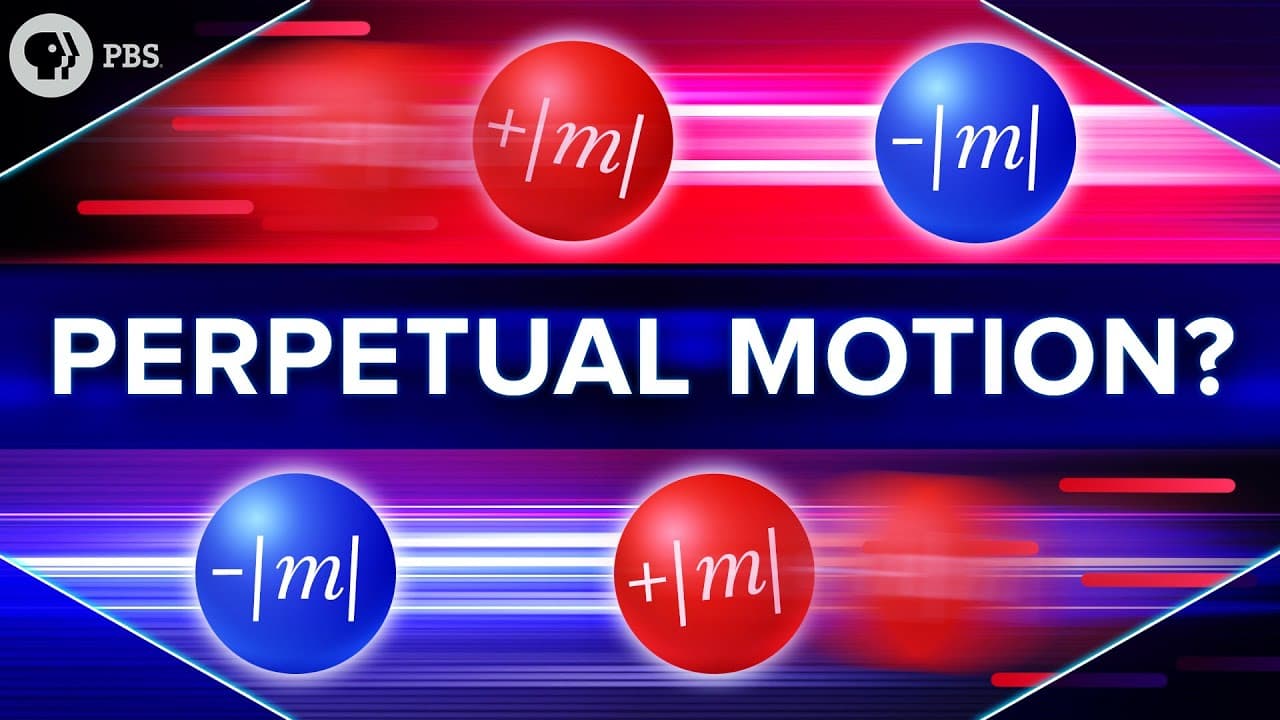
Challenge question: if 1kg of apples is $5 and 2kg is $10, how much is -1kg of apples? The answer? Priceless. Because you could use negative-mass apples to build warp drives, travel in time, and construct a perpetual motion machine. In fact that last one will be today’s actual challenge question. Matter with negative mass
- has long been the pipedr... Read More
Key Insights
- Negative mass is a theoretical concept that could enable faster-than-light travel and time travel by curving space in unique ways.
- In Newtonian physics, negative mass would behave differently than positive mass, with opposite masses repelling each other.
- General relativity suggests that negative mass would cause negative curvature in spacetime, leading to repulsive gravitational effects.
- The equivalence principle, a foundation of general relativity, assumes inertial and gravitational masses are identical, complicating the concept of negative mass.
- Negative mass could theoretically lead to perpetual motion machines, violating conservation laws by generating infinite energy.
- Negative inertial mass implies incoherent physics, as it would reverse acceleration directions and disrupt energy conservation.
- The existence of negative mass remains unresolved, with conflicting theories about its behavior and implications for fundamental physics.
- Theoretical exploration of negative mass challenges current understanding of physics and invites creative problem-solving in speculative science.
Install to Summarize YouTube Videos and Get Transcripts
Explore YouTube Video Summarizer or Get YouTube Transcript Extractor
Questions & Answers
Q: What is the significance of negative mass in science fiction?
Negative mass is significant in science fiction because it offers the possibility of faster-than-light travel and time travel. These concepts are popular in science fiction as they allow for exploration of distant galaxies and alternate timelines. Negative mass could theoretically create warp fields and hold open wormholes, making it a key element in speculative narratives.
Q: How does Newtonian physics describe the behavior of negative mass?
In Newtonian physics, negative mass would behave differently than positive mass. Like masses, whether positive or negative, should attract each other. However, opposite mass signs, such as positive and negative, should repel each other. This behavior contrasts with electric charges, where like charges repel and opposite charges attract.
Q: What role does the equivalence principle play in general relativity?
The equivalence principle is foundational to general relativity, stating that gravitational and inertial mass are identical. It posits that there is no experiment that can distinguish between the feeling of acceleration in empty space and the feeling of weight in a gravitational field. This principle ensures that all masses experience the same acceleration in a gravitational field, maintaining consistency in the laws of physics.
Q: Why is the concept of negative inertial mass problematic?
Negative inertial mass is problematic because it implies reversing the direction of acceleration in response to applied forces. This contradicts basic physics principles, as it would mean an object accelerates towards an applied force while losing kinetic energy. Such behavior is incoherent and disrupts the conservation of energy, making negative inertial mass an unlikely concept within current physics frameworks.
Q: How does general relativity describe the effects of negative mass?
General relativity describes gravity as the warping of spacetime. Negative mass would cause negative curvature, leading to repulsive gravitational effects. This means that a negative mass would repel both positive and negative masses, unlike positive mass, which attracts other masses. These effects challenge our understanding of gravitational interactions and raise questions about the stability of the universe.
Q: Can negative mass lead to perpetual motion machines?
Theoretically, negative mass could lead to perpetual motion machines by creating a system where positive and negative masses accelerate each other indefinitely. This would violate conservation laws, as it allows for infinite energy generation. However, such machines remain speculative and challenge established physics principles, making them a topic of theoretical exploration rather than practical application.
Q: What are the unresolved debates surrounding negative mass?
There are several unresolved debates surrounding negative mass, including whether it can exist and how it would behave if it did. Theories differ on whether like mass signs attract or repel each other and how negative mass would interact with positive mass. These debates highlight the complexities and uncertainties in our understanding of mass and gravity, inviting further research and exploration.
Q: Why is negative mass considered speculative science?
Negative mass is considered speculative science because it challenges fundamental principles of physics and lacks empirical evidence. Its theoretical implications, such as faster-than-light travel and perpetual motion, defy current understanding of energy conservation and gravitational interactions. While it offers intriguing possibilities, negative mass remains a topic of theoretical exploration and debate, rather than a proven scientific concept.
Summary & Key Takeaways
-
Negative mass is a theoretical concept that fascinates scientists and science fiction enthusiasts alike. It holds potential for revolutionary advancements like faster-than-light travel and perpetual motion machines, though it remains speculative. Theories about its gravitational behavior vary, with unresolved debates in the physics community.
-
In Newtonian mechanics, negative mass would exhibit unique behaviors, such as repelling positive mass. However, general relativity provides a more complex view, suggesting negative mass could cause repulsive gravitational fields. These ideas challenge foundational principles like the equivalence principle, complicating our understanding of mass and gravity.
-
Despite its theoretical allure, negative mass poses significant challenges to existing physics frameworks. The concept of negative inertial mass, in particular, leads to contradictions in energy conservation and force interactions. While some theorists explore its possibilities, others question its feasibility, leaving negative mass a subject of ongoing debate.
Read in Other Languages (beta)
Share This Summary 📚
Summarize YouTube Videos and Get Video Transcripts with 1-Click
Try YouTube Summary with ChatGPT & Claude or YouTube Transcript Generator
Explore More Summaries from PBS Space Time 📚

Summarize YouTube Videos and Get Video Transcripts with 1-Click
Try YouTube Summary with ChatGPT & Claude or YouTube Transcript Generator