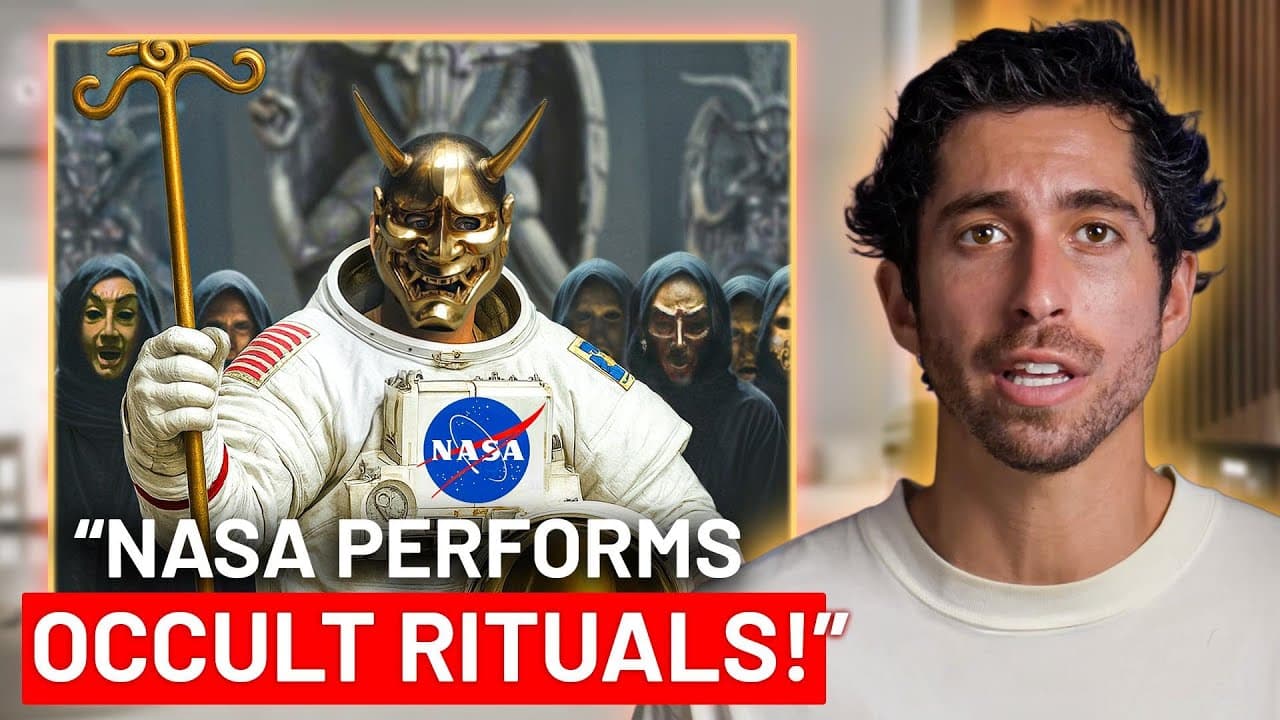
How Is Occultism Tied to NASA and Rocket Science?
TL;DR
Space exploration has a long occult and mystical undercurrent: Buzz Aldrin, a 33rd degree Scottish Rite Freemason, took communion and a Masonic silk flag to the moon, while Apollo 14's Edgar Mitchell ran a private ESP card experiment in transit that scored better than chance. Wernher von Braun encouraged Mitchell's consciousness research, and astronomer George Ellery Hale said an elf-like being gave him creative inspiration.
Transcript
What is rocket science really? In the beginning, God created the heaven and the earth. In this special episode of American Alchemy, we're going to pull on all of the threads of this hidden history. Sex magic, Nazi scientists, secret societies, launch rituals, rockets launched in time with pagan festivals, Walt Disney's hidden messages. This is the ... Read More
Key Insights
- Buzz Aldrin conducted the first religious ceremony on the moon, administering communion from a small silver chalice with wine and bread he carried in a personal kit, roughly two and a half hours after landing and before the first moonwalk on July 16, 1969.
- The Scottish Rite of Freemasonry is a branch steeped in esoteric symbols, ritual, and mysticism, and its highest rank, the 33rd degree, is symbolically tied to the 33 vertebrae of the spine, culminating in the crown chakra, described as the gateway to divine insight.
- Apollo 11 established an appendant body of the Masonic Lodge on the moon, according to the Masonic Grand Lodge of Ohio. Aldrin carried a small silk flag handstitched with the Scottish Rite symbol, now on full display at the Masonic Temple in Washington DC.
- Edgar Mitchell's in-flight ESP experiment used a set of cards to send mental images back to Earth, and colleagues who scored the results found them better than chance. He told the New York Times in 1971 that uses could be discussed once the mechanism is understood.
- Wernher von Braun, the former Nazi and father of American rocketry, was deeply supportive of Mitchell's psychic research, encouraging him to find a site within NASA to study consciousness and attending an early fundraising dinner for the Institute of Noetic Sciences.
- The overview effect, the experience of seeing Earth from space, was spiritual for Mitchell and made him wonder whether the entire cosmos might be conscious. Another speaker describes the Earth as too purposeful and beautiful to have happened by accident, implying a creator above human religions.
- Edwin Hubble's 1923 observation through the 100 inch Hooker telescope at Mount Wilson resolved individual stars inside Andromeda, proving it was a separate galaxy millions of light years away and shifting cosmic perspective as Copernicus had by removing Earth from the solar system's center.
- George Ellery Hale invented the spectroheliograph while at MIT, founded observatories including Mount Wilson, and built Caltech out of Throop Polytechnic. He put a tribute to Akhenaten above his Pasadena solar laboratory arch, and obituaries called him a priest of the sun.
Install to Summarize YouTube Videos and Get Transcripts
Explore YouTube Video Summarizer or Get YouTube Transcript Extractor
Questions & Answers
Q: What did Buzz Aldrin do on the moon that was religious?
Before the first moonwalk, about two and a half hours after touching down on July 16, 1969, Aldrin opened a small kit of personal items and quietly administered communion using a small silver chalice, a bit of wine, and a piece of bread he had brought with him. It was the first religious ceremony ever conducted on the moon. He later recalled the wine curling slowly and gracefully up the side of the cup, noting the first liquid ever poured on the moon was communion wine.
Q: Was Buzz Aldrin a Freemason, and what did he take to the moon?
Aldrin held the 33rd degree, the highest rank of the Scottish Rite of Freemasonry, a branch steeped in esoteric symbols, ritual, and mysticism. Among his belongings on Apollo 11 was a small silk flag handstitched with the Scottish Rite symbol, which is now on full display at the Masonic Temple in Washington DC. According to the Masonic Grand Lodge of Ohio, the Apollo 11 mission even established an appendant body of the Masonic Lodge on the moon.
Q: What is the significance of the 33rd degree in the Scottish Rite?
The 33rd degree is the highest rank in the Scottish Rite of Freemasonry, a branch of Freemasonry described as steeped in esoteric symbols, ritual, and mysticism. The rank is symbolically tied to the 33 vertebrae of the human spine, culminating in the crown chakra, which is said to be the gateway to divine insight. Buzz Aldrin, the second man to walk on the moon, held that rank, which is part of why researchers began asking questions about the meaning of the rituals performed there.
Q: What ESP experiment did Edgar Mitchell run on the way to the moon?
Edgar Mitchell, the Apollo 14 astronaut and sixth man to walk on the moon, conducted a private extrasensory perception experiment during his journey, attempting to send mental images back to Earth using a set of cards. Colleagues on Earth scored the results, which came out better than chance. Mitchell was open about it, telling the New York Times in 1971 that people are too uninformed about telepathy or ESP to project its uses, but that once the mechanism is understood, uses can be discussed.
Q: How did Wernher von Braun respond to psychic research at NASA?
Few people at NASA were interested in Edgar Mitchell's consciousness and psychic research, with one exception: Wernher von Braun, the former Nazi and father of American rocketry. According to Mitchell, von Braun was deeply supportive, even encouraging him to find a site within NASA where consciousness could be studied further. After his mission, Mitchell founded the Institute of Noetic Sciences, a think tank dedicated to consciousness, psychic phenomena, and metaphysics, and von Braun attended one of its early fundraising dinners.
Q: What is the overview effect and why did it matter to Edgar Mitchell?
The overview effect refers to the experience of seeing Earth from space. For Mitchell it was spiritual rather than merely visual, and it led him to wonder whether the entire cosmos might be conscious. He was not alone in that reaction. Another speaker in the episode describes the Earth as dynamic and overwhelming, with too much purpose, too much logic, and too much beauty to have happened by accident, concluding in a spiritual rather than religious sense that there must be a creator standing above the religions humans create to govern their lives.
Q: Why did Edwin Hubble's 1923 observation change our view of the universe?
In 1923, Hubble peered through the 100 inch Hooker telescope at Mount Wilson Observatory, which was powerful enough to resolve individual stars inside what most assumed was just a cloud of gas within our own galaxy. That cloud, Andromeda, turned out to be another galaxy entirely, millions of light years away. The discovery shattered the view that the Milky Way was the whole universe, showing it was one among many. The episode compares the shift to Copernicus removing Earth from the center of the solar system.
Q: Who was George Ellery Hale and why is he called mystical?
Hale was a physicist who invented the spectroheliograph while at MIT, a device that could capture solar flares erupting from the sun's surface, and who founded multiple observatories including Mount Wilson. He also transformed Throop Polytechnic into Caltech. He saw astronomy as a philosophy linking back to ancient Greece, Mesopotamia, Egypt, and Babylon, decorated astronomer lodges with Egyptian hieroglyphs, and claimed he received creative inspiration from a being he described as an elf or spirit. He put a tribute to Akhenaten above his Pasadena solar laboratory entrance, and his obituaries called him a priest of the sun and a modern Zoroaster.
Summary & Key Takeaways
-
On July 16, 1969, Neil Armstrong and Buzz Aldrin landed 230,000 miles from home. About two and a half hours later, before the first moonwalk, Aldrin opened a kit of personal items and administered communion with a small silver chalice, wine, and bread, the first religious ceremony conducted on the moon.
-
Aldrin also carried a small silk flag handstitched with the symbol of the Scottish Rite of Freemasonry, now displayed at the Masonic Temple in Washington DC. The Masonic Grand Lodge of Ohio says Apollo 11 established an appendant body of the Masonic Lodge on the moon. Aldrin held the 33rd degree.
-
Apollo 14 astronaut Edgar Mitchell, the sixth man to walk on the moon, conducted a private ESP card experiment during his journey. Colleagues scoring the results on Earth found them better than chance. He later founded the Institute of Noetic Sciences, a think tank on consciousness, psychic phenomena, and metaphysics.
-
George Ellery Hale invented the spectroheliograph at MIT and founded Mount Wilson Observatory, where Edwin Hubble's 1923 observation through the 100 inch Hooker telescope resolved Andromeda into a separate galaxy. Hale decorated astronomer lodges with Egyptian symbols and claimed an elf or spirit gave him inspiration.
-
The episode frames these as a pattern rather than isolated quirks, asking what rocket science really is. Mission patches still carry Roman gods and Latin phrases, and one insider reportedly answered that the audience for them is 'our sponsors,' hinting at acknowledgements to older powers behind the hardware.
Read in Other Languages (beta)
Share This Summary 📚
Summarize YouTube Videos and Get Video Transcripts with 1-Click
Try YouTube Summary with ChatGPT & Claude or YouTube Transcript Generator
Explore More Summaries from Jesse Michels 📚
Summarize YouTube Videos and Get Video Transcripts with 1-Click
Try YouTube Summary with ChatGPT & Claude or YouTube Transcript Generator