How to stand up to a manipulative daughter-in-law at a funeral
TL;DR
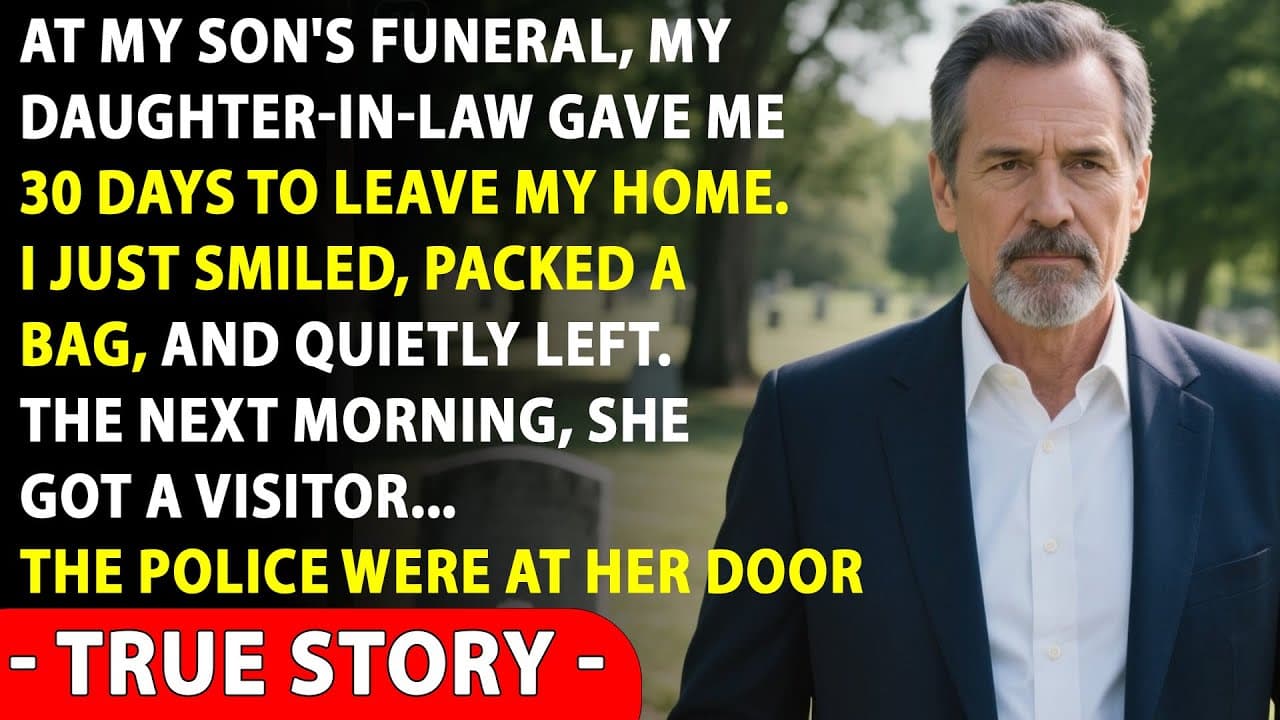
The narrator exposes that the house and finances were his to begin with, not his son’s widow’s. He stays quiet at first, then reveals the truth at the right moment and leverages David’s hidden records to resist eviction and reclaim his legacy. The key move is turning silence into a strategic reveal that shifts power back to the rightful owner.
Transcript
At my son's funeral, his wife threw me out of my own house. I'm Thomas Mitchell. What happened next changed everything. Picture this. Your child just died. You're grieving and your daughter-in-law looks you in the eye and says, "Stop crying. Pack your bags and get out of my house now." She called me a worthless burden in front of everyone at my son... Read More
Key Insights
- The truth about ownership is a turning point, revealing that David never owned the house and that the narrator retained control of finances and property.
- Victoria’s assumption that she was the beneficiary of the house and finances is exposed as a calculated control tactic rather than a factual transfer of ownership.
- Quiet strength and deliberate timing can be more powerful than loud confrontation when fighting for rightful claims.
- Visible signs of manipulation include erasing memories and controlling the narrative at the funeral and in the home.
- Hidden documents and long-term records become decisive assets in a family power struggle.
- The narrator distinguishes respect from fear, showing that dignity persists when one refuses to be cowed by manipulation.
- Societal expectations about care for elders are challenged by a practical, evidence-based defense of rights.
- The story demonstrates that true inheritance comes from documented ownership and financial responsibility, not appearances or assumptions.
Install to Summarize YouTube Videos and Get Transcripts
Explore YouTube Video Summarizer or Get YouTube Transcript Extractor
Questions & Answers
Q: How can someone prove ownership when a spouse claims everything belongs to them?
Proving ownership when a partner claims control involves gathering and presenting documentary evidence that clearly establishes legal title, asset ownership, and responsibility for debts. In the narrative, the crucial step is uncovering historical records that show David did not legally own the house, and that the narrator retained ownership and financial oversight. This approach shifts the burden of proof and legitimizes the rights of the rightful owner, especially when manipulated narratives attempt to minimize or erase decades of contribution.
Q: What role do quiet actions play in confronting manipulation?
Quiet actions can be a powerful counterforce to manipulation because they avoid giving the manipulator the emotional fuel of a heated reaction. In the story, the narrator’s restrained demeanor, careful listening, and deliberate planning create space for truth to surface. This restraint prevents escalation, preserves credibility, and allows time to assemble verifiable evidence that exposes the manipulation without being drawn into a destabilizing conflict.
Q: Why are memories and mementos targeted in family power struggles?
Memories and mementos are targeted because they symbolize legitimacy, shared history, and emotional attachment to a rightful place. By removing photos and keepsakes, a manipulator attempts to rewrite identity and undermine the other person’s claim to history and legitimacy. In the narrative, erasing Margaret and David’s memorabilia is a tactic to sever the emotional anchor that supports the rightful owner’s narrative and rights.
Q: How does a character use a timeline or dates in a dispute over a home?
A timeline or specific dates can anchor a dispute by clarifying when ownership, responsibility, and arrangements actually began or ended. In the story, a timeline would reveal the true sequence of events and who paid for what, exposing assumptions that Victoria exploited. Concrete dates help prevent opportunistic reinterpretation and establish a factual framework for negotiations or legal steps.
Q: What is the significance of questioning assumed ownership in inheritance conflicts?
Questioning assumed ownership is crucial because assumptions can be based on appearances rather than documented reality. In the narrative, Victoria assumes David owned everything because he managed finances, but the truth lies in the documents that prove who owned the house and who bore the obligations. Challenging assumptions prevents a single person from rewriting family history to suit their agenda.
Q: What strategies help defend an elder family member’s rights without escalating conflict?
Strategies include gathering verifiable records, documenting contributions and financial responsibilities, communicating with clarity and restraint, and seeking lawful channels when necessary. The story demonstrates how careful preparation, credible evidence, and measured discourse can protect an elder’s rights while minimizing interpersonal damage and preserving dignity for all involved.
Q: How can a person balance dignity with firmness in a confrontation over finances?
Balancing dignity with firmness involves staying true to one’s values, maintaining respectful dialogue, and relying on factual proof rather than emotions. In the narrative, the narrator refuses to be coerced, keeps emotions in check, and uses a well-timed disclosure of evidence to assert rightful ownership. This approach preserves dignity while confidently defending essential financial and home rights.
Q: What lesson about respect and truth can viewers take from this story?
The core lesson is that respect is earned through truth and fairness, not through domination or coercion. When appearances are weaponized to erase someone’s history, exercising patience, gathering evidence, and speaking truth at the right moment can restore balance and ensure that long-standing contributions are acknowledged and protected.
Summary & Key Takeaways
-
The narrator recalls decades of memories and how Victoria treated the house as hers after David’s death, prompting a strategic response rather than blind compliance.
-
He discovers crucial records that prove ownership and control over finances, foiling Victoria’s attempt to rewrite the family history.
-
Ultimately, the narrator uses patient restraint and a planned disclosure to turn the tables and defend his rights and dignity.
Read in Other Languages (beta)
Share This Summary 📚
Summarize YouTube Videos and Get Video Transcripts with 1-Click
Try YouTube Summary with ChatGPT & Claude or YouTube Transcript Generator
Explore More Summaries from Silken Vengeance 📚





Summarize YouTube Videos and Get Video Transcripts with 1-Click
Try YouTube Summary with ChatGPT & Claude or YouTube Transcript Generator