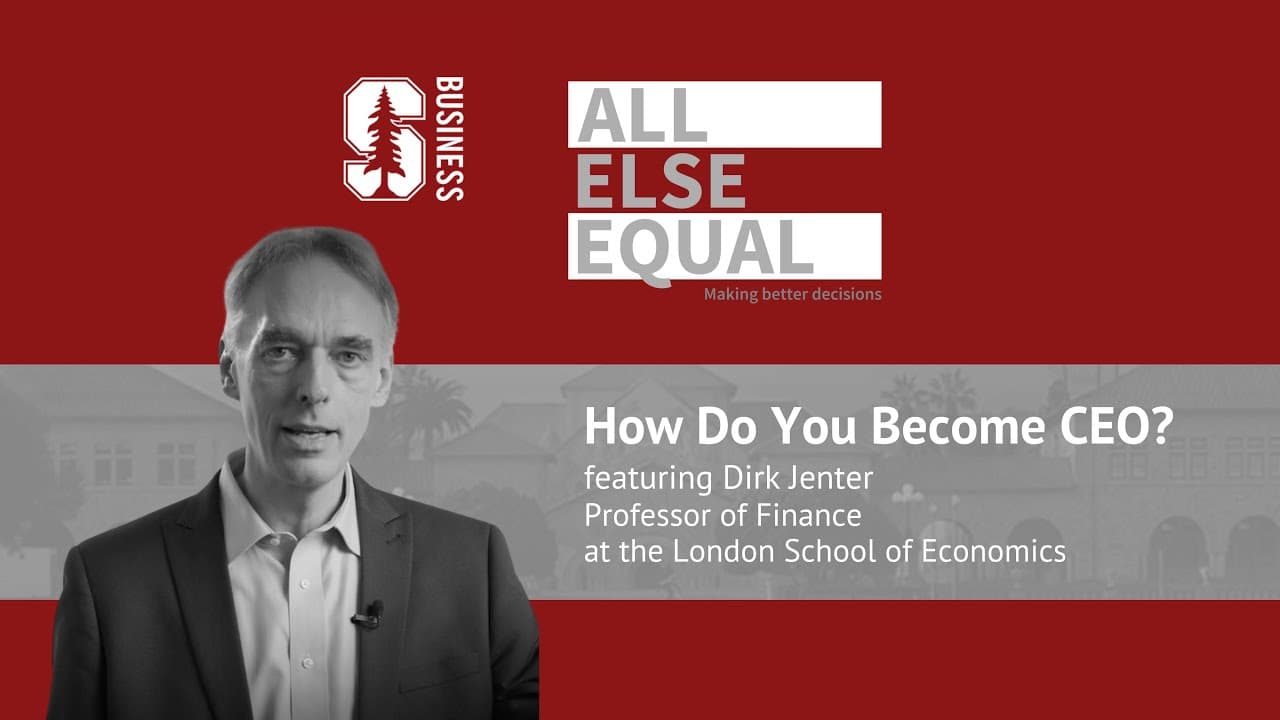
Ep29 “How Do You Become CEO?” with Dirk Jenter
TL;DR
To become a CEO, focus on gaining diverse experience within a company, as over 80% of new S&P 500 CEOs are internal promotions. Building a broad skill set across various functions is essential, and joining a company where you can grow into this role years in advance increases your chances of success.
Transcript
[MUSIC] Hi, I'm Jules Van Binsbergen, and a finance professor at the Wharton School of the University of Pennsylvania. >> And I'm Jonathan Berk, a finance professor at the Graduate School of Business at Stanford University. >> And this is the All Else Equal podcast. [MUSIC] Welcome back, everybody. Today is going to be our last episode before we go... Read More
Key Insights
- 💱 CEOs have a significant impact on company performance and behavior, leading to changes in firm performance when CEOs change.
- ❓ Insider hires dominate CEO appointments, as they possess valuable company-specific knowledge and networks.
- 🪡 CEO compensation is driven by market forces, the scale of companies, and the need to ensure fairness and motivation.
Install to Summarize YouTube Videos and Get Transcripts
Explore YouTube Video Summarizer or Get YouTube Transcript Extractor
Questions & Answers
Q: Why do CEOs matter to companies?
CEOs matter because when a CEO changes, the company tends to undergo significant changes in both behavior and performance. Evidence shows that CEOs have a direct impact on a company's success.
Q: What is the typical background of a CEO?
The majority of CEOs are promoted internally, often from the divisional or executive level. There is a shift towards CEOs having a broad range of experience and skills across multiple companies and functions.
Q: Why are insider hires dominant in CEO appointments?
Insider hires are common because company-specific knowledge, understanding of culture, and networks within the company are highly valuable for effective leadership. Outsider hires are typically seen in crisis situations.
Q: Are CEOs typically only CEOs of one company?
Yes, the vast majority of CEOs are CEO of only one company. CEO positions are seen as highly valuable, and CEOs generally stay with a company long-term.
Q: How is CEO compensation structured?
CEO compensation is structured to attract and retain top talent. It is often influenced by peer pay, as CEOs compare their pay to that of their peers to assess fairness and motivation.
Summary
In this episode of the All Else Equal podcast, Jules Van Binsbergen and Jonathan Berk discuss the importance of CEOs with Dirk Jenter, a finance professor at the London School of Economics. They explore the impact CEOs have on companies, the characteristics required to become a CEO, and the fairness of CEO compensation.
Questions & Answers
Q: Why should we be interested in CEOs and why do they matter for the world?
CEOs matter because when a CEO changes or a company changes its CEO, the company tends to change in terms of behavior and performance. While it's difficult to determine whether the changes are solely caused by the CEO or part of a larger change program, the fact that boards believe CEOs are important suggests their impact. Additionally, research shows that structured management processes strongly correlate with company performance, indicating that management matters.
Q: What are the characteristics required to become a CEO?
Research on new S&P 500 CEOs over the past 30 years reveals that the majority (over 70%) are promoted from within the company. Another 10% are former executives or board members of the same company. This suggests that becoming a CEO often requires a long-term commitment to a single company. The modern CEO's CV typically includes a college degree, an MBA, experience in multiple companies and functions, and general managerial skills. The key is to join the company in which you want to become a CEO at least five to ten years before you are ready for that role.
Q: Are CEOs typically only CEO of one company or can they be CEOs of multiple companies?
The vast majority of CEOs are only CEOs of one company. While there is a perception that CEOs move between companies, the reality is that most CEOs remain with a single company throughout their careers.
Q: Why do boards primarily hire internally for CEO positions instead of utilizing a competitive labor market for managerial talent?
There are several reasons boards prefer internal hires. Firstly, insiders possess firm-specific knowledge, culture, and networks that external candidates lack. Secondly, there is lower risk in hiring someone already known and trusted within the company. Finally, the downside of hiring the wrong CEO is high and can be detrimental to the company, thus incentivizing boards to prioritize familiarity over a competitive labor market.
Q: How is CEO compensation structured and is it fair?
CEO pay is often criticized for being exorbitantly high, but the market capitalization of large firms justifies the scale of these amounts. Boards primarily focus on the pay of peer CEOs when determining CEO compensation, as CEOs use this information to assess the fairness of their own pay. Boards aim to avoid situations where CEOs perceive their pay to be unfair, as it can undermine their intrinsic motivation and lead to lower performance. The structure of CEO compensation is complex and contested, and there is ongoing debate about its fairness.
Q: Is there a competitive labor market for CEOs where firms hire top executives away from other companies?
The data suggests that there is not a vibrant market for CEOs. The majority of new CEO hires are internal promotions, and less than 3% of new CEOs are poached from other companies. When external hires do occur, they often involve individuals who have worked closely with the hiring firm's directors. This indicates that boards prioritize familiarity and existing relationships over aggressive hiring from external companies.
Q: How do boards set CEO pay and why is there a focus on peer pay rather than other factors?
Boards heavily rely on the pay of peer CEOs when setting CEO compensation. This is not driven by concerns about CEOs being hired away by other companies, as the market for CEO talent is not as competitive as assumed. The focus on peer pay stems from CEOs' psychological need for fair treatment and recognition. Boards want to avoid situations where CEOs perceive their pay to be unfairly low compared to their peers, as it can harm their intrinsic motivation and performance.
Q: Are CEOs worth the high salaries they receive?
The market capitalization of large firms justifies the high salaries of CEOs, as their impact on company value can be substantial. While the high salaries may seem excessive, the scale of these companies and the importance of leadership warrants their compensation. The perception of worthiness will vary, but it's important to consider the value CEOs bring to their organizations.
Q: Can CEOs be hired back after leaving a company, like Steve Jobs returning to Apple?
It is not uncommon for companies to bring back former executives as CEOs, particularly during times of crisis. This practice is driven by the belief that former insiders possess valuable knowledge and understanding of the company, its culture, and its challenges. Boards often turn to familiar faces in these situations, who may be more likely to stabilize the company and navigate it through difficult times.
Q: Is there a correlation between CEO pay and company performance?
The relationship between CEO pay and company performance is complex and the subject of ongoing research. While some studies suggest a positive correlation, others find no clear connection. It is difficult to disentangle the impact of CEO actions from broader factors influencing company performance. The fairness and effectiveness of CEO pay remain a topic of debate.
Takeaways
CEOs play a crucial role in shaping companies and their performance. Research indicates that CEOs have a significant impact on firm behavior and outcomes. To become a CEO, individuals should join the company they aspire to lead five to ten years before aiming for that role. CEO positions are primarily filled internally, indicating the importance of firm-specific knowledge and relationships. CEO compensation is a complex issue, with boards focused on peer pay and perceived fairness rather than a competitive labor market. The high salaries of CEOs are justified by the scale of the companies they lead. The correlation between CEO pay and performance is still under investigation.
Summary & Key Takeaways
-
CEOs have a significant impact on company performance and behavior, with changes in CEOs often resulting in changes in firm performance.
-
Hiring CEOs from within the company is the norm, with insider hires making up the majority of new CEO appointments in S&P 500 companies.
-
CEO compensation is structured to attract and retain top talent, with a focus on peer pay to ensure fairness and motivate CEOs to perform their best.
-
Pay levels for CEOs of large publicly traded companies can be high due to the scale of these companies and the potential value they can create.
Read in Other Languages (beta)
Share This Summary 📚
Summarize YouTube Videos and Get Video Transcripts with 1-Click
Try YouTube Summary with ChatGPT & Claude or YouTube Transcript Generator
Explore More Summaries from Stanford GSB Podcasts 📚






Summarize YouTube Videos and Get Video Transcripts with 1-Click
Try YouTube Summary with ChatGPT & Claude or YouTube Transcript Generator