How the Boeing 787 Works | Full Documentary
TL;DR
This video provides a comprehensive deep dive into the engineering marvel that is the Boeing 787 Dreamliner. It explores how the aircraft revolutionized the airline industry with its use of composite materials, innovative design features, and advanced engine technology, all contributing to enhanced fuel efficiency, passenger comfort, and reduced environmental impact.
Transcript
This video is brought to you by Grand News. Sign up today and get 40% off your subscription. If you were not paying attention, you may not have noticed the revolution happening in the airline industry. The days of attempting to build bigger and bigger airliners like the 850 passenger double-decker A380 and the 660 passenger Humpt 747 are gone. The ... Read More
Key Insights
- The Boeing 787 Dreamliner is a revolutionary aircraft that has transformed the airline industry with its advanced use of composite materials, primarily carbon fiber reinforced plastics.
- Composite materials in the 787 offer significant advantages, including reduced weight, increased strength, and improved aerodynamics, which contribute to enhanced fuel efficiency and passenger comfort.
- The 787's fuselage is pressurized to an equivalent of 6,000 feet, compared to 8,000 feet in previous aircraft, reducing passenger discomfort and jet lag effects.
- The Dreamliner features massive windows made possible by composites' resistance to fatigue, allowing for larger openings without compromising structural integrity.
- The aircraft's wings are designed with a high aspect ratio and supercritical airfoil, optimizing them for fuel efficiency and increased range by reducing vortex drag.
- The GENX engines on the 787 are highly efficient, utilizing a high bypass ratio and advanced materials like gamma titanium aluminite to achieve 15% lower fuel consumption than previous engines.
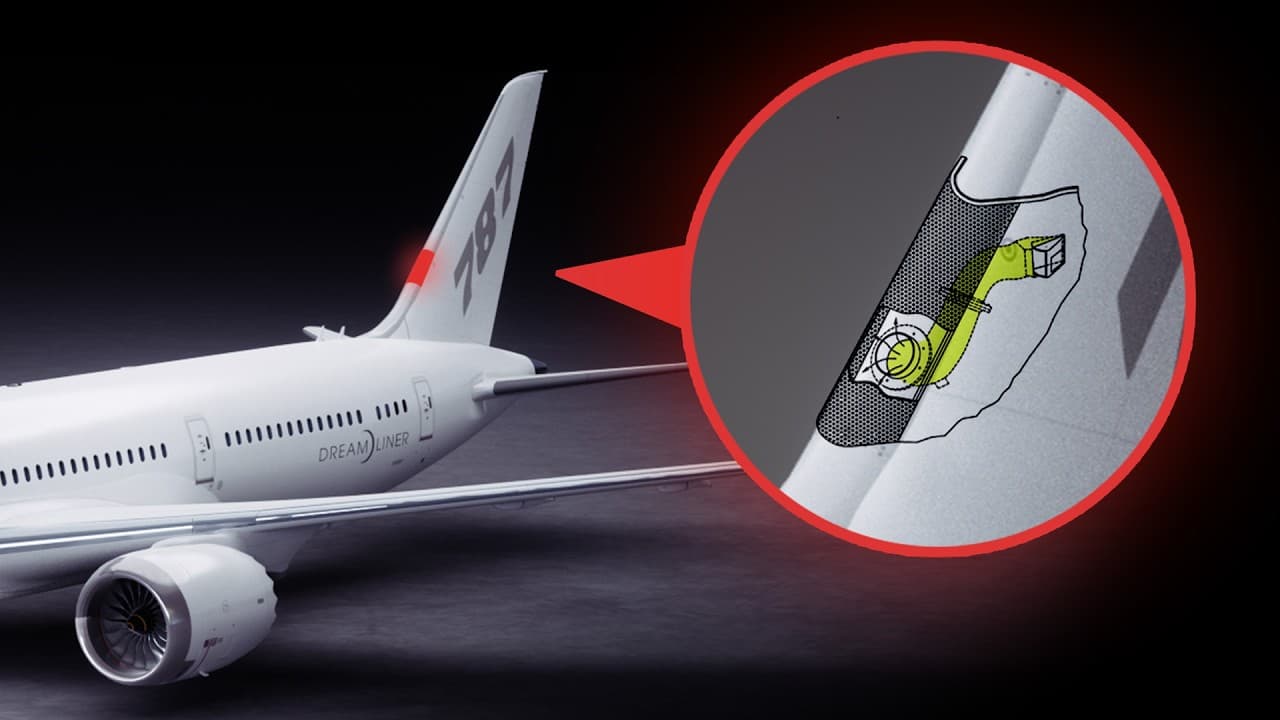
- Boeing's use of hybrid laminar flow control and other aerodynamic innovations in the 787 help minimize drag and improve overall aircraft performance.
- The 787's electrical systems, including electric braking and cabin pressurization, replace traditional pneumatic systems, contributing to weight savings and increased efficiency.
Install to Summarize YouTube Videos and Get Transcripts
Explore YouTube Video Summarizer or Get YouTube Transcript Extractor
Questions & Answers
Q: What role do composite materials play in the Boeing 787's design?
Composite materials are crucial to the Boeing 787's design, making up 55% of the aircraft by weight. These materials, such as carbon fiber reinforced plastics, offer significant advantages in terms of strength and weight reduction compared to traditional metals like aluminum. This enables the 787 to have larger windows, improved aerodynamics, and enhanced fuel efficiency, revolutionizing the way modern aircraft are built and operated.
Q: How does the 787's pressurization system improve passenger comfort?
The 787's pressurization system significantly improves passenger comfort by maintaining a cabin pressure equivalent to 6,000 feet, compared to the 8,000 feet standard in older aircraft. This lower cabin altitude reduces the effects of jet lag and discomfort, such as bloating and reduced oxygen intake, making long-haul flights more pleasant for passengers. The stronger composite fuselage allows for this increased pressure without compromising structural integrity.
Q: What are the benefits of the 787's high aspect ratio wings?
The high aspect ratio wings of the 787 provide several benefits, including improved fuel efficiency and increased range. By having a longer and narrower shape, these wings reduce vortex drag, which is the energy lost due to air mixing at the wingtips. This design, combined with the use of composite materials, allows the aircraft to glide more efficiently, similar to a glider, and supports the 787's goal of being an efficient long-range aircraft.
Q: How do the GENX engines contribute to the 787's efficiency?
The GENX engines on the 787 contribute to its efficiency through a combination of high bypass ratios and advanced materials. These engines have a bypass ratio of 9:1, meaning they move a large volume of air around the engine core, increasing fuel efficiency. Additionally, the use of lightweight carbon fiber fan blades and gamma titanium aluminite in the turbine section helps reduce weight and improve performance, resulting in a 15% reduction in fuel consumption compared to previous engines.
Q: What is hybrid laminar flow control and how does it benefit the 787?
Hybrid laminar flow control is a technology used in the 787 to delay and control the formation of turbulent airflow over the aircraft's surfaces. By using a suction system to draw in slow-moving boundary layer air, this technology reduces drag and improves fuel efficiency. Although details are sparse due to its proprietary nature, it is known to significantly contribute to the 787's aerodynamic performance, allowing for reduced fuel burn and enhanced efficiency.
Q: How does the 787's electrical system differ from traditional aircraft systems?
The 787's electrical system differs from traditional aircraft systems by eliminating the use of bleed air for powering various systems. Instead, it uses electrical power for cabin pressurization, braking, and other functions, reducing the aircraft's reliance on engine-driven pneumatic systems. This shift results in weight savings, increased efficiency, and a more streamlined design. The aircraft is equipped with multiple generators to provide the necessary electrical power, making it one of the most electrically advanced airliners.
Q: What challenges did Boeing face with the use of composite materials in the 787?
Boeing faced several challenges with the use of composite materials in the 787, including issues with galvanic corrosion when composites were in contact with aluminum. To address this, Boeing used titanium, which is more compatible with carbon fiber, but also more expensive. Additionally, the manufacturing process for composite parts required significant investment in new technologies and facilities, such as large curing ovens and automated tape laying machines, to produce the aircraft's components efficiently.
Q: How do the 787's engines reduce noise pollution?
The 787's engines reduce noise pollution through the use of chevrons on the fan casing and engine exhaust. These sawtooth patterns help control the mixing of high-speed exhaust air with the ambient air, reducing the formation of vortices that generate noise. This design feature, combined with the engines' overall quieter operation, results in a 60% reduction in noise compared to similar-sized aircraft, enhancing passenger comfort and reducing environmental impact.
Summary & Key Takeaways
-
The Boeing 787 Dreamliner is an engineering marvel that has redefined air travel with its use of composite materials, offering enhanced fuel efficiency and passenger comfort. The aircraft's innovative design features, such as high aspect ratio wings and advanced GENX engines, contribute to its status as a leading example of modern aeronautical engineering.
-
Composite materials are central to the 787's design, providing significant weight savings and strength improvements over traditional materials. This allows for larger windows and a more comfortable cabin environment, while also enabling the aircraft to achieve greater fuel efficiency and range.
-
The GENX engines of the 787 are a key component of its efficiency, utilizing a high bypass ratio and advanced fuel injection technology to reduce fuel consumption by 15%. The aircraft's electrical systems further enhance performance by replacing traditional pneumatic systems, leading to additional weight savings and efficiency gains.
Read in Other Languages (beta)
Share This Summary 📚
Summarize YouTube Videos and Get Video Transcripts with 1-Click
Try YouTube Summary with ChatGPT & Claude or YouTube Transcript Generator
Explore More Summaries from Real Engineering 📚





Summarize YouTube Videos and Get Video Transcripts with 1-Click
Try YouTube Summary with ChatGPT & Claude or YouTube Transcript Generator