What Is Programming? A Beginner's Intro to Computer Science
TL;DR
Programming is getting a computer to complete a specific task without mistakes by giving extremely precise instructions. Because computers only understand binary machine code, programmers use programming languages as a middleman that translates human-readable instructions into ones and zeros, written and run inside an IDE following each language's strict syntax rules.
Transcript
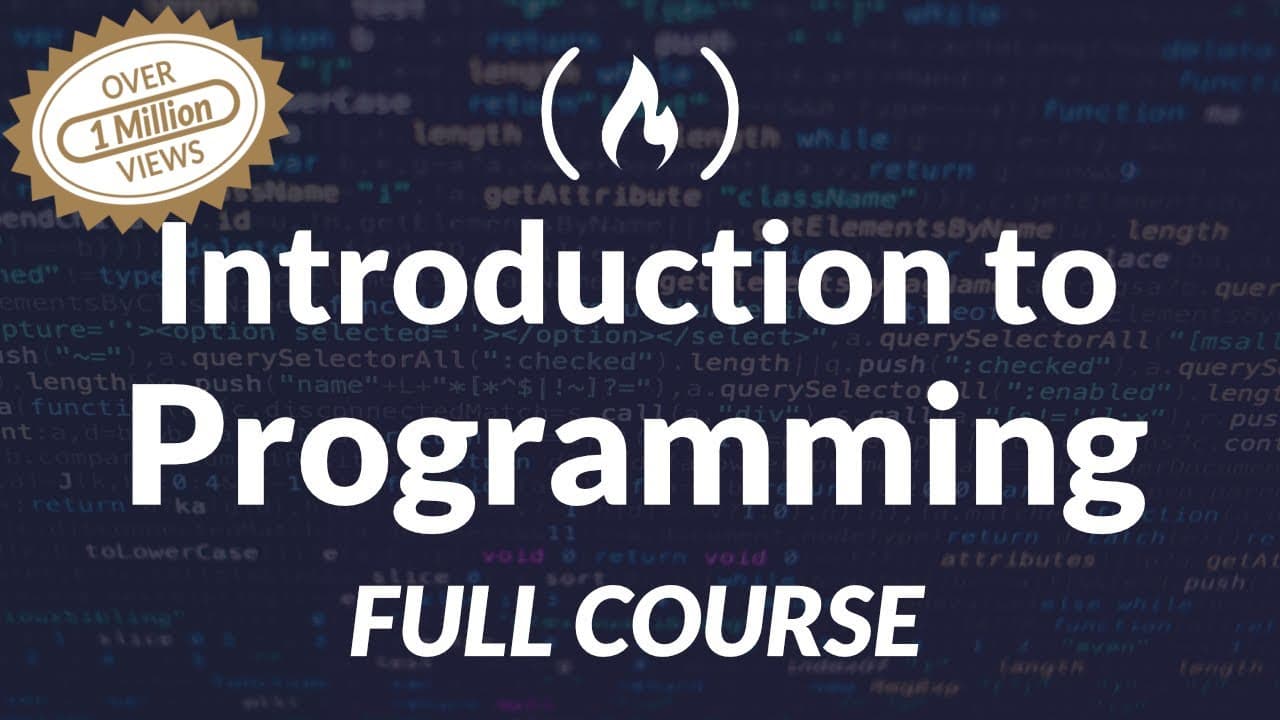
Welcome to Introduction to programming. My name is Steven in my name is Shawn. Over the next 90 minutes, we'll be taking you through this series consisting of 21 different segments that hope to cover the basics of computer programming, which can apply to any and all programming languages you might want to learn. We'll be starting with the sim... Read More
Key Insights
- Programming is essentially attempting to get a computer to complete a specific task without making mistakes, which requires giving very specific instructions because even one unplaced piece can corrupt the entire goal.
- Computers are actually very dumb, and their sophisticated functionality comes entirely from how humans manipulate them to serve our needs, not from any inherent intelligence.
- Machine code is a numerical language known as binary made of ones and zeros, designed so the computer can quickly read it and carry out instructions; every instruction is converted into a string of ones and zeros.
- Programming languages are fundamentally a middleman for translating a program into machine code, and they are much easier for humans to learn than binary, acting like an interpreter between English and the computer.
- A language's power or level is measured by how similar it is to machine code; low-level languages like assembly or C are closer to binary, while high-level languages like Java or Python are further away.
- An IDE (integrated development environment) provides a graphic interface to write, run, and debug code, turning your code into machine code with tools like built-in error checking, auto-filling, and a project hierarchy.
- Syntax is a programming language's grammar, the set of rules you must follow to a tee for your program to run correctly, and each language has its own unique syntax even if some rules overlap.
- Breaking or disregarding a language's syntax rules will result in an error, just as breaking rules of grammar in real life produces an unintended message.
Install to Summarize YouTube Videos and Get Transcripts
Explore YouTube Video Summarizer or Get YouTube Transcript Extractor
Questions & Answers
Q: What is programming in simple terms?
In layman's terms, programming is essentially attempting to get a computer to complete a specific task without making mistakes. The video compares it to giving a less-than-intelligent friend very specific instructions to build a Lego set with no instructions of their own. If even one piece is not told exactly where and how to be placed, the entire set is ruined. Programmers feed information on how to complete a program like a game or web application in the same detailed way.
Q: Why do we need programming languages instead of writing machine code directly?
Computers only understand machine code, a numerical binary language of ones and zeros. Directly translating what you want into machine code is extremely difficult, in fact almost impossible, and would take a very long time because each program is composed of millions upon millions of ones and zeros. Programming languages are a middleman that translate a program into machine code. They are much easier for humans to learn than binary, acting like an interpreter that converts your English instructions into something the computer can understand.
Q: What is the difference between low-level and high-level programming languages?
A programming language's power or level is measured by how similar it is to machine code, the series of zeros and ones. Low-level programming languages such as assembly or C are closer to binary, while high-level programming languages such as Java or Python are further away. The basic idea is that the lower the level of your language, the more your code will resemble what the machine can directly interpret as instructions. High-level languages are further from machine code but easier for humans to work with.
Q: What is an IDE and why is it used?
IDE stands for integrated development environment, and it allows the facilitation of code by a computer. It provides a graphic interface where the programmer can easily write, run, and debug code without worrying about problems with compilation or interpretation. IDEs turn your code into machine code and run it to produce results. They also provide useful tools like built-in error checking, auto-filling for frequently used words or phrases, and a project hierarchy to organize files. IDEs are used in almost 100% of programming projects.
Q: What is syntax in programming?
Syntax is the term for programming grammar, and it is very similar to real-world grammar. Each programming language has its own syntax, or set of rules that you must follow to a tee if you want your program to run correctly. These rules can include things such as how you type out certain functions, what you put at the end of a line of code, and how you set up certain functions. Each language is unique in its syntax, and while some may share similar rules, all have some quirk that makes them stand out.
Q: How do you choose which programming language to learn?
Aside from the different purposes each language fulfills, choosing a language typically comes down to a matter of preference, since there are usually many languages that can accomplish similar tasks. Different languages have different uses: general-purpose languages like Python and Java can perform a variety of computational tasks, while HTML or CSS are designed for more specific purposes like constructing a website. The video suggests trying different languages and deciding which rules, interface, and level of simplification you like best.
Q: Why are computers described as dumb?
The video emphasizes that computers are actually very dumb. We built them up to be a super sophisticated piece of technology, when in actuality a computer's main functionality comes entirely from how we manipulate it to serve our needs. On their own, computers only understand machine code and cannot interpret human instructions or random words. They carry out only exactly what they are told, which is why programmers must provide extremely specific instructions translated through a programming language for the computer to do anything useful.
Q: What topics does this introduction to programming course cover?
The 90-minute series consists of 21 segments covering basics that apply to all programming languages. According to the description, topics include what programming is, how to write code, getting information from computers, variables and how to manipulate them, conditional statements, arrays, loops, errors, debugging, functions, importing and making your own functions, ArrayLists and dictionaries, data structures, recursion, pseudocode, choosing the right language, and applications of programming. It deliberately avoids language-specific topics like object-oriented coding and command line navigation.
Summary & Key Takeaways
-
This 90-minute lecture-style series by Steven and Shawn covers 21 segments teaching computer programming basics that apply to any language. It targets people interested in coding who have no idea where to start, deliberately avoiding language-specific topics like object-oriented coding and command line navigation, and requires no software downloads.
-
Programming means getting a less-than-intelligent computer to complete a task without mistakes through precise instructions. Since computers only understand binary machine code, and directly translating human intent into millions of ones and zeros is nearly impossible, programming languages serve as an easier-to-learn middleman that translates programs into machine code.
-
Code is written inside an IDE, which provides a graphic interface to write, run, and debug programs plus tools like error checking and auto-fill. Every language enforces its own syntax, the grammar rules you must follow exactly, and disregarding those rules produces errors that stop the program from running correctly.
Read in Other Languages (beta)
Share This Summary 📚
Summarize YouTube Videos and Get Video Transcripts with 1-Click
Try YouTube Summary with ChatGPT & Claude or YouTube Transcript Generator
Explore More Summaries from freeCodeCamp.org 📚



Summarize YouTube Videos and Get Video Transcripts with 1-Click
Try YouTube Summary with ChatGPT & Claude or YouTube Transcript Generator