How Does a Basic Java Hello World Program Work?
TL;DR
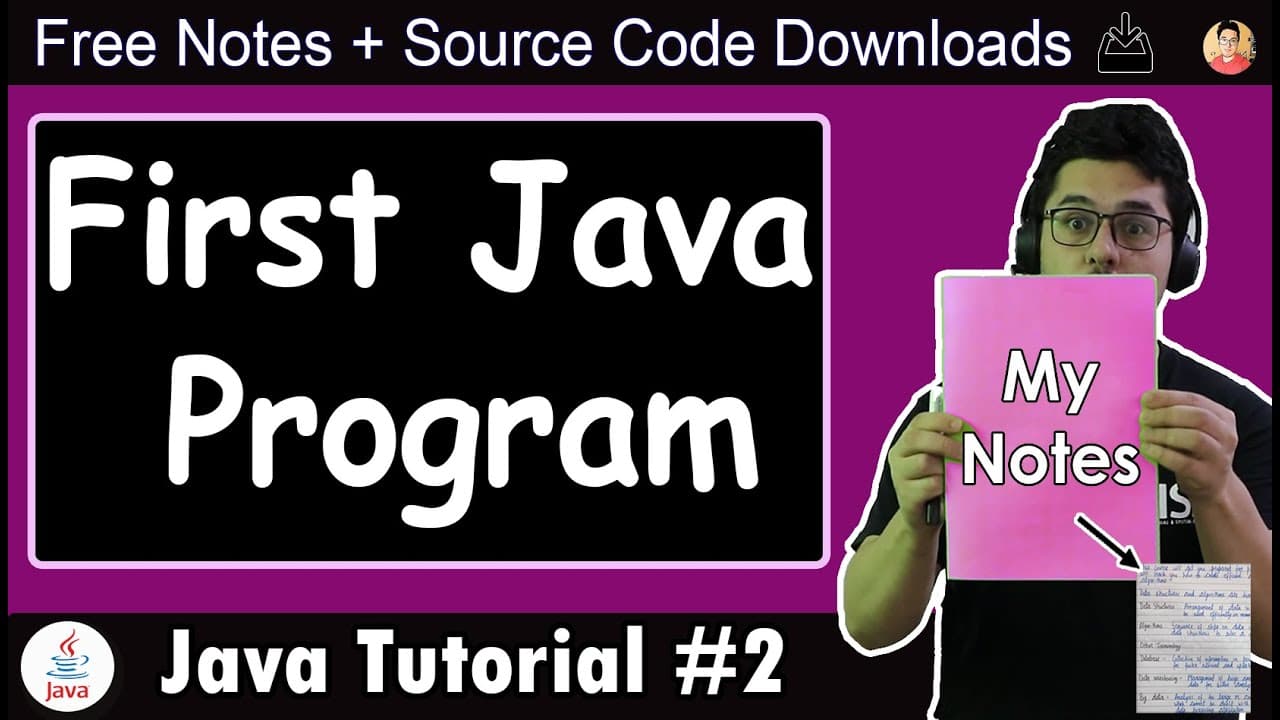
A Java program starts execution from the main method, where statements such as the Hello World output instruction are placed. The example organizes main inside a class and the class inside a package, while public, static, and void describe accessibility, object-free invocation, and the absence of a returned value. Java classes use PascalCase, methods use camelCase, and // marks an ignored comment.
Transcript
Guys in the previous video we had installed the tools and accessories to run java we had installed the jdk and we had installed IntelliJ Idea in our computer. Guys java is a very beautiful and strong language and in today's video we will explore that java program which we wrote in the previous video. Guys one more thing is that this is the 1000th v... Read More
Key Insights
- A Java program is organized around packages, classes, functions, and executable statements. In the example, the com.company package contains the Main class, the class contains the main method, and the method contains the code that produces the Hello World output.
- The main method is the starting point of the demonstrated Java program. Code placed inside public static void main() is executed when the program starts, making the method the location for statements that should run at the beginning.
- A function is grouped code designed to perform a particular task. A function for adding two numbers, for example, contains the relevant code and can perform that work repeatedly whenever the function is called.
- A class is a collection that can group similar functions. The household-repair analogy treats the class as a shared category containing specialized functions represented by a plumber, carpenter, painter, and other workers who perform related tasks.
- A class is a template from which objects are created. The form analogy compares a class to a blank form containing fields such as name, address, phone number, and age, while a completed entity created from that form represents an object.
- The static keyword allows the main method to run without creating an object of its class. It is used when a function can operate independently of a particular object while still residing within a class.
- The public, void, and String[] args elements describe aspects of main. Public indicates that the method can be accessed from anywhere, void indicates that it returns nothing, and String[] args identifies the arguments received by the function.
- Java naming conventions distinguish classes from functions. Class names use PascalCase, with every word beginning in uppercase, while function names use camelCase, with a lowercase initial letter and uppercase initials for subsequent words. Double forward slashes introduce comments that Java ignores.
Install to Summarize YouTube Videos and Get Transcripts
Explore YouTube Video Summarizer or Get YouTube Transcript Extractor
Questions & Answers
Q: What is the basic structure of a Java program?
The demonstrated Java program contains a package, a class, a main method, and executable code inside that method. The com.company package groups the program's classes and functions. The Main class contains public static void main(), which serves as the program's starting point. Statements placed inside main are executed, including the instruction that produces the Hello World output.
Q: What is the main method in a Java program?
The main method is presented as the starting point of a Java program. When the program begins, execution starts from main, and the code written inside its body runs. In the example, the method appears inside the Main class as public static void main(), with String[] args specifying the arguments that the function receives.
Q: What does a function do in Java?
A function groups code that performs a particular task. For example, a function created to add two numbers contains the code needed for that operation. Whenever the same work is required, the function can be called again. The plumber analogy illustrates this idea: calling a plumber represents invoking a function to complete a specific repair task.
Q: What is the difference between a Java class and a function?
A function contains grouped code for a particular task, while a class groups similar functions together. The household-repair analogy treats individual workers, such as a plumber, carpenter, or painter, as task-specific functions. Household Repair represents the class that unifies those related capabilities, allowing the required function to be selected and called when its work is needed.
Q: What is the difference between a class and an object?
A class is described as a template through which objects are made. The form analogy uses a blank form containing fields such as name, address, phone number, and age to represent the class. Once the form is filled and becomes a specific entity, that completed entity represents an object created from the class template.
Q: What do public, static, and void mean in Java main?
Public is an access modifier indicating that the method can be accessed from anywhere. Static makes it possible to run the method without first creating an object of the class. Void indicates that the function returns no value after it is called. Together, these keywords describe how the main method can be accessed, invoked, and completed.
Q: How should Java classes and functions be named?
Java class names use PascalCase, which capitalizes the first letter of every word, including the first word. Function names use camelCase, which begins with a lowercase letter and capitalizes the first letter of each later word. For example, the phrase add two numbers becomes AddTwoNumbers in PascalCase and addTwoNumbers in camelCase because identifier names cannot contain spaces.
Q: How do comments work in a Java program?
A Java comment can begin with two forward slashes, written as //. Text following those marks is treated as a note and ignored rather than processed as executable code. Without the comment marks, arbitrary note text can cause an error because Java attempts to interpret it as program code. Adding // allows the program to run and produce the earlier Hello World output.
Summary & Key Takeaways
-
The Hello World program is divided into a package, a class, a main method, and the statements inside that method. The com.company package groups related classes and functions. The Main class contains the program's starting point, while the code placed inside main is executed when the Java program begins running.
-
Functions group code that performs a particular task and can be called whenever that task is needed. Classes collect similar functions and act as templates for objects. The household-repair analogy presents a class as the overall service and functions as specialized workers, such as a plumber, carpenter, or painter.
-
The main declaration introduces several Java keywords and conventions. Public describes access, static permits execution without creating a class object, void means no value is returned, and String[] args represents received arguments. Classes follow PascalCase, methods follow camelCase, and text following // is treated as a comment and ignored.
Read in Other Languages (beta)
Share This Summary 📚
Summarize YouTube Videos and Get Video Transcripts with 1-Click
Try YouTube Summary with ChatGPT & Claude or YouTube Transcript Generator
Explore More Summaries from CodeWithHarry 📚




Summarize YouTube Videos and Get Video Transcripts with 1-Click
Try YouTube Summary with ChatGPT & Claude or YouTube Transcript Generator