How to Make Novolac Resin for Bakelite
TL;DR
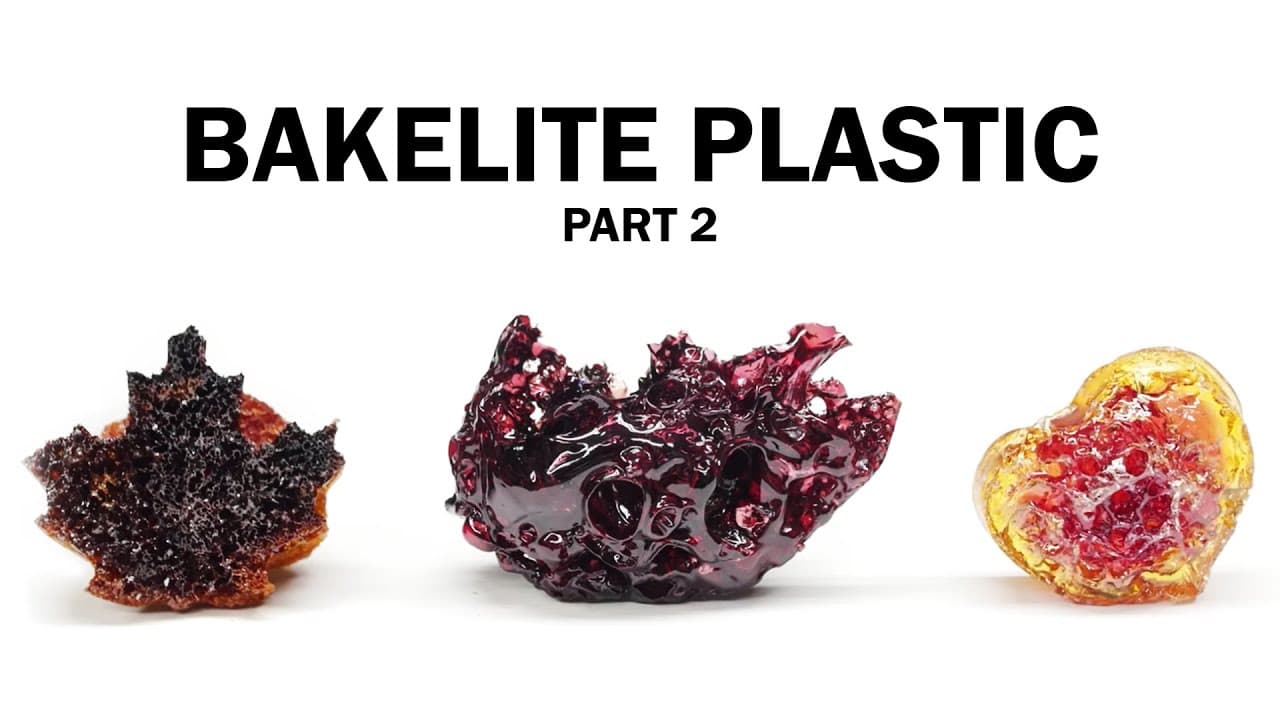
To make novolac resin for bakelite, mix phenol and formaldehyde in a ratio of 1.2:1 and heat the mixture with sulfuric acid. The reaction forms pre-polymers that can be stabilized with hexamine, producing a hard but brittle resin that can resemble hard candy in texture.
Transcript
welcome to part two of this video in the first part we made wrestle and did the classic bakelite demonstration and in the second part I'm going to be making the other type of resin which is called novolac I highly suggest that you watch the first part before this one otherwise things might be a little confusing to make the novolac I'll need five th... Read More
Key Insights
- 🥳 Novolac resin requires a different ratio of phenol to formaldehyde compared to resol resin.
- 💁 The acid catalyst in novolac resin formation leads to the formation of mono-substituted pre-polymers.
- 💁 The reaction between novolac resin and hexamine involves the formation of hydroxybenzene amine and various intermediate compounds.
- 💦 The bubbling issue during the reaction is caused by the release of water and gaseous side products.
- 😒 The use of a heat gun as a curing method for novolac resin is not effective.
- 🍬 The resulting novolac resin is hard but brittle, and the texture resembles that of hard candy.
- 😍 The resin can be crushed into a powder for further use.
Install to Summarize YouTube Videos and Get Transcripts
Explore YouTube Video Summarizer or Get YouTube Transcript Extractor
Questions & Answers
Q: What is the difference between novolac and resol resin?
The main difference lies in the ratio of phenol to formaldehyde used. Novolac resin has a higher ratio of phenol to formaldehyde, resulting in a different chemical structure.
Q: How does the acid catalyst affect the reaction in making novolac resin?
The acid catalyst protonates the formaldehyde, which is then attacked by the phenyl ring. Water helps regenerate the acid catalyst and reform the double bond.
Q: What happens during the vacuum distillation process in making novolac resin?
Vacuum distillation is used to eliminate water and unreacted phenol from the mixture. The resin is heated in an oil bath to temperatures above 100°C.
Q: Why does the novolac resin solidify quickly during the extraction process?
The novolac resin solidifies due to its high viscosity. When it becomes too viscous to extract, it can be warmed up with a hairdryer to continue the extraction process.
Summary & Key Takeaways
-
The process of making novolac resin involves using phenol, formaldehyde, sulfuric acid, sodium hydroxide, and hexamine in specific ratios.
-
The mixture is heated, and as pre-polymers form, it becomes thicker.
-
The acidic conditions and acid catalyst lead to the formation of mono-substituted pre-polymers, which react with each other to form ether or carbon bridges.
Read in Other Languages (beta)
Share This Summary 📚
Summarize YouTube Videos and Get Video Transcripts with 1-Click
Try YouTube Summary with ChatGPT & Claude or YouTube Transcript Generator
Explore More Summaries from NileRed 📚
Summarize YouTube Videos and Get Video Transcripts with 1-Click
Try YouTube Summary with ChatGPT & Claude or YouTube Transcript Generator