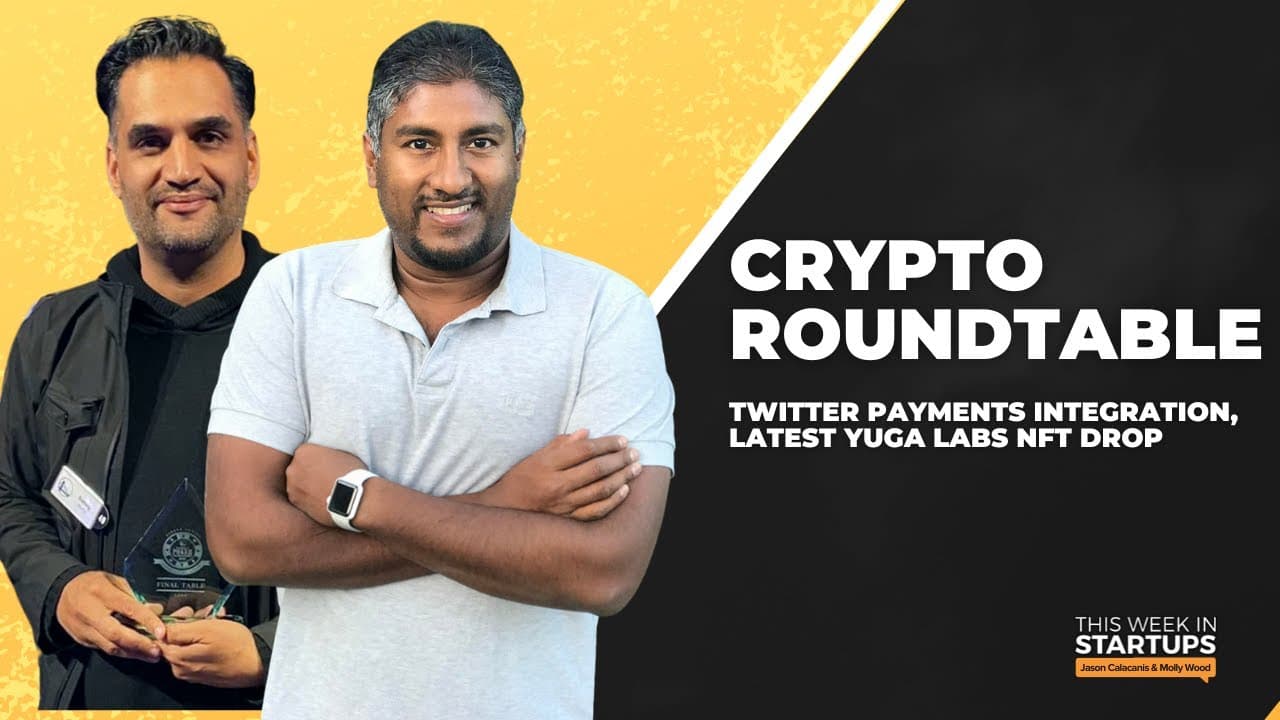
Crypto Roundtable: Twitter payments integration and latest Yuga Labs NFT drop | E1688
TL;DR
Twitter's payments integration faces delays after the layoff of its micropayments executive, with core product and advertising issues prioritized first. Meanwhile, Yuga Labs' NFT drop on the Bitcoin blockchain challenges scalability due to Bitcoin's limited transaction capacity. Coinbase's new developer platform and Spotify's NFT playlist experiment highlight ongoing innovation in the crypto ecosystem.
Transcript
hey everybody Welcome to twist I am sitting down today for another great crypto round table with sunny and Vinnie we're breaking down all kinds of things the future of Twitter and payments because of news that the executive in charge of rolling out micropayments has been laid off uh then we're going to talk about the latest Yuga Labs nft dropping o... Read More
Key Insights
- ❓ Twitter's struggles with payments integration highlight the complexities and challenges in developing payment solutions.
- 😀 Limited edition NFT drops bring exclusivity but face scalability constraints on the Bitcoin blockchain.
- 🎯 Coinbase's diversification efforts through a developer AWS platform target enterprise solutions in the crypto ecosystem.
- 🎼 Spotify's foray into NFT playlists showcases innovative enhancements to music listening experiences through blockchain technology.
- 😒 Exploration of digital collectibles and novel use cases for NFTs offers opportunities for artists and creators to engage with audiences in unique ways.
- 👾 Emphasis on experimentation and learning from failures drives innovation and progress in the crypto and NFT space.
- 🤗 Collaboration between artists, technology platforms, and collectors opens doors for new forms of engagement and monetization in the music industry and beyond.
Install to Summarize YouTube Videos and Get Transcripts
Explore YouTube Video Summarizer or Get YouTube Transcript Extractor
Questions & Answers
Q: What does Crypto Roundtable E1688 say about the future of Twitter payments integration?
The speakers do not treat the executive’s layoff as proof that Twitter payments are finished. Sunny Mandro expects some intersection between Twitter and crypto eventually, but says payments will likely come after the company addresses its core product, algorithms, and advertising decline.
Q: Why might payments and crypto be a lower priority for Twitter?
Sunny says Twitter is dealing with advertising falloff, major platform changes, algorithm concerns, and other core product issues. In his concentric-circle analogy, tweeting sits at the center, while payments and crypto belong in a later layer.
Q: Why does Vinnie Lingham say payments are difficult to build?
Vinnie says people underestimate how hard payments are because they can be approached from many different angles. He also believes Twitter has too many moving parts for one person or team to understand and manage easily.
Q: Could Twitter still use cryptocurrency for payments?
Sunny believes Twitter and crypto have natural intersections, including tipping and creator payments. He expects something involving crypto to emerge, although he does not present a launch date or confirmed implementation.
Q: Does the roundtable expect Twitter to integrate Dogecoin?
Vinnie says he had thought Elon Musk might integrate Dogecoin and make it a key part of Twitter’s strategy. However, he emphasizes that this has not happened yet, so it remains his speculation rather than a confirmed plan.
Q: What payment products had Twitter delivered when the executive was laid off?
Vinnie says he did not think Twitter had produced anything in payments at that point. From his perspective, the absence of visible payment progress made the decision to remove the person responsible understandable.
Q: What crypto feature on Twitter did the speakers view positively?
Vinnie points to Twitter’s hexagonal NFT profile pictures as an example of interesting crypto work. He contrasts that feature with payments, where he says the company had not shown comparable results.
Q: What other crypto and NFT topics are introduced in Crypto Roundtable E1688?
The episode introduces Yuga Labs’ latest NFT drop on the Bitcoin blockchain and Coinbase’s effort to build a developer “AWS” for big businesses. It also previews a Spotify NFT experiment, alongside the main discussion of Twitter payments.
Summary
In this crypto roundtable discussion, the hosts discuss various topics including the future of Twitter and payments, the latest NFT project on the Bitcoin blockchain, Coinbase's move to diversify its business, and Spotify's NFT experiment. They provide insights into the challenges of payments, the importance of identity systems, and the limitations of the Bitcoin blockchain for NFTs.
Questions & Answers
Q: What are the hosts' thoughts on Twitter's recent layoff of the executive in charge of payments integration?
The hosts express mixed feelings about Twitter, with one host using it less and having complaints about the platform. They point out that Twitter's focus on payments integration is a complex task due to the many angles and viewpoints on payments. They speculate that Twitter might be attempting to build a comprehensive product with integrated features like Dogecoin, but mention the challenges of navigating the complexities of payments and the limitations of the current team.
Q: Why are payments considered a difficult area to tackle for companies?
Payments are a lucrative business, as the amount of money moved in the payments world is significant. However, payments are regulated and require compliance with various laws and regulations. Large companies, such as Twitter, face challenges in entering the payments space due to the control and bureaucracy that comes with regulatory compliance. These hurdles and the risk to the company prevent them from achieving scale in payments.
Q: How important are payments in the crypto ecosystem, and what is their role beyond being a store of value?
Payments play a crucial role in the crypto ecosystem beyond being a store of value. They have the potential to provide seamless transactions, facilitate tipping, and enable creator payments. With the rise of decentralization and blockchain-based technology, payments can be simplified and made more efficient. However, integrating payments into existing systems and regulations poses challenges, and finding practical utility for cryptocurrencies beyond store of value is an ongoing discussion.
Q: Is identity verification a critical factor for implementing payments and other functionalities on platforms like Twitter?
Yes, identity verification is crucial for implementing payments and other functionalities on platforms like Twitter. The hosts highlight the need for an ideal identity system on Twitter that relies on third-party credentials. They propose that Twitter should adopt a system that allows users to export their credentials from trusted sources, such as banks or government agencies. This would help Twitter solve its identity problem and create a more secure and reliable platform.
Q: How can an ideal Twitter identity system be implemented using crypto and decentralized technology?
The hosts suggest that Twitter should adopt an identity system where users can input verifiable claims and credentials in a decentralized way. This would involve using open-source protocols, such as verifiable credentials, and allowing various providers to issue and verify credentials. By relying on cryptographic proofs and maintaining privacy between users and Twitter, a robust and scalable identity system can be established. Users could choose to verify themselves, improving engagement and trust on the platform.
Q: What are the challenges and limitations of implementing NFTs on the Bitcoin blockchain?
The hosts discuss a recent NFT project called 12-fold, which uses the Bitcoin blockchain through the ordinals protocol. They explain that unlike Ethereum, where NFTs primarily store information off the blockchain, the ordinals protocol encodes the entire NFT into a Satoshi on the Bitcoin blockchain. While this opens up new possibilities for the Bitcoin blockchain, the hosts point out that it has limitations in terms of transaction speed and cost. They believe it is more of a niche development and highlight the scalability and cost-efficiency advantages of other blockchains like Ethereum, Solana, or Bitcoin Cash.
Q: Is the use of the ordinals protocol on the Bitcoin blockchain an innovative advancement for NFTs?
The hosts express skepticism about the use of the ordinals protocol on the Bitcoin blockchain. They suggest that while it may be exciting for some individuals in the Bitcoin community, it is not a scalable solution due to the limitations of the one megabyte block size and high transaction fees. They believe that other blockchains have already established a lead in the NFT space, making it difficult for the Bitcoin blockchain to compete.
Q: What is the outlook for the Yuga Labs NFT project on the Bitcoin blockchain?
The hosts believe that the Yuga Labs NFT project on the Bitcoin blockchain is more of a publicity stunt and a way to create hype rather than a scalable solution. They question the market demand for such NFTs and its long-term sustainability. The limited edition nature of the NFTs and the potential high costs make them less attractive to a wide range of buyers. They compare it to luxury sports cars that have a small market of passionate collectors but are not in high demand.
Takeaways
In summary, the hosts provide insights into the challenges of integrating payments on platforms like Twitter, the importance of identity systems, and the limitations of the Bitcoin blockchain for NFTs. They discuss the need for Twitter to adopt a decentralized identity system and the potential for NFTs on blockchains beyond Bitcoin. They conclude that while there is room for experimentation, the scalability and cost-efficiency of other blockchains make them more suitable for NFTs.
Summary & Key Takeaways
-
Crypto roundtable delves into the implications of Twitter laying off its executive overseeing payments integration.
-
Yuga Labs' NFT drop on the Bitcoin blockchain sparks discussion about limited editions.
-
Coinbase aims to diversify its business with a developer AWS while Spotify experiments with NFTs.
Read in Other Languages (beta)
Share This Summary 📚
Summarize YouTube Videos and Get Video Transcripts with 1-Click
Try YouTube Summary with ChatGPT & Claude or YouTube Transcript Generator
Explore More Summaries from This Week in Startups 📚






Summarize YouTube Videos and Get Video Transcripts with 1-Click
Try YouTube Summary with ChatGPT & Claude or YouTube Transcript Generator