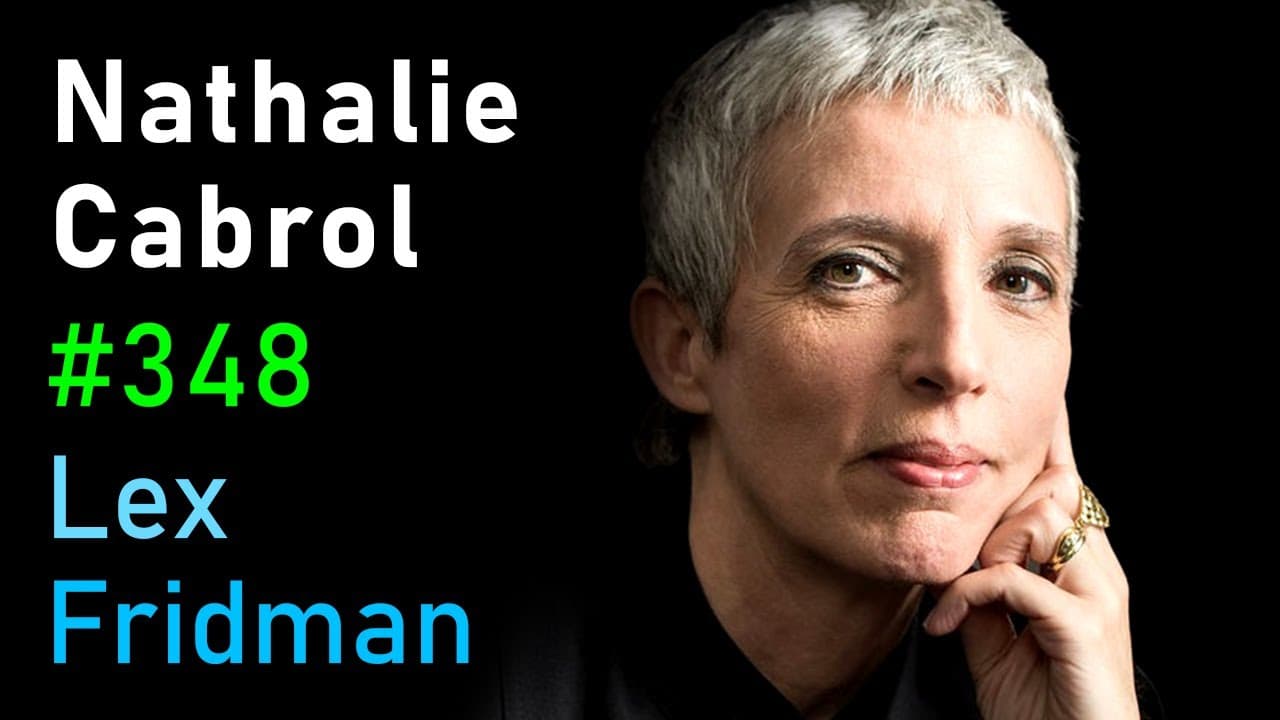
Nathalie Cabrol: Search for Alien Life | Lex Fridman Podcast #348
TL;DR
Nathalie Cabrol explores some of Earth's harshest environments, like volcanic lakes and high-altitude locations, to uncover clues about life on Mars. She emphasizes that understanding the origins and nature of life should take precedence over simply searching for life on other planets. Cabrol highlights the role of extreme conditions in revealing the potential for life beyond Earth.
Transcript
my friend is telling me that the volcano seems to be starting to rot if that volcano goes up we have nowhere to go that got my attention so if you say scared I would say that I got the realization that what that meant I went called for like a fraction of a second but that meant that just my adrenaline started to kick in and it was a very very stran... Read More
Key Insights
- 🧑🔬 Exploration of extreme environments on Earth helps scientists understand living organisms beyond our planet.
- 👽 The scientific search for alien life focuses on places analogous to Mars, such as ancient lakes and impact craters.
- 🛟 The nature of life is more important to study than the simple question of whether there is life on Mars.
- ❓ Technological advancements, like AI, can enhance scientific understanding but must be used responsibly.
- 🇨🇫 Communication and public engagement are crucial to convey the wonders and complexities of scientific discoveries.
- 🧑🔬 The UFO phenomenon generates public interest, and scientists are interested in investigating these sightings alongside credible agencies.
Install to Summarize YouTube Videos and Get Transcripts
Explore YouTube Video Summarizer or Get YouTube Transcript Extractor
Questions & Answers
Q: How does Cabral decide which extreme environments to explore in her search for organisms similar to those on Mars?
Cabral looks for environments analogous to Mars based on the conditions and questions she wants to answer. She focuses on places with geology that survived from 3.5 billion years ago, such as ancient lakes and impact craters.
Q: What are the signs of life on Mars that Cabral and other scientists look for?
They look for morphological traces of the interaction between life and its environment, such as rock formations built by microbes called stromatolites. They also investigate chemical traces, including different carbon isotopes and methane abundance.
Q: Is it possible that the building blocks of life came from elsewhere in the universe?
Cabral believes that the building blocks of life, such as carbon, hydrogen, oxygen, and nitrogen, are abundant in the universe. They could have been brought to Earth by asteroids and comets. However, the origin of life itself, the process of how life began, is still a big question.
Q: What factors contribute to the duration of intelligent civilizations?
Cabral explains that the duration of a civilization depends on various factors. It could be destroyed by internal conflicts or external events, or it could become so advanced that it blends into the background of the universe. The environment, climate history, and location within the galaxy also play a role.
Summary
In this conversation, Lex Friedman interviews Natalie Cabrol, an astrobiologist and scientist at The SETI Institute. They discuss Natalie's work in extreme environments on Earth, the search for life on Mars, and the nature of life itself. Natalie shares insights into the origin of life, the potential for life on other planets, and the co-evolution of humans and technology. The conversation touches on topics such as the Drake equation, panspermia, and the role of AI in understanding the nature of life.
Questions & Answers
Q: What led Natalie Cabrol to travel to extreme and dangerous environments in search of life?
Natalie explains that as a scientist, she had questions and hypotheses about life beyond Earth. To answer these questions, she needed to go to places on Earth that were similar to the conditions on Mars. So she and her husband developed the concept of studying lakes in impact craters, using the Viking Mission data as a starting point.
Q: What did the Viking Mission discover about Mars in 1976?
The Viking Mission, which consisted of two landers and two orbiters, was the first successful mission to land on Mars. The data from Viking revealed volcanoes, valleys, ancient channels, dune fields, and polar caps on Mars. While the mission did not find evidence of extraterrestrial civilization, it provided a glimpse into the similarities between Earth and Mars.
Q: What do we know about life on Mars and its conditions billions of years ago?
Natalie explains that our understanding of Mars and its conditions has significantly improved since the Viking Mission. Mars lost its magnetic field and atmosphere early on, but life likely appeared on the planet soon after its formation. If life existed on Mars, it would have been simple microbial life that evolved when the planet was still habitable. The best signs of life on Mars would be morphological traces of the interaction between life and its environment, as well as chemical traces.
Q: Is there a way to detect signs of past life on Mars?
Natalie mentions that various signs of past life on Mars include morphological traces like stromatolites and chemical signatures like certain carbon isotopes. However, these signs are not definitive proof of life and require further investigation. The search for life on Mars involves studying ancient lakes, impact craters, and rocks from the planet's past to understand the environment and conditions at the time.
Q: Is there a possibility of extraterrestrial life being different from the life on Earth?
According to Natalie, it is not unlikely for extraterrestrial life to have a similar biochemistry to that on Earth. The building blocks of life, such as carbon, hydrogen, oxygen, and nitrogen, are abundant throughout the universe. While there may be different types of biochemistry, the prevalence of these elements suggests that life could have similar properties in terms of its fundamental building blocks.
Q: What is the nature of life and its connection to the universe?
Natalie believes that the nature of life involves the gathering, exchanging, and preserving of information. Life, including humans, is constantly seeking to acquire and understand more information about its surroundings. This process of information acquisition and complexity is what makes life distinct and potentially universal. Understanding the nature of life would provide a universal signature that could be found throughout the universe.
Q: Can artificial intelligence (AI) systems help understand the nature of life?
Natalie and Lex discuss the potential of AI systems in unraveling the nature of life. While AI can provide insights and discoveries beyond human comprehension, Natalie believes that as long as AI remains a tool built and used by humans, it will not surpass human understanding. The integration of AI into human cognition has the potential to enhance our knowledge, but the true understanding of life's nature may come from a deeper cognition that could arise from humans or AI.
Q: What are the prospects for human civilization and its interaction with technology?
Natalie acknowledges the challenges facing human civilization, including the threat to the environment and the misuse of technology. She highlights the need for a sense of balance and maturity as a civilization, along with a growing consciousness of our place in the universe. Natalie finds optimism in the scientific advancements and revolutions in fields such as cosmology and astrobiology, which have the potential to reshape our understanding of the universe and our role within it.
Q: Do humans have a bias in the search for extraterrestrial life?
Natalie agrees that humans have a bias in the search for extraterrestrial life due to our limited understanding and perspective. However, she believes that this bias is based on the prevalence of the building blocks of life, such as carbon, throughout the universe. While life elsewhere may have different forms and biochemistry, the abundance of these elements suggests that life resembling what we know on Earth might be more common than other possibilities.
Q: Is there a likelihood of intelligent civilizations being detectable for long periods of time?
Natalie explains that the duration of detectable intelligent civilizations, represented by the "L" in the Drake equation, depends on their technological capabilities. While civilizations may come and go, the ability to be detectable depends on the presence and use of advanced technologies. Natalie also mentions the idea of civilizations becoming so advanced that they become undetectable or indistinguishable from physical processes, adding to the complexity of understanding their longevity and presence in the universe.
Takeaways
In this thought-provoking conversation, Natalie Cabrol shares her insights into astrobiology, the search for extraterrestrial life, and the nature of life itself. She emphasizes the need for a better understanding of the origin and nature of life rather than simply focusing on the search for life beyond Earth. Natalie's optimism is derived from the scientific advancements being made in various fields, which have the potential to reshape our view of the universe and our place in it. As a civilization, she believes we must strive to achieve balance, maturity, and a deeper connection with our environment to move forward.
Summary & Key Takeaways
-
Natalie Cabral dives in volcanic lakes at high altitudes to understand organisms that live in harsh conditions similar to those on Mars.
-
She started her career analyzing data from Mars missions and studying water on Mars.
-
Cabral believes understanding the origins and nature of life is more important than the question of whether there is life on Mars.
Read in Other Languages (beta)
Share This Summary 📚
Summarize YouTube Videos and Get Video Transcripts with 1-Click
Try YouTube Summary with ChatGPT & Claude or YouTube Transcript Generator
Explore More Summaries from Lex Fridman Podcast 📚


Summarize YouTube Videos and Get Video Transcripts with 1-Click
Try YouTube Summary with ChatGPT & Claude or YouTube Transcript Generator