Atomic packing factor
TL;DR
This video demonstrates how to calculate packing efficiency in various crystal structures.
Transcript
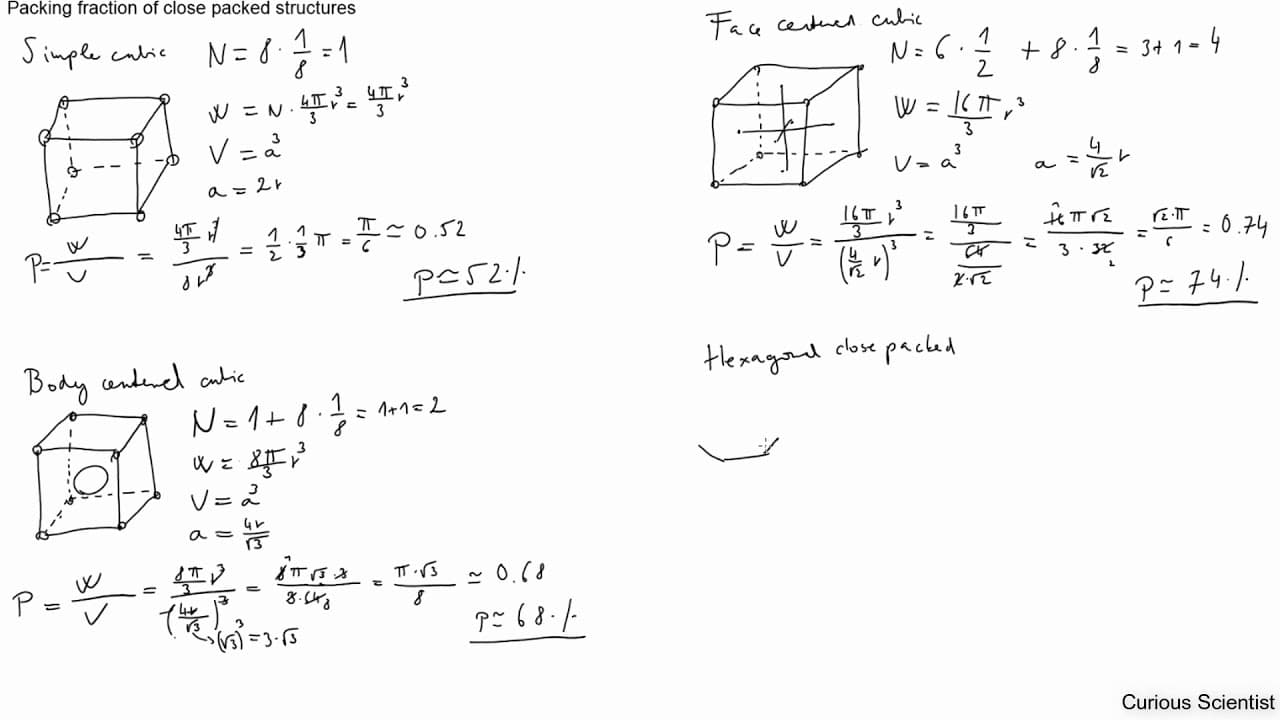
welcome in this video I will show you how to calculate the packing efficiency or packing fraction of the for closed packed structures these for closed packed structures are the simple cubic body-centered cubic face-centered cubic and hexagonal close-packed structures yeah let's just start it so I will start with the simple cubic structure just let ... Read More
Key Insights
- 😘 The simple cubic structure has the lowest packing efficiency due to limited atom placement around the unit cell.
- 😀 The transition to body-centered cubic significantly enhances packing efficiency but is still less than that of face-centered cubic structures.
- 😚 Face-centered cubic and hexagonal close-packed structures share the highest packing efficiencies at 74%, indicating their optimal arrangement in space.
- 🧡 Understanding packing efficiency is crucial for materials science, influencing choices in applications ranging from metallurgy to nanotechnology.
- 🫀 The calculations are derived from fundamental geometry and physical properties of atoms, emphasizing mathematical relationships in solid-state physics.
- 🫵 The video builds on previous tutorials, encouraging viewers to engage with foundational concepts in crystallography.
- ❓ Efficient packing arrangements are foundational in determining the material properties and characteristics of compounds in chemistry and physics.
Install to Summarize YouTube Videos and Get Transcripts
Explore YouTube Video Summarizer or Get YouTube Transcript Extractor
Questions & Answers
Q: What is packing efficiency, and why is it important?
Packing efficiency refers to the ratio of the volume of atoms in a crystal structure to the total volume of the unit cell. It’s significant because it provides insight into how closely atoms are arranged in a material, influencing its properties like density, strength, and thermal conductivity. Higher packing efficiency often indicates a denser and potentially stronger material.
Q: How do you calculate the volume occupied by atoms in a cubic unit cell?
The volume occupied by atoms in a cubic unit cell involves determining the number of atoms per unit cell and their geometric volume. For instance, in the simple cubic structure, there’s one atom at the corners of the cube contributing to a total volume calculated using the formula for the volume of a sphere, V = (4/3)πR^3, where R is the atomic radius.
Q: What were the packing efficiencies of the different structures discussed?
The video indicates that the simple cubic structure has a packing efficiency of 52%, the body-centered cubic has 68%, the face-centered cubic achieves 74%, and the hexagonal close-packed also reflects a packing efficiency of 74%. This illustrates a significant increase in efficiency as the complexity of the structure increases.
Q: What is the significance of the body-centered cubic structure's packing efficiency?
The body-centered cubic structure's packing efficiency of 68% is notable because it indicates a substantial improvement over the simple cubic structure. Despite having more complexity and additional atoms within the unit cell, it still does not reach the efficiencies of face-centered cubic or hexagonal close-packed, demonstrating a balance of structure and efficiency.
Summary & Key Takeaways
-
The video explains the process of calculating packing efficiency or packing fraction for different closed-packed structures: simple cubic, body-centered cubic, face-centered cubic, and hexagonal close-packed.
-
Detailed calculations show how to determine the number of atoms per unit cell and the volume occupied by these atoms, rendering packing efficiency as a percentage for each structure.
-
The packing efficiency improves from 52% in simple cubic to 74% in face-centered cubic, highlighting the differences in spatial efficiency among crystal structures.
Read in Other Languages (beta)
Share This Summary 📚
Summarize YouTube Videos and Get Video Transcripts with 1-Click
Try YouTube Summary with ChatGPT & Claude or YouTube Transcript Generator
Explore More Summaries from Curious Scientist 📚




![Building a coil winder [Part 6] - A few improvements thumbnail](/_next/image?url=https%3A%2F%2Fi.ytimg.com%2Fvi%2F3eyxG_g2iUA%2Fhqdefault.jpg&w=750&q=75)

Summarize YouTube Videos and Get Video Transcripts with 1-Click
Try YouTube Summary with ChatGPT & Claude or YouTube Transcript Generator