Manoj on Java Spring Boot Interview Experience
TL;DR
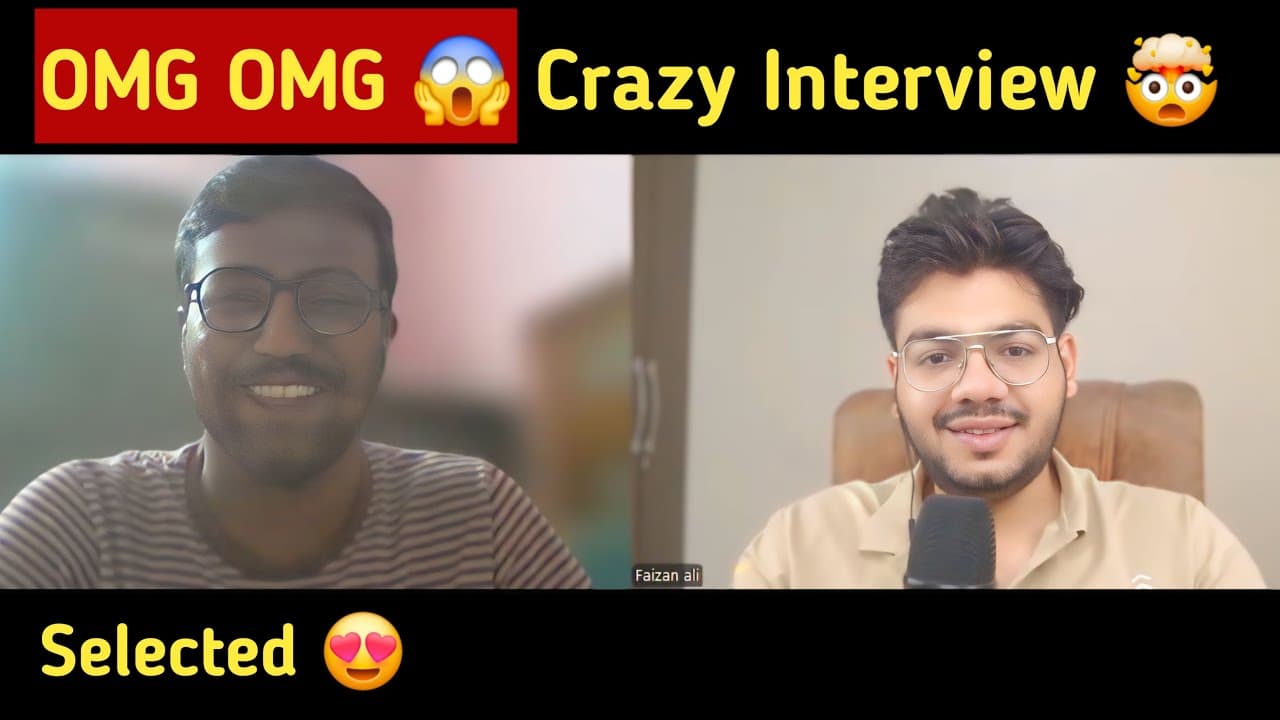
Manoj shares a three year Java Spring Boot and microservices interview experience. He discusses the tech stack, project details, and key concepts such as Java 21 features, concurrency, memory model, and common interview questions. The session highlights agile methodology, memory management, and how to prepare with an interview kit.
Transcript
Hey guys, today we have Manoj and he is having total three years of experience in Java Spring Boot and microservices domain. And those who want to give same free mock interview, please fill out the form below in the description. So now let's get started. Hey, hello Manoj, how are you? Hi Faz, I'm fine. How about you? Yes, I'm also good. Shall we st... Read More
Key Insights
- Manoj has three years of professional Java Spring Boot experience with a retail domain project called Omis store.
- Java 21 features are discussed, including virtual threads, which are JVM managed rather than OS managed.
- The project uses Azure cloud for testing and a fixed thread pool approach for chunking tasks.
- Concurrency risks in HashMap are highlighted and ConcurrentHashMap is used for thread safety.
- Java memory model and the role of synchronized versus volatile are explained.
- CompletableFuture is described as a way to chain asynchronous tasks with fine grained control.
- Phantom references are introduced as a memory management concept related to GC.
- Memory leaks can occur in Java despite GC, especially with static references and long running processes.
- Designing a thread pool that scales with system load is discussed, including modern options in Java 21 and traditional thread pool concepts.
Install to Summarize YouTube Videos and Get Transcripts
Explore YouTube Video Summarizer or Get YouTube Transcript Extractor
Questions & Answers
Q: A real search query question about the video (e.g. 'How to...', 'What is...', 'Why does...', 'When should...'). Question 1
Manoj discusses his three year Java Spring Boot experience and the retail domain project Omis store, including the tech stack Java 21, Spring Boot, Azure deployment, and CI CD with Docker. He explains that the project uses a fixed thread pool for certain tasks and highlights how agile methodology structures work in practice with stories and product owner validation. This answer stands alone to describe the context of his interview experience.
Q: What features of Java 21 were mentioned and are they used in the project?
The interview mentions virtual threads as a new feature in Java 21 and notes they are JVM managed rather than OS managed, capable of handling millions of threads. Manoj says they are not used in his project currently due to existing archival and purging microservices and a fixed thread pool approach. This reflects how new features influence but do not always get adopted immediately.
Q: How does Manoj describe concurrency risks and the solution used?
Manoj explains that HashMap is not thread safe for concurrent read and write operations, so a Concurren tHashMap is used to allow mutually exclusive access to segments and improve performance in multi threading. He contrasts the behavior before and after Java 8, where segmentation reduces locking scope, enabling other threads to access different parts of the map. This answer is self contained and reflects his view on concurrency risk and mitigation.
Q: What is explained about volatile and synchronized keywords and memory visibility?
The explanation covers that volatile addresses the visibility problem, ensuring that updates made by one thread are visible to others by reading from JVM memory. Synchronized is described as providing mutual exclusion to ensure only one thread executes a critical section at a time. The answer clarifies the roles of these keywords in enforcing thread safety and memory consistency.
Q: What is the role of CompletableFuture in Manoj’s discussion?
CompletableFuture is described as a means to invoke threads and perform tasks, with the possibility of chaining dependent tasks using methods that allow waiting for results and then applying further processing. This approach provides fine grained control over asynchronous execution and task composition, aligning with common interview topics around asynchronous programming in Java.
Q: What memory management topics are touched on during the interview?
The discussion mentions phantom references as a memory management concept related to garbage collection, describing them as references that are enqueued after finalization but before memory is reclaimed. The topic is framed as a miscellaneous concept that can be useful in resource management and GC scenarios.
Q: How does Manoj describe memory leaks and how to diagnose them?
Manoj notes that memory leaks can occur in Java despite GC, especially with static references that are not cleared and with multi threading scenarios where objects remain referenced. He suggests heat dumps and heap analysis as diagnostic steps and mentions caching and explicit cleanup as potential mitigations, highlighting practical debugging approaches.
Q: What approaches to scaling a thread pool were discussed?
The conversation covers using Java 21 virtual threads for dynamic autoscaling and traditional thread pools with configurable core and maximum pool sizes in older Java versions. It emphasizes choosing between modern dynamic scaling options and conventional thread pool design, depending on the Java version and project needs. This provides a grounded view on thread pool sizing strategies.
Summary & Key Takeaways
-
Manoj explains his three year background in Java Spring Boot and microservices, working on a retail domain project with a product called Omis store. He notes Java 21 as the tech stack and Azure for deployment, with CI CD and Docker. The conversation covers interview topics and preparation resources.
-
The discussion covers concurrency, memory management, and core Java concepts such as volatile, synchronized, and completable future, with examples like HashMap versus ConcurrentHashMap and memory leaks.
-
The interview prep kit mentioned in the video promises comprehensive material, real projects, and referral support, highlighting its structure and potential benefits for cracking interviews.
Read in Other Languages (beta)
Share This Summary 📚
Summarize YouTube Videos and Get Video Transcripts with 1-Click
Try YouTube Summary with ChatGPT & Claude or YouTube Transcript Generator
Explore More Summaries from GenZ Career 📚

Summarize YouTube Videos and Get Video Transcripts with 1-Click
Try YouTube Summary with ChatGPT & Claude or YouTube Transcript Generator