Why Covered Call Funds Underperform Their Stocks
TL;DR
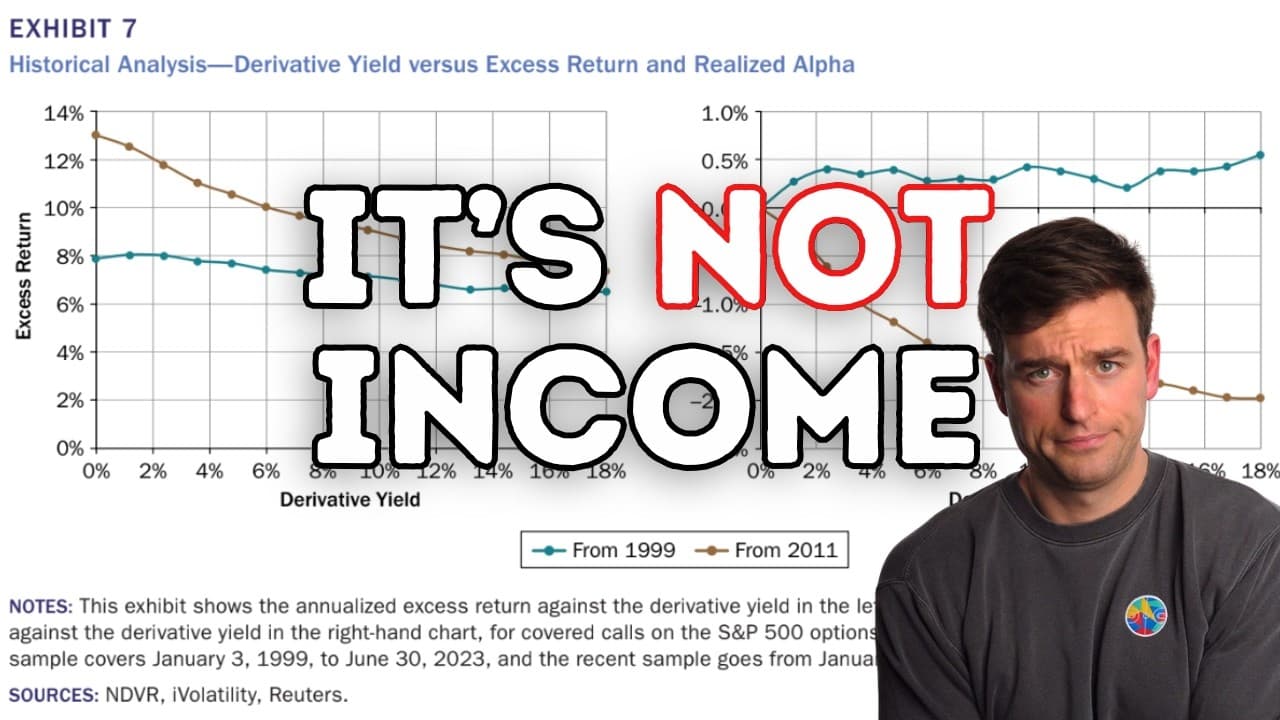
Covered call strategies are mechanically expected to underperform the stocks they hold, and more so at higher distribution yields. Selling calls caps upside while leaving downside unprotected, eliminating the mean reversion that helps stocks recover after downturns. High distribution yields are not sustainable income, because they signal lower total returns, not higher ones.
Transcript
The idea that covered calls generate income is financial These strategies are mechanically expected to underperform their underlying equity and increasingly so at higher targeted levels of distributions. For long-term investors, covered calls increase risk by leaving the downside unprotected while capping the upside, eliminating the mean reverting ... Read More
Key Insights
- Distribution yield on covered call funds is a misleading metric because selling a call creates a liability that empirically more than offsets the premium income received, so the yield does not represent a total return.
- Higher yields mechanically mean lower expected total returns, because generating more income requires selling options with lower strike prices, which increases short delta and reduces exposure to the underlying equity.
- Total returns, not distributions, are what you actually need to buy groceries, so marketing a high distribution yield as income or expected return is indifferent to the truth.
- Covered calls create an asymmetric payoff: investors keep most of the downside but cap upside at the strike price, systematically missing stock market recoveries that are common after major downturns.
- The volatility risk premium, where implied volatility exceeds realized volatility, is a potential saving grace, but since about 2011 it has not been anywhere near enough to offset the lost equity exposure.
- Covered calls eliminate the mean-reverting tendency of stocks, which historically makes stocks less risky than bonds at long horizons, making these strategies particularly risky for long-term investors funding inflation-adjusted spending.
- The BMO Covered Call Utilities ETF launched October 20, 2011 with a 7.37% distribution yield versus 3.43% for an underlying-equity ETF, yet trailed the underlying by an annualized 2.6 percentage points since inception.
- The covered call fund trailed the underlying in more than 70% of three-year rolling periods and nearly 85% of four-year rolling periods, with underperformance worst when equities drop sharply and then recover.
Install to Summarize YouTube Videos and Get Transcripts
Explore YouTube Video Summarizer or Get YouTube Transcript Extractor
Questions & Answers
Q: Why do covered calls underperform the underlying stocks?
Covered calls are mechanically expected to underperform because selling a call option reduces exposure to the underlying equity and its risk premium. The strategy caps upside at the strike price while leaving most of the downside unprotected. This asymmetry means investors eat losses during market volatility but do not participate in a large portion of recoveries, driving an increasingly large wedge between the covered call strategy and its underlying equity over time.
Q: Why is a high distribution yield misleading?
Selling a call option generates premium income but simultaneously creates a liability, the potential need to sell shares below market value if the price rises above the strike. Empirically this liability more than offsets the income received. So while distributions feel like investment returns, they are not total returns. Total returns are what you actually need to fund spending, and marketing a high distribution yield as income or expected return ignores this critical distinction.
Q: How are covered call yields related to expected returns?
Yields on covered call strategies are inversely related to their expected returns, so higher yields mechanically mean lower expected total returns. To earn more income, a fund sells options with lower strike prices, which have higher deltas. Selling a higher-delta option means a larger short position against the underlying stock, reducing exposure to the equity risk premium. This lower exposure directly translates into lower expected returns, making high yields a warning sign, not a benefit.
Q: Why are covered calls especially risky for long-term investors?
Long-term equity investors historically benefit from mean reversion, the tendency of stocks to perform better than average after performing poorly. This makes stocks less risky at long horizons, sometimes even less risky than bonds, which do not rebound the same way. Selling calls eliminates this mean-reverting tendency by capping the upside recovery while only slightly improving the downside by the premium amount, making covered calls very risky for those funding inflation-adjusted spending.
Q: What is the volatility risk premium and does it help covered calls?
The volatility risk premium arises because equity options tend to be priced with implied volatility higher than realized volatility, letting option sellers earn a premium for enduring the risk that realized volatility exceeds implied. It is a potential saving grace for covered calls and makes back-tested strategies look good since about 2011. However, it has not been anywhere near sufficient to offset the reduction in equity exposure from selling options, resulting in poor performance.
Q: Are covered calls good in a sideways market?
The video argues this is a misconception because equity markets don't actually go sideways. They are volatile even over periods where they have flat returns. Every time a covered call strategy eats the downside during a dip and is denied the upside during the recovery, the investor loses. Because volatility exists in all market conditions, the covered call strategy underperforms the underlying equity across any market environment, not just clearly rising ones.
Q: Can you replicate covered call returns more simply?
Yes. Because covered calls work by reducing equity beta and exposure to the equity risk premium, you could reach a similar place by simply reducing your direct exposure to the stock and holding some cash instead. This alternative achieves lower equity exposure without the asymmetric payoff problem of covered calls, which keep most of the downside while capping the upside at the strike price and eliminating the mean-reverting recovery potential of stocks.
Q: What did the live BMO covered call fund performance show?
The BMO Covered Call Utilities ETF launched October 20, 2011 and currently has a 7.37% distribution yield versus 3.43% for an ETF of the underlying equities. Despite the higher yield, it trailed the underlying by an annualized 2.6 percentage points since inception. It underperformed in more than 70% of three-year rolling periods and nearly 85% of four-year rolling periods, with the worst gaps occurring when equities dropped and then recovered.
Summary & Key Takeaways
-
Covered call funds sell call options on stocks they own and distribute the premiums as high-yield cash, but this is only the first step of the trade. The fund takes on a liability to sell shares below market value if prices rise above the strike price, capping upside.
-
Higher distribution yields require selling lower-strike options, increasing short delta and reducing exposure to the equity risk premium. The reduction is asymmetric: investors keep most of the downside while surrendering upside, so they eat losses during volatility but miss the recoveries that follow.
-
Live funds confirm the theory. The BMO Covered Call Utilities ETF trailed its underlying by 2.6 percentage points annualized since 2011 and lagged in most multi-year rolling periods. Presenting these unsustainable distributions as passive income is irresponsible for long-term investors.
Read in Other Languages (beta)
Share This Summary 📚
Summarize YouTube Videos and Get Video Transcripts with 1-Click
Try YouTube Summary with ChatGPT & Claude or YouTube Transcript Generator
Explore More Summaries from Ben Felix 📚

Summarize YouTube Videos and Get Video Transcripts with 1-Click
Try YouTube Summary with ChatGPT & Claude or YouTube Transcript Generator