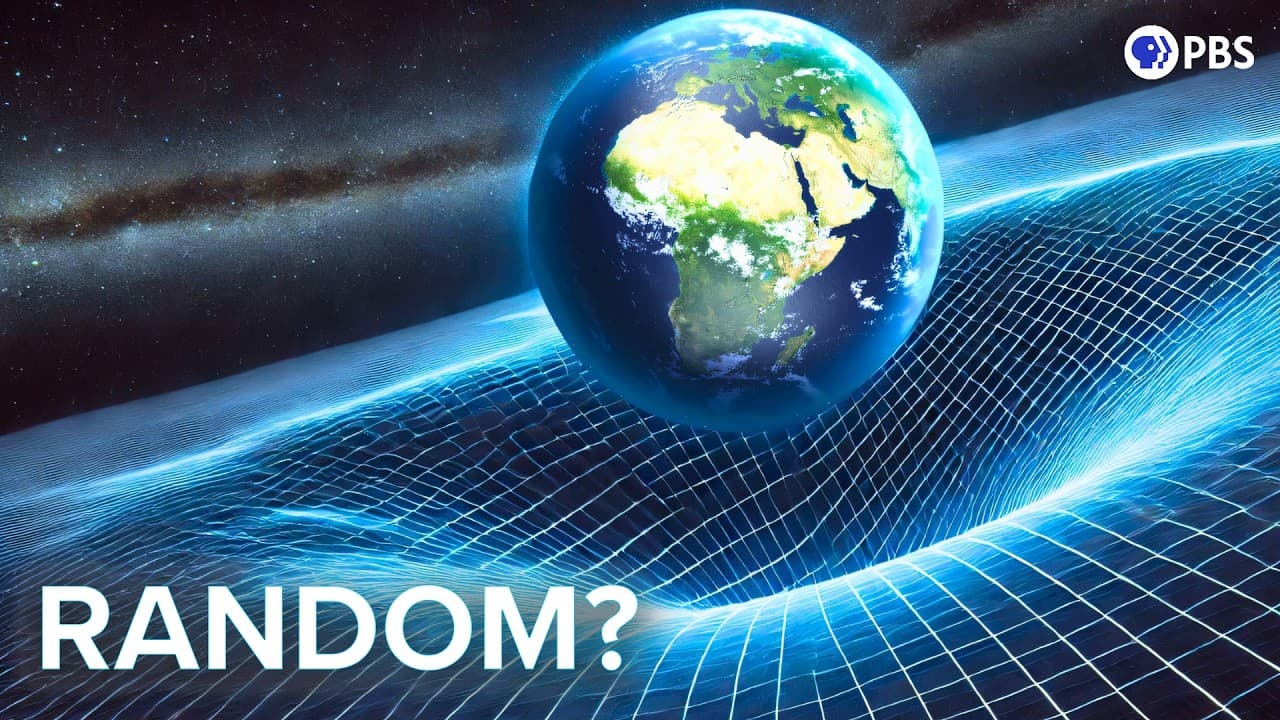
Is Gravity RANDOM Not Quantum?
TL;DR
Exploring the post-quantum gravity hypothesis of Jonathan Oppenheim.
Transcript
Hey everyone, we have brand new product at the merch store. More info at the end of the episode. The holy grail of theoretical physics is to find the long-sought theory of quantum gravity. But what if this theory is as mythical as the grail of legend? What if gravity isn’t weirdly quantum at all, but rather … just a bit messy? Or random? So say... Read More
Key Insights
- Jonathan Oppenheim suggests that gravity might not be inherently quantum, proposing a post-quantum gravity theory where gravity is classical but includes randomness.
- General relativity and quantum mechanics are the two pillars of physics, yet they contradict each other at fundamental levels, prompting the search for a unified theory.
- Traditional approaches to unifying these theories focus on quantizing gravity, but Oppenheim's hypothesis challenges this by suggesting gravity remains classical.
- The Einstein equation, a classical representation of spacetime and gravity, contrasts with the quantum nature of matter, leading to difficulties in their unification.
- Oppenheim proposes that randomness in gravity could maintain quantum behaviors without violating principles like Heisenberg's uncertainty principle.
- In post-quantum gravity, gravitational fields fluctuate randomly, reflecting the quantum superposition of matter, allowing for a consistent classical-quantum interaction.
- This theory challenges the conservation of quantum information, potentially resolving paradoxes like the black hole information paradox by allowing information destruction.
- Post-quantum gravity, though not definitive, opens new avenues for resolving the century-old problem of unifying quantum mechanics with general relativity.
Install to Summarize YouTube Videos and Get Transcripts
Explore YouTube Video Summarizer or Get YouTube Transcript Extractor
Questions & Answers
Q: What is the main proposal of Jonathan Oppenheim's hypothesis?
Jonathan Oppenheim's hypothesis proposes that gravity might not need to be quantized to align with quantum mechanics. Instead, he suggests a post-quantum gravity theory where gravity remains classical but incorporates randomness. This randomness in gravitational fields reflects the quantum superposition of matter, potentially allowing for a consistent interaction between classical spacetime and quantum matter.
Q: How does post-quantum gravity differ from traditional approaches to unifying physics theories?
Traditional approaches to unifying physics theories focus on quantizing gravity to make it compatible with quantum mechanics. In contrast, post-quantum gravity suggests that gravity can remain classical but includes randomness to account for quantum behaviors. This approach challenges the assumption that gravity must be quantum and opens new possibilities for resolving the contradictions between general relativity and quantum mechanics.
Q: What problem does post-quantum gravity aim to address?
Post-quantum gravity aims to address the fundamental contradiction between general relativity and quantum mechanics. By suggesting that gravity can remain classical with inherent randomness, this theory seeks to provide a consistent framework where classical spacetime interacts with quantum matter without violating principles like the Heisenberg uncertainty principle or requiring the quantization of gravity.
Q: How does randomness in gravity help maintain quantum behaviors?
In post-quantum gravity, randomness in gravitational fields reflects the quantum superposition of matter. This randomness prevents precise determination of positions through gravitational interactions, thus maintaining quantum behaviors without violating the Heisenberg uncertainty principle. It allows for a probabilistic distribution of possible positions, aligning with the quantum nature of matter while keeping gravity classical.
Q: What radical consequence does Oppenheim's theory introduce?
Oppenheim's theory introduces the radical consequence of allowing the destruction of quantum information. This challenges the traditional conservation of quantum information, which is a fundamental aspect of quantum mechanics. By permitting information destruction, the theory potentially resolves paradoxes like the black hole information paradox, offering a new perspective on the nature of quantum information.
Q: Why is post-quantum gravity not considered a final theory?
Post-quantum gravity is not considered a final theory because it is still a developing hypothesis that presents a new direction for solving the unification problem. While it offers an intriguing approach by maintaining a classical view of gravity with added randomness, it is one of many potential solutions and may or may not lead to the ultimate unification of general relativity and quantum mechanics.
Q: What does the introduction of noise in gravitational fields achieve?
The introduction of noise in gravitational fields achieves a way to reconcile classical gravity with quantum mechanics without requiring gravity to be quantized. This noise reflects the quantum superposition of matter, allowing gravitational interactions to remain probabilistic and preventing precise position determinations that could violate the Heisenberg uncertainty principle. It provides a mechanism for consistent interaction between classical spacetime and quantum matter.
Q: How does post-quantum gravity address the black hole information paradox?
Post-quantum gravity addresses the black hole information paradox by allowing for the destruction of quantum information through random fluctuations in gravitational fields. This approach challenges the traditional view that quantum information must always be conserved. By permitting information destruction, the theory offers a potential resolution to the paradox, suggesting that information might not be preserved in all quantum processes, especially in extreme conditions like those involving black holes.
Summary & Key Takeaways
-
Jonathan Oppenheim's post-quantum gravity hypothesis suggests that gravity might be classical with inherent randomness, challenging the assumption that gravity must be quantum. This theory aims to reconcile the contradictions between general relativity and quantum mechanics without requiring gravity to be quantized.
-
Traditional efforts to unify general relativity and quantum mechanics focus on quantizing gravity. However, Oppenheim proposes that gravity remains classical, with random fluctuations that align with the quantum nature of matter, offering a new approach to the longstanding problem of quantum gravity.
-
Post-quantum gravity introduces randomness to gravitational fields, allowing for classical spacetime to coexist with quantum matter. This approach potentially resolves issues like the black hole information paradox by permitting the destruction of quantum information, a radical departure from traditional quantum mechanics.
Read in Other Languages (beta)
Share This Summary 📚
Summarize YouTube Videos and Get Video Transcripts with 1-Click
Try YouTube Summary with ChatGPT & Claude or YouTube Transcript Generator
Explore More Summaries from PBS Space Time 📚

Summarize YouTube Videos and Get Video Transcripts with 1-Click
Try YouTube Summary with ChatGPT & Claude or YouTube Transcript Generator