MAX31855 - A better thermocouple module
TL;DR
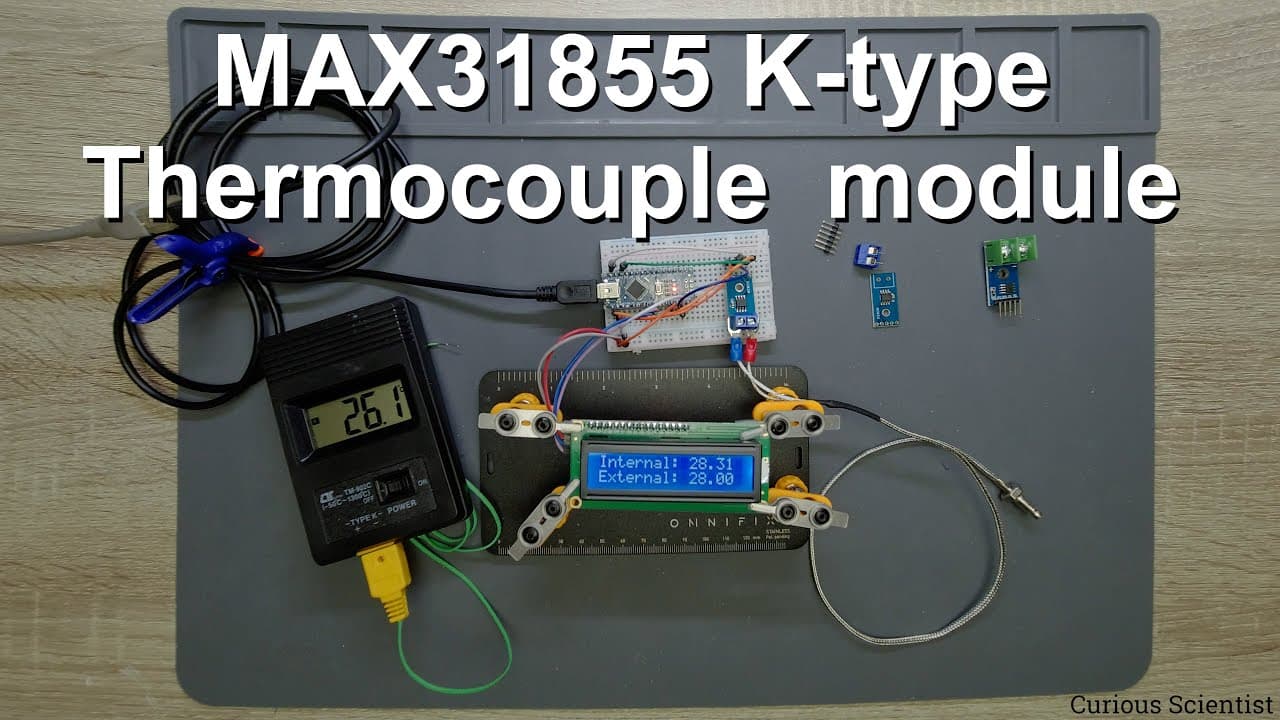
The Max 31855 thermocouple module measures temperatures from -270 to 1800 degrees Celsius.
Transcript
welcome everyone in this video i'm going to introduce the max 31 855 thermocouple module i have a previous video on thermocouple module which is the max 6675 and i showed you its advantages and disadvantages and for example the most striking disadvantage of the 6675 was that we could not measure negative temperatures with it so that's uh not so goo... Read More
Key Insights
- ❓ The Max 31855 is capable of measuring temperatures down to -270 degrees Celsius and up to 1800 degrees Celsius.
- 😒 The module is optimized for use with a 3.3V power supply, emphasizing the importance of adhering to voltage specifications.
- 💄 It supports various thermocouple types, making it versatile for different applications.
- ❓ The fault detection feature is a critical aspect for ensuring accurate readings and reliable operation.
- ❓ Its simple SPI communication protocol facilitates easy integration with many microcontroller platforms, including various Arduino models.
- ☠️ The module can update temperature readings at a maximum rate of approximately 10 Hz, making it suitable for most applications that do not require rapid changes.
- ❓ Proper calibration and setup are essential to achieve the stated resolution and precision.
Install to Summarize YouTube Videos and Get Transcripts
Explore YouTube Video Summarizer or Get YouTube Transcript Extractor
Questions & Answers
Q: What is the main advantage of the Max 31855 over the Max 6675?
The Max 31855 offers the key advantage of measuring negative temperatures, with a range from -270 to +1800 degrees Celsius. In contrast, the Max 6675 can only measure temperatures above 0 degrees Celsius, limiting its application in colder environments. This makes the 31855 more versatile for a variety of temperature measurement needs, particularly in scientific and industrial applications.
Q: How does the Max 31855 connect to microcontrollers?
The Max 31855 connects to microcontrollers using SPI (Serial Peripheral Interface) communication. It requires connections for VCC, GND, Chip Select (CS), Serial Clock (SCK), and only outputs data through the slave output. Compatibility with popular microcontrollers such as Arduino, Raspberry Pi, and STM32 facilitates ease of integration into various projects.
Q: What are the typical resolutions and precisions of the Max 31855?
The Max 31855 provides a temperature resolution of 0.25 degrees Celsius, but the precision can vary based on specific temperature ranges due to device linearity. Therefore, for accurate applications, further calibration may be necessary, especially when measuring temperatures close to the limits of its operating range.
Q: What precautions should be taken when powering the Max 31855?
It is crucial to power the Max 31855 with a 3.3V supply. Connecting it to a 5V source can potentially damage the module. Users should ensure that they double-check the voltage requirement to prevent any electrical mishaps, as the module operates optimally at 3.3V.
Q: How can faults in the thermocouple wiring be detected using the Max 31855?
The Max 31855 features a fault detection mechanism. By soldering a specific connection on the chip, it can monitor the temperature lead connections. If there is an open circuit or any issues in the thermocouple wiring, the module can identify this fault and indicate it through the transmitted data to the microcontroller.
Q: What types of thermocouples are compatible with the Max 31855?
The Max 31855 is compatible with several thermocouple types, including K, J, T, S, R, and E types. Users should ensure they select the appropriate thermocouple for their application and check compatibility when purchasing the module, as performance characteristics may vary between thermocouple types.
Summary & Key Takeaways
-
The Max 31855 thermocouple module is designed to measure both negative and positive temperatures, unlike the previous Max 6675 model, which only measured positive temperatures.
-
This module supports various types of thermocouples, including the popular K-type, and operates on a 3.3V power supply, making it essential to avoid using 5V.
-
The presentation covers the module's wiring, SPI communication, and code structure for interfacing with microcontrollers like Arduino, detailing how to read and process temperature data effectively.
Read in Other Languages (beta)
Share This Summary 📚
Summarize YouTube Videos and Get Video Transcripts with 1-Click
Try YouTube Summary with ChatGPT & Claude or YouTube Transcript Generator
Explore More Summaries from Curious Scientist 📚
![Building a Peltier cooler-based cooling box - First iteration, improvements [Part 2/6] thumbnail](/_next/image?url=https%3A%2F%2Fi.ytimg.com%2Fvi%2F0YlNw0EGnzI%2Fhqdefault.jpg&w=750&q=75)
Summarize YouTube Videos and Get Video Transcripts with 1-Click
Try YouTube Summary with ChatGPT & Claude or YouTube Transcript Generator