Canon R50 V vs Sony ZV-E10 II: Which Is Better?
TL;DR
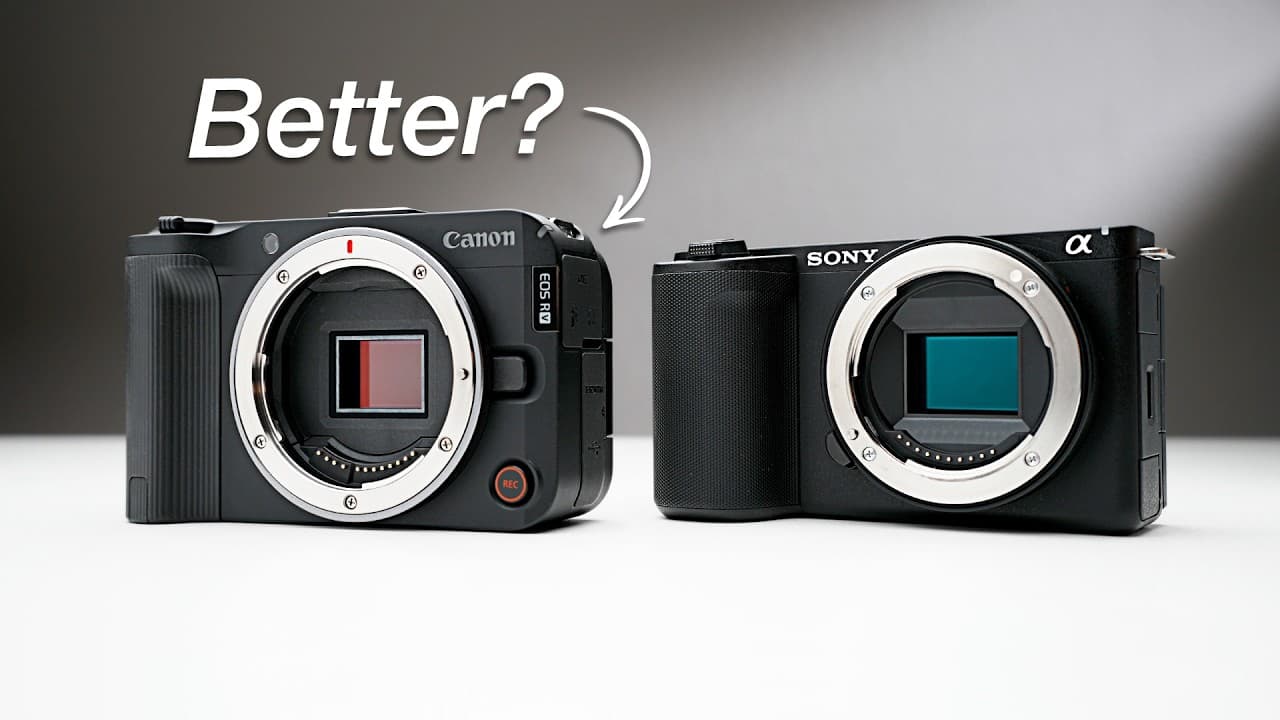
Choose the Canon R50 V for more natural out-of-camera color, flattering skin tones, cleaner 1080p slow motion, and a better built-in microphone. Choose the Sony ZV-E10 II for sharper footage, stronger low-light autofocus, a smaller 4K 60 fps crop, a sturdier feel, a more comfortable grip, and easier SD card access while mounted on a tripod.
Transcript
If you're looking for a camera to make YouTube videos, vlogs, or even start a podcast while trying to stay on a budget, then the Canon R50V and the Sony ZV10 Mark II are both great options. In this video, I put the two side by side to help you figure out which one is right for you. You got to just press record. Hey, welcome back to Think Media. Nat... Read More
Key Insights
- The Canon R50 V is designed specifically around video creation, with clearly labeled controls, a front-facing record button, and a side quarter-20 mount that allows vertical tripod placement without requiring a cage or an unusual rig.
- The Sony ZV-E10 II has the more practical physical layout for tripod use because its SD card slot remains accessible from the side. It also feels slightly sturdier, provides a more comfortable grip, and accommodates a larger battery.
- The Canon R50 V produces a slightly softer and more neutral image that can flatter faces and skin tones. The Sony ZV-E10 II produces noticeably sharper footage with more saturated out-of-camera colors that may affect how skin tones appear.
- The 4K 60 fps crop is substantially stronger on the Canon R50 V at 1.56x, making wide-angle recording more difficult. The Sony ZV-E10 II also crops at that setting, but its stated crop is only 1.1x.
- The Canon R50 V delivers cleaner 1080p footage at 120 fps in the comparison, while the Sony result appears blockier and contains more artifacts. Using Canon's 1080p high-frame-rate mode also avoids the severe crop found in its 4K 60 fps mode.
- Both cameras record 10-bit video and offer log profiles for flexible color grading. Canon Log 3 and Sony S-Log 3 retain enough color information for stronger adjustments, while the Canon also provides false color and the ability to record LUTs into the video file.
- The Sony ZV-E10 II provides more dependable autofocus in very low light. Both cameras track a moving face reliably under normal conditions, but the Canon R50 V can lose its subject and produce visibly out-of-focus moments when very little light is available.
- Neither camera has in-body image stabilization, so stable handheld footage depends on a stabilized lens or electronic correction. Digital stabilization crops significantly into the frame, making a sufficiently wide lens especially important for arm's-length vlogging.
Install to Summarize YouTube Videos and Get Transcripts
Explore YouTube Video Summarizer or Get YouTube Transcript Extractor
Questions & Answers
Q: Which is better for YouTube, Canon R50 V or Sony ZV-E10 II?
The better choice depends on the creator's priorities. The Canon R50 V is preferable for natural out-of-camera colors, flattering skin tones, cleaner 1080p recording at 120 fps, stronger built-in audio, and convenient vertical mounting. The Sony ZV-E10 II is preferable for sharper footage, more reliable low-light autofocus, a much smaller 4K 60 fps crop, sturdier construction, and easier SD card access on a tripod.
Q: Which camera has better out-of-camera image quality?
The Canon R50 V produces a slightly softer, more natural, and more neutral image that is especially flattering when filming faces. Its skin tones also look better in the comparison. The Sony ZV-E10 II records a visibly sharper and more saturated image, which some creators may prefer depending on their subject. Both cameras can produce customized results through 10-bit recording and color grading.
Q: How do the Canon R50 V and Sony ZV-E10 II compare at 4K 60 fps?
Both cameras can record 4K video at up to 60 frames per second, but their crops differ considerably. The Canon R50 V applies a 1.56x crop, which makes wide-angle framing difficult. The Sony ZV-E10 II applies a smaller 1.1x crop. That difference gives the Sony a clear framing advantage for 4K 60 fps recording, particularly when filming at close distances.
Q: Which camera is better for slow-motion video at 120 fps?
The Canon R50 V performs better in the demonstrated 1080p recording test at 120 frames per second. Its footage looks cleaner, while the Sony ZV-E10 II result appears more blocky and contains more visible artifacts. On the Canon, this mode is also a useful alternative to 4K at 60 frames per second because it avoids that mode's severe 1.56x crop, although resolution drops to 1080p.
Q: Which camera has better autofocus for filming yourself?
Both cameras provide reliable video autofocus and can keep a creator's face focused while the person moves through the frame. The Sony ZV-E10 II has the advantage in very low light because it continues tracking when little light is available. Under the same difficult conditions, the Canon R50 V can lose tracking and create moments when the subject is completely out of focus.
Q: Which camera has better built-in audio and microphone support?
The Canon R50 V has the better-sounding built-in microphone in the comparison, making it more useful when an external microphone is unavailable. An external microphone should still provide better results than either internal system. Both cameras include a microphone input for connecting external audio equipment, and both provide a headphone jack so creators can monitor recorded sound while filming.
Q: Are the Canon R50 V and Sony ZV-E10 II good for handheld vlogging?
Both cameras can be used for handheld vlogging, but neither includes in-body image stabilization. A lens with image stabilization can reduce shakes, and both cameras also offer digital stabilization. Electronic correction introduces a significant crop, however, which can make an arm's-length shot too tight. A wide-angle lens, including options that reach 10 mm, helps maintain workable framing with stabilization enabled.
Q: Can the Canon R50 V and Sony ZV-E10 II record log and 10-bit video?
Both cameras support 10-bit video and flat log profiles that provide greater flexibility during color grading. The Canon R50 V offers Canon Log 3, while the Sony ZV-E10 II provides different S-Log choices, including S-Log 3. The additional color information allows stronger adjustments without the image breaking apart as quickly. The Canon also includes false color and can record LUTs into the video file.
Summary & Key Takeaways
-
The Canon R50 V and Sony ZV-E10 II are compact, lightweight, entry-level mirrorless cameras designed for creators. Both support interchangeable lenses, flip-out touchscreens, vertical displays, 4K recording, 10-bit video, log profiles, microphone inputs, headphone monitoring, dependable autofocus, and digital stabilization, making either model suitable for long-term creative growth.
-
The Canon R50 V emphasizes video-friendly operation with clearly labeled controls, a front record button, and a side quarter-20 mount for vertical shooting. Its footage looks softer and more natural, with pleasing skin tones, while its built-in microphone and 1080p recording at 120 fps outperform the Sony examples shown in the comparison.
-
The Sony ZV-E10 II feels slightly sturdier and offers a deeper, more comfortable battery grip, a larger battery, and side-accessible SD card storage. Its image is sharper, its 4K 60 fps crop is less severe, and its autofocus remains more reliable in very low light, although its colors appear more saturated.
-
Neither camera includes in-body image stabilization, so handheld creators must use stabilized lenses or digital stabilization. Digital stabilization introduces a substantial crop that can make self-filmed vlogging uncomfortably tight. A wide-angle lens, such as one reaching 10 mm, helps preserve useful framing when electronic stabilization is enabled on either camera.
Read in Other Languages (beta)
Share This Summary 📚
Summarize YouTube Videos and Get Video Transcripts with 1-Click
Try YouTube Summary with ChatGPT & Claude or YouTube Transcript Generator
Explore More Summaries from Think Media 📚


Summarize YouTube Videos and Get Video Transcripts with 1-Click
Try YouTube Summary with ChatGPT & Claude or YouTube Transcript Generator