Why Does Manifestation Feel Unnecessarily Hard?
TL;DR
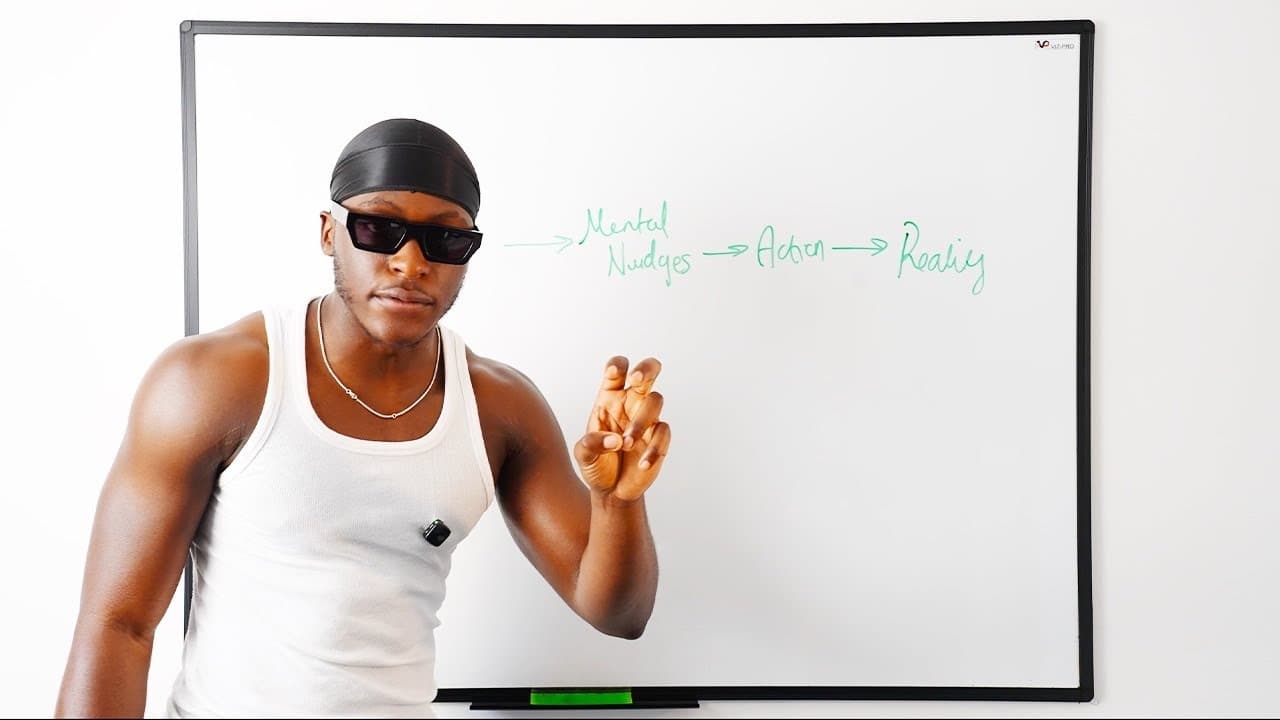
Unnecessary struggle persists when difficulty becomes part of your beliefs, self-concept, and emotional alignment. The proposed solution begins with separating yourself from struggle-based thoughts, recognizing that they do not define you, and pursuing your desired reality through physical action that feels natural, effortless, and aligned rather than complicated.
Transcript
You are addicted to the frequency of struggle. You see, there's an aspect of you that requires for things to be so complicated, so complex, so difficult when it comes to desiring to materialize your desired reality. Cuz as you know, spirituality without the ability to control your reality is vanity. And more often than not, we have this tendency to... Read More
Key Insights
- A struggle complex is an unconscious belief that desired outcomes must involve difficulty, pressure, trials, or complication. According to the speaker, this pattern can influence attempts to earn money, secure employment, receive a promotion, or develop a healthy relationship.
- Beliefs are described as influences that identify with people, rather than qualities people simply possess. The speaker summarizes this distinction by arguing that a person does not merely have a struggle complex, the struggle complex has captured that person's consciousness.
- Awareness is the first step toward isolating unnecessary struggle. Recognizing recurring thoughts about hardship as a pattern creates distance from them and makes it possible to question whether difficulty is genuinely required or merely expected.
- Thought ownership reinforces the struggle pattern when every thought is automatically interpreted as personal truth. The speaker argues that taking ownership of struggle-based thoughts allows those thoughts to take ownership of consciousness, self-concept, and subsequent behavior.
- Manifestation is defined as an internal shift that ends emotional dependence on physical circumstances changing. The example from Ecuador illustrates this principle through a person who felt good whether or not money arrived, then reported paying bills through unexpected sources.
- Physical action is required because nothing materializes on the physical plane without some form of physical activity. The speaker rejects complete inactivity while emphasizing that effective action does not have to feel difficult, forced, or exhausting.
- Aligned action is physical effort that feels effortless, natural, and consistent with the desired reality. This approach avoids both unnecessary hardship and laziness by preserving action while removing the assumption that suffering is evidence of meaningful progress.
- All beliefs are presented as half-truths with an opposite polarity. A belief that success must be complex therefore hides the possibility that the same goal could be reached more simply, without repeated crises, pressure, or avoidable complications.
Install to Summarize YouTube Videos and Get Transcripts
Explore YouTube Video Summarizer or Get YouTube Transcript Extractor
Questions & Answers
Q: Why does manifestation feel unnecessarily difficult?
Manifestation feels unnecessarily difficult when a person unconsciously expects desired outcomes to require struggle, pressure, or complicated circumstances. The speaker calls this expectation a struggle complex. Because it becomes part of consciousness, self-concept, and emotional frequency, the person repeatedly approaches money, employment, promotions, and relationships through patterns that reproduce the anticipated difficulty.
Q: What is a struggle complex in manifestation?
A struggle complex is described as a belief that worthwhile outcomes cannot arrive easily and must be preceded by hardship, trials, pressure, or a point of desperation. The speaker treats this belief as an entity that attempts to express itself physically by occupying a person's thoughts, emotions, consciousness, and self-concept until struggle becomes a recurring experience.
Q: How can you recognize an addiction to struggle?
An addiction to struggle can be recognized by noticing whether goals repeatedly become more complicated than necessary. Common signs include expecting a fight before receiving what you want, believing progress cannot be easy, and repeatedly reaching high-pressure situations. The speaker recommends observing these expectations without automatically accepting them as your identity or personal truth.
Q: How do beliefs shape physical reality according to the speaker?
Beliefs shape physical reality by first existing mentally and emotionally, which the speaker describes as vibrational existence. Within the video's three-plane model, the mental and spiritual planes are realms of cause, while the physical plane is the realm of effect. A belief occupying consciousness can therefore seek physical expression through aligned expectations, emotions, choices, and actions.
Q: Does manifestation require physical action?
Manifestation requires physical action according to the speaker because nothing occurs on the physical plane without some form of physical activity. However, action does not need to be difficult or punishing. It can feel effortless, natural, and aligned. The speaker rejects the idea that no action is necessary, while also refusing to equate meaningful action with struggle.
Q: What is aligned action in manifestation?
Aligned action is physical activity that feels natural and consistent with the reality a person wants to experience. It is neither forced suffering nor passive inactivity. The speaker presents it as a way to participate in physical change without reinforcing a struggle complex, allowing action to remain necessary while unnecessary difficulty, pressure, and complication are removed.
Q: How can you separate yourself from struggle-based thoughts?
Separating yourself from struggle-based thoughts begins with recognizing that a thought appearing in your mind does not automatically make it your own. The speaker warns that taking ownership of every thought allows recurring beliefs to dominate consciousness. By identifying the struggle complex as a distinct pattern, you can isolate it and question its influence on your goals and actions.
Q: What does emotional independence mean in manifestation?
Emotional independence means shifting internally until your well-being no longer depends on external circumstances changing. The speaker identifies this as the true definition of manifestation. A viewer's report about feeling good whether money arrived or not is offered as an example. The aim is to desire change without making emotional stability conditional upon receiving the desired outcome.
Summary & Key Takeaways
-
The central argument is that people may unconsciously expect money, careers, promotions, and relationships to require excessive difficulty. This expectation forms a struggle complex that repeatedly shapes experience. Becoming aware of the pattern creates enough psychological distance to examine it instead of automatically treating struggle-based thoughts as personal truth.
-
The speaker describes beliefs as entities that seek expression by occupying consciousness, self-concept, and emotional frequency. Within this framework, mental and spiritual conditions operate as causes, while physical circumstances appear as effects. A belief in necessary hardship therefore encourages people to reproduce complication while pursuing otherwise achievable desires.
-
Manifestation is presented as an internal shift that removes emotional dependence on external change, but it still requires physical action. The recommended action is neither forced hardship nor inactivity. It should feel natural, effortless, and aligned, allowing a person to pursue goals without treating suffering, pressure, or complexity as prerequisites for success.
Read in Other Languages (beta)
Share This Summary 📚
Summarize YouTube Videos and Get Video Transcripts with 1-Click
Try YouTube Summary with ChatGPT & Claude or YouTube Transcript Generator
Explore More Summaries from Nero Knowledge 📚




Summarize YouTube Videos and Get Video Transcripts with 1-Click
Try YouTube Summary with ChatGPT & Claude or YouTube Transcript Generator