How to Edit AI Content for More Organic Traffic
TL;DR
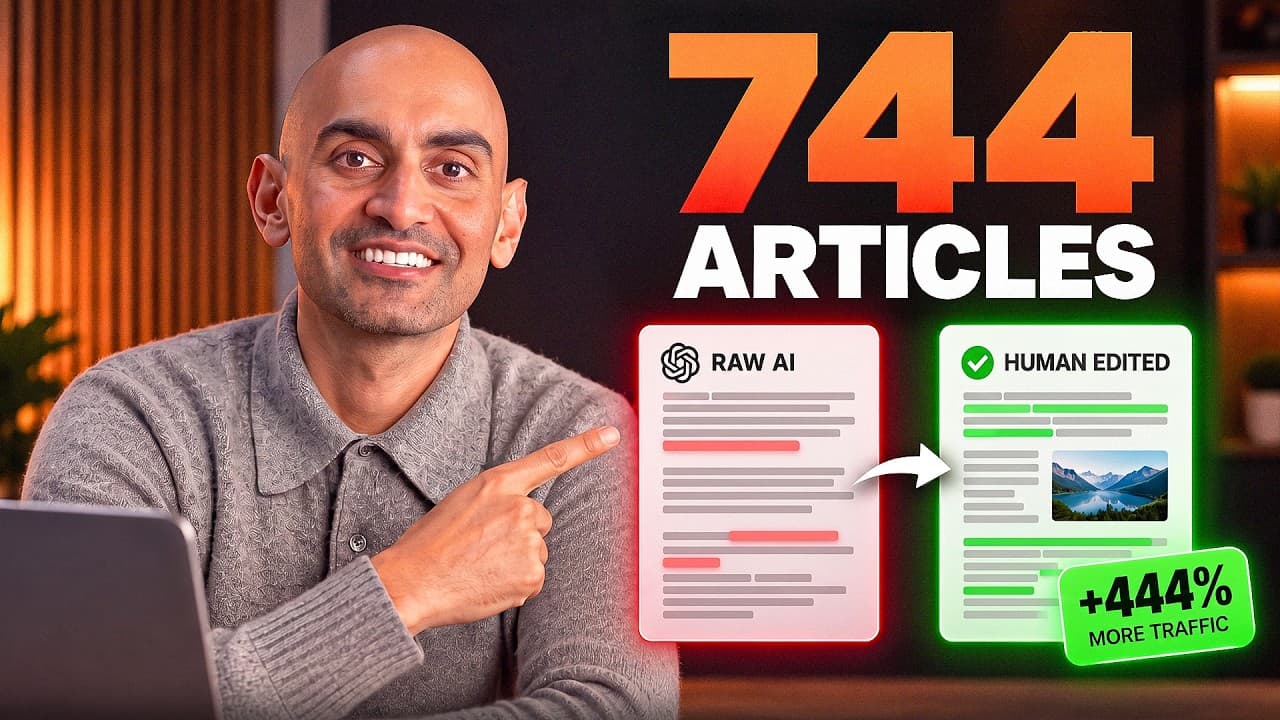
Human editing is presented as the difference between disposable AI drafts and content that earns lasting organic traffic. In a reported test of 744 articles across 68 websites, edited drafts received 5.44 times the traffic of raw AI output. The recommended human layer adds firsthand experience, proprietary information, tighter claims, current facts, and an accountable author before publication.
Transcript
We published 744 articles across 68 websites. Half were written by AI and published exactly as the machine wrote them. The other half got one extra step before going live. That one extra step produced 444% [music] more traffic. Everyone is arguing whether AI content works. We stopped arguing and [music] tested it at scale nobody else has. By the en... Read More
Key Insights
- Human-edited AI content earned 5.44 times the traffic of raw AI content in the reported test of 744 articles across 68 websites. The human editing pass was described as the only controlled difference between the two groups, producing a stated 444% traffic lift.
- Raw AI content decays while edited content compounds, according to the presented experiments. Following one Google spam update, pure AI sites reportedly lost roughly 17% of organic traffic, compared with about 6% for human-edited sites exposed to the same update on the same day.
- AI-generated material accounted for 52.1% of newly published content in the presented market analysis but received only 4.9% of organic traffic. Human-written content represented 14.5% of publishing output while attracting 87% of the traffic measured across the analyzed companies.
- Light human modification is presented as insufficient for creating valuable content. Human-modified AI material accounted for 27.4% of published content but earned 8.1% of traffic, suggesting that synonym changes, typo corrections, and superficial rewrites do not add the trust signals search engines reward.
- Trust is presented as the mechanism behind stronger search performance, not a direct penalty against AI-generated text. The rewarded signals identified across six platforms included expert authors, third-party citations, brand mentions, real experience, original data, and current information that other sources can confidently cite.
- The human editing layer consists of five actions: inject firsthand experience, add information AI could not know, remove filler and tighten claims, fact-check and refresh the material, and attach a real author with relevant credentials who can stand behind the published claims.
- Freshness was identified as the leading citable factor, receiving 91% in the reported survey. The recommended editing process therefore includes updating statistics, removing dead links, checking factual claims, and ensuring that information is current before an AI-assisted article reaches publication.
- Search and social content require different human contributions, according to the proposed workflow. AI can draft search articles before substantive human editing, but social posts should be researched and conceived with AI assistance while a human performs the actual writing to preserve a recognizably human voice.
Install to Summarize YouTube Videos and Get Transcripts
Explore YouTube Video Summarizer or Get YouTube Transcript Extractor
Questions & Answers
Q: How should AI content be edited before publishing?
AI content should receive a substantive human editing pass before publication. The recommended process adds a real client story or firsthand observation, introduces proprietary data or a business-specific example, removes filler and hedging, verifies facts and refreshes outdated information, and names a qualified author. A simple spelling check or rewritten introduction does not provide the same trust signals.
Q: How much more traffic did edited AI content receive?
Human-edited AI content reportedly received 5.44 times the traffic of content published exactly as the AI generated it. That result represents a stated 444% lift. The comparison covered 744 articles distributed across 68 real websites, with matched topics and similar keyword difficulty. The human editing pass was described as the only difference between the two groups.
Q: Does Google penalize content simply because AI wrote it?
The presentation says Google does not impose a direct ranking penalty merely because content was generated with AI. It cites a public study of 600,000 pages that found no correlation between AI use and ranking position. The proposed mechanism is evaluation of trust and usefulness, meaning raw AI can still perform poorly when it lacks expertise, experience, originality, citations, and accountability.
Q: What trust signals help AI-assisted content rank?
The trust signals identified across six platforms include expert authorship, third-party citations, brand mentions, firsthand experience, original data, and fresh information. These elements show who is responsible for the claims and why the material deserves attention. Raw AI output generally lacks proprietary knowledge and lived experience, so human editors must deliberately add evidence that distinguishes the page from generic summaries.
Q: What are the five steps in the human editing layer?
The five steps are to inject firsthand experience, add something the AI could not know, remove filler and tighten every claim, fact-check and refresh the information, and place a real author behind the article. The author should have a name and relevant credentials. Together, these actions make the draft more specific, defensible, current, and accountable.
Q: Why is light editing insufficient for AI content?
Light editing usually changes surface features without adding reasons to trust or cite the page. Fixing spelling, replacing synonyms, or writing a new introduction does not create original data, firsthand experience, stronger evidence, or accountable authorship. In the presented analysis, human-modified AI content formed 27.4% of published material but captured only 8.1% of organic traffic.
Q: Should AI be used differently for search and social content?
AI should draft search content that humans then improve through substantive editing, but the suggested social workflow gives humans a larger writing role. For social posts, AI supports ideation and research while a person writes the final material. The distinction comes from reported engagement results showing human-made posts earned 2.15 times the likes and three times the saves of AI posts.
Q: Why does raw AI content lose value over time?
Raw AI content is described as a depreciating asset because it begins as an average synthesis of existing internet material and can become less useful as facts, statistics, and links age. Repeated language-model passes may also accumulate errors and sameness. Human-edited content can remain more durable when editors add original evidence, verify claims, remove dead links, and continually refresh information.
Summary & Key Takeaways
-
A controlled test compared 744 AI-assisted articles across 68 real websites. Half were published exactly as generated, while half received a human editing pass. The edited group reportedly earned 5.44 times the traffic, equivalent to a 444% lift, and showed greater resilience when search traffic declined after a Google spam update.
-
The central argument is that Google does not need an explicit AI-content penalty to produce unequal outcomes. Search and AI engines reward trust signals such as expert authorship, third-party citations, brand mentions, firsthand experience, original data, and freshness. Raw AI drafts commonly lack these qualities because they summarize existing internet information.
-
The recommended workflow keeps AI for drafting but adds a substantial human layer before publication. Editors should contribute real experience, insert proprietary examples or data, remove filler, verify and refresh facts, and identify a qualified author. For social content, the proposed rule is different: AI supports ideation and research while humans perform the writing.
Read in Other Languages (beta)
Share This Summary 📚
Summarize YouTube Videos and Get Video Transcripts with 1-Click
Try YouTube Summary with ChatGPT & Claude or YouTube Transcript Generator
Explore More Summaries from Neil Patel 📚





Summarize YouTube Videos and Get Video Transcripts with 1-Click
Try YouTube Summary with ChatGPT & Claude or YouTube Transcript Generator