How to Get Your First App Customer With AI
TL;DR
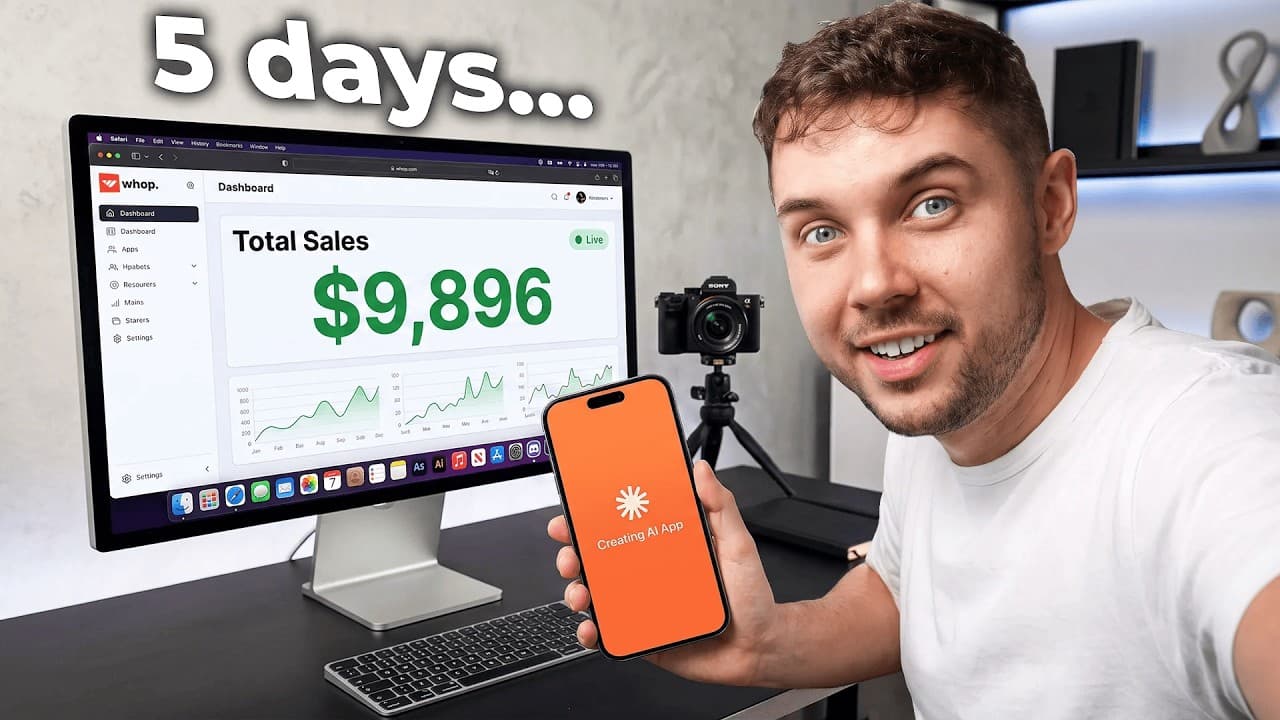
Validate an app by identifying a market gap, launching a focused MVP, and testing the complete sales funnel with paid traffic. AI accelerated research, product planning, design, coding, payments, advertising, and optimization, helping turn an astrology-for-business concept into a live SaaS product with its first paying user in four days.
Transcript
Is it possible to go from an app idea to your first customer in 1 week? Well, I'm challenging myself to find out. Last year, I built a software product that went from zero to a million users in 60 days, but that required a full team, months of work, and a six-figure budget. So, for this challenge, [music] I wanted to see what would happen if I stri... Read More
Key Insights
- Market validation is more important than perfecting an unproven product. The project began by examining what customers already bought, identifying a large astrology category, and investigating whether a male-focused business angle could address a gap before committing significant effort to development.
- The selected opportunity was astrology for business rather than general relationship astrology. Most observed apps targeted women and emphasized relationships, while the new positioning focused on an outcome described as important to men and avoided explicitly excluding women from the addressable audience.
- AI tools can compress product planning and implementation into a short cycle. Feature descriptions became a product requirements document, which Claude Code turned into a functioning first version within minutes, while further AI-assisted iterations handled branding, landing-page structure, checkout, paid features, deployment, and advertising.
- A landing page is a critical part of early product validation because potential customers must pass through it before experiencing the software. The creator spent most of the first day refining its design and used Mobbin examples to study layout and sales psychology for cold traffic.
- The onboarding funnel delivered personalized value before requesting payment. Users entered information for a reading based on their zodiac sign, numerology, and Chinese New Year animal, then received a free founder archetype and personal chart reading before encountering the subscription paywall.
- The monetization model combined recurring access with personalized features. Customers could choose $8.99 per week with a 3-day free trial or $98 per year, receive daily, weekly, and monthly business-oriented readings, and use an AI chat informed by their personal chart.
- Paid advertising produced fast validation data but required careful configuration. Missing geographic targeting generated hundreds of clicks at 3 cents each and wasted $20, prompting the campaign to be limited to four major English-speaking countries before meaningful conversion results were evaluated.
- Mobile usability was the clearest funnel weakness after acquisition proved effective. With 75% of traffic arriving through mobile web, testing revealed a location field that rejected manual entries and a time field requiring an unexplained colon, leaving the submission button unclickable for affected users.
Install to Summarize YouTube Videos and Get Transcripts
Explore YouTube Video Summarizer or Get YouTube Transcript Extractor
Questions & Answers
Q: How can AI help get the first customer for an app?
AI can assist across the entire path from concept to customer. In the challenge, it supported market research, product requirements, coding, brand guidelines, landing-page analysis, checkout implementation, paid-feature development, deployment, ad creation, campaign setup, benchmark analysis, and bug fixes. Combined with paid Meta traffic, this workflow produced the first user who entered credit card details four days after the project began.
Q: How was the app idea validated before development?
The idea was evaluated using evidence from the existing astrology market. One App Store astrology product had over 200,000 ratings, the market was described as a $12.8 billion industry growing 20% year over year, and most competing apps appeared to target women and relationships. Research also indicated that 18% of men believe in astrology, supporting a test of the underserved segment.
Q: How was the AI astrology app positioned for customers?
The app was positioned as astrology for business rather than another relationship-focused astrology product. Its front-end promise was to identify the business a user was built for using their zodiac sign, numerology, and Chinese New Year animal. The business framing was selected because it represented an outcome men were said to care about, while the messaging still allowed women to use the product.
Q: How was the SaaS MVP built in two days?
The creator described desired features to Claude Co-work with Wasp CLI, asked for a product requirements document, and pasted that document into Claude Code to generate a functioning first version. AI then created a brand kit and helped redesign the interface and landing page. Payments, personalized readings, recurring forecast features, AI chat, a domain, and Vercel hosting completed the live SaaS product within two days.
Q: What did the app offer before and after its paywall?
Before the paywall, users completed a signup form and received a free founder archetype plus a personalized chart reading generated through the GPT 5.5 API. The free result was intended to establish trust and provide value before payment. Paid access added daily, weekly, and monthly updates for business decisions, while an AI chat offered hyper-personalized answers based on the user’s chart.
Q: How were payments and subscription prices configured?
Payments were configured through Whop by installing its CLI into Claude and requesting two pricing options. The weekly option cost $8.99 and included a 3-day free trial, while the annual plan cost $98. Claude created the products and embedded checkout on the site within 30 seconds, after which a researched payment modal design was implemented as part of onboarding.
Q: What happened during the first paid advertising test?
The creator committed $500 of personal money and set a $100 daily budget for Meta ads. The first campaign generated hundreds of clicks at only 3 cents each, but that unusually low cost exposed missing geographic targeting. About $20 was spent before the problem was corrected. Delivery was then limited to four major English-speaking countries to improve audience quality.
Q: What results proved that the app had initial market demand?
After geographic targeting was corrected, the campaign brought over 100 visitors to the product. Of those visitors, 32 generated their charts and one entered credit card details for the $8.99 weekly plan. The acquisition cost was about $40, so the business was not yet profitable, but a stranger’s willingness to pay provided evidence of market demand and perceived value.
Q: How were onboarding conversion problems diagnosed?
A metrics dashboard exposed a large drop between users who started a chart and those who generated one. The onboarding completion rate was reported as 20% below the benchmark provided by Claude. Because 75% of traffic came from mobile web, the creator tested the product on a phone and discovered two form problems that prevented some users from activating the completion button.
Q: Which mobile bugs reduced onboarding completion?
The location field did not recognize manual entries, and the mobile time field required a colon without explaining that syntax to users. When either field was entered incorrectly, the submission button remained unclickable. Claude was asked to correct both minor bugs, and the transcript reports that the completion rate immediately began to rise after the fixes were applied.
Summary & Key Takeaways
-
The project began with market research rather than product development. App Store activity, industry size, annual growth, and male belief in astrology suggested a possible underserved audience. The resulting concept positioned astrology around business decisions, appealing to men without explicitly excluding women from the product’s broader potential market.
-
AI tools converted feature descriptions into a product requirements document, generated a functioning first version, established masculine brand guidelines, and redesigned the landing page using patterns studied through Mobbin. The product combined low-friction onboarding, a free personalized founder archetype, paid recurring readings, AI chat, embedded checkout, and deployment through Vercel.
-
Paid Meta ads produced hundreds of initial clicks, but missing geographic targeting wasted $20 on likely low-quality traffic. After restricting delivery to four major English-speaking countries, the funnel produced over 100 visitors, 32 generated charts, and one paid signup. Mobile testing then exposed form bugs that were depressing onboarding completion.
Read in Other Languages (beta)
Share This Summary 📚
Summarize YouTube Videos and Get Video Transcripts with 1-Click
Try YouTube Summary with ChatGPT & Claude or YouTube Transcript Generator
Explore More Summaries from Brett Malinowski 📚


Summarize YouTube Videos and Get Video Transcripts with 1-Click
Try YouTube Summary with ChatGPT & Claude or YouTube Transcript Generator