How Does the “Boring” Gap-Up Scalping Strategy Make $45,833 a Month?
TL;DR
The strategy targets gap-up stocks with strong momentum, then uses the daily chart to favor gaps that end an existing downtrend and surprise short sellers. The trader builds a pre-market watch list around 8:30 a.m. Eastern, scans with TradingView or Think or Swim, and executes his bias after the 9:30 a.m. open. Read on for the exact scanning process, gap definition, and first quality rule.
Transcript
I've made over half a million dollars over the last 12 months day trading stocks that I'm going to teach you the very first scalping strategy that my father taught me five years ago that I still trade every single day. It's stupid simple. It's consistent and it's so intuitive that even a beginner trader can master it. In this video, I'm going to br... Read More
Key Insights
- A gap is an overnight change in price between yesterday's 4:00 p.m. Eastern close and the next morning's open. Frog closed Thursday at $47.26 and opened Friday at $56.38, a roughly 20% gap up you can see directly on the chart.
- Gap scanning happens before the market opens, with the pre-market watch list built starting around 8:30 a.m. Eastern. The trader identifies stocks with a high probability of momentum, forms a pre-market bias, and executes on that bias when the market opens at 9:30 a.m.
- Momentum stocks are the only ones worth trading because you cannot make money if the stock does not move. The focus is on names with a high probability of moving 20%, 50%, or even 100% in a single day, or sometimes within a couple of hours.
- TradingView.com is a free scanning resource: go to products, screeners, stocks, then extended hours and sort by pre-market gap percentage. Sorting descending shows gap ups (MSGM gapped 128%, TSC 59%, VME 59% on Friday) and ascending shows gap downs.
- Think or Swim can scan gaps natively by right-clicking the watch list column, choosing customize, and adding the 'mark percent change' function. Clicking that column sorts by the biggest gap downs or gap ups, giving the same result without an external site.
- The reason a stock gaps does not matter to this strategy, only what the gap does to the price action. Gaps can be caused by earnings, company news, a crazy company event, macroeconomic data, or even the president tweeting something.
- The daily time frame is the primary chart used to read gaps every morning. High-quality gaps are separated from low-quality ones using three specific rules, and the video focuses on gap ups rather than gap downs.
- The first rule is to trade a gap up that ends a downtrend. Because bears and short sellers controlled the prior downtrend, a gap that reverses the trend surprises all those sellers who shorted at lower prices along the way.
Install to Summarize YouTube Videos and Get Transcripts
Explore YouTube Video Summarizer or Get YouTube Transcript Extractor
Questions & Answers
Q: How does the gap-up scalping strategy work?
The trader first scans for stocks with overnight price gaps, strong momentum, clear direction, and significant volume. He then evaluates gap ups on the daily chart, with the first quality rule being a gap up that ends an existing downtrend and catches short sellers off guard.
Q: What is a gap in stock trading?
A gap is an overnight change in a stock’s price between the prior close and the next morning’s open. For example, Frog closed at $47.26 on Thursday and opened at $56.38 on Friday, creating a gap up of around 20%.
Q: How can you scan for gap stocks for free with TradingView?
On TradingView.com, go to Products, Screeners, Stocks, and then Extended Hours. Sort the pre-market gap percentage descending to find the largest gap ups or ascending to find the largest gap downs, then add relevant tickers to your watch list.
Q: How can you scan for gaps directly in Think or Swim?
Right-click a watch-list column, choose Customize, and add the “mark percent change” function. Clicking that column lets you sort the list by the biggest gap downs or gap ups without using an external scanning site.
Q: When should you build a pre-market watch list?
The trader begins building his watch list around 8:30 a.m. Eastern, sometimes earlier, before the market opens. He identifies stocks likely to show momentum, establishes a pre-market bias, and executes that bias after the 9:30 a.m. Eastern open.
Q: What is the first rule for identifying a high-quality gap up?
The first rule is to find a gap up that ends a downtrend, using the daily time frame. Because bears and short sellers controlled the preceding decline, the reversal can surprise traders who shorted at lower prices.
Q: Why does the strategy focus on momentum stocks?
The trader avoids sideways stocks with little movement or volume because he says he cannot make money if a stock does not move. He instead seeks stocks with a high probability of moving 20%, 50%, or even 100% within a day or sometimes a few hours.
Q: Why do stocks gap, and does the cause matter to this strategy?
Stocks may gap because of earnings, company news, unusual company events, macroeconomic data, or a president’s social-media post. The strategy does not prioritize the catalyst; it focuses on what the overnight price change does to the chart and subsequent price action.
Summary & Key Takeaways
-
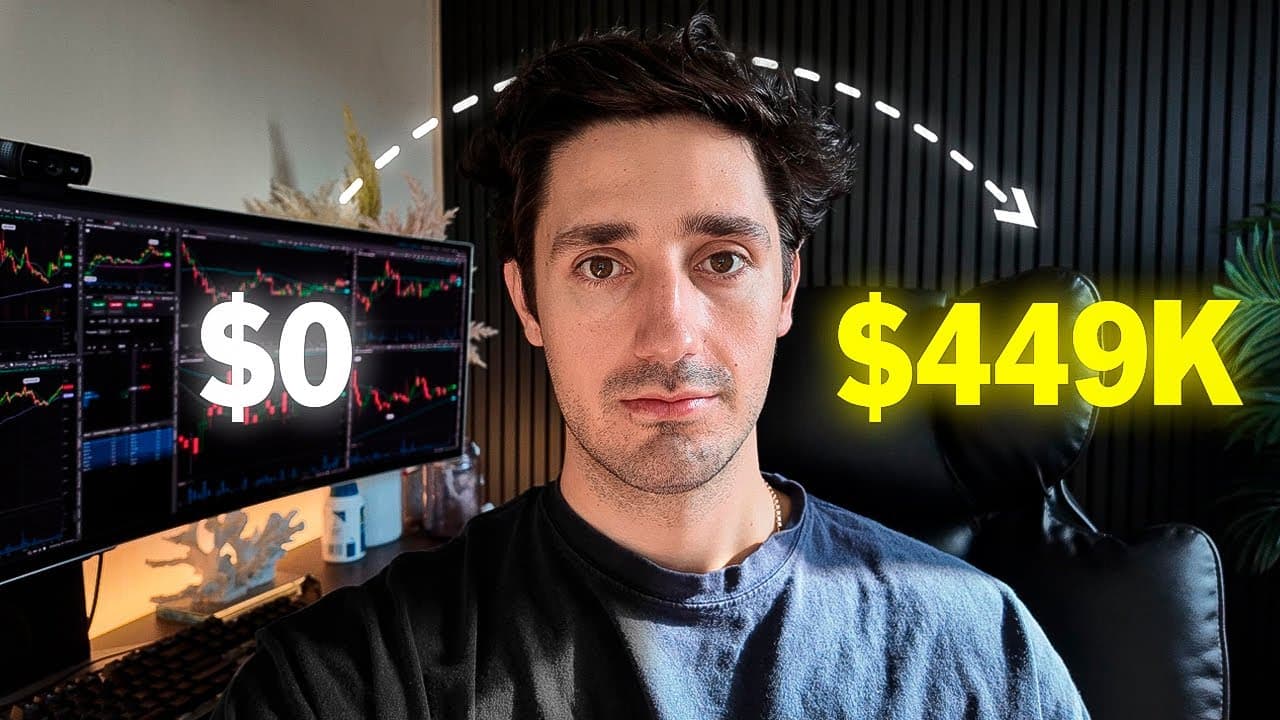
The trader shows a Charles Schwab brokerage account with over $548,000 made day trading over the last 12 months, and refreshes the page live to prove it is not a screenshot. He learned this scalping strategy from his father, who was his trading mentor, five years ago and still trades it daily.
-
Every morning he builds a pre-market watch list of stocks that gapped overnight, using free tools like TradingView (screeners, extended hours, pre-market gap percentage), Market Chameleon's pre-market report, and Think or Swim's mark percent change column. He sorts to find the biggest gap ups and gap downs.
-
Not every gapping stock is worth trading, so three rules separate high-quality gaps from low-quality ones, read on the daily time frame. The video focuses on gap ups, and the first rule is a gap up that ends a downtrend, which surprises the short sellers who controlled the prior move.
Read in Other Languages (beta)
Share This Summary 📚
Summarize YouTube Videos and Get Video Transcripts with 1-Click
Try YouTube Summary with ChatGPT & Claude or YouTube Transcript Generator
Explore More Summaries from Emmanuel Malyarovich 📚
Summarize YouTube Videos and Get Video Transcripts with 1-Click
Try YouTube Summary with ChatGPT & Claude or YouTube Transcript Generator