How Does Our Brain Create Reality Through Simulation?
TL;DR
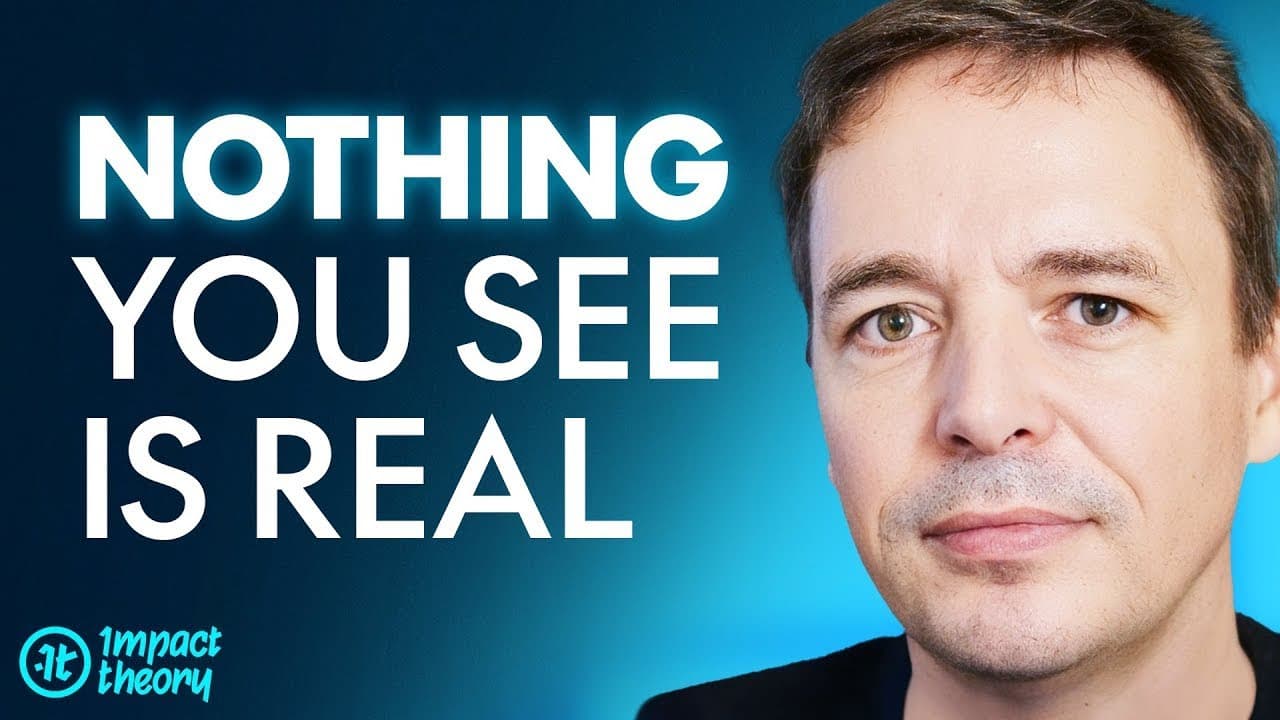
Our brains generate a simulation of reality to navigate complexity, stemming from distorted narratives that confuse subjective perceptions with actual experiences. Understanding this self-generated simulation can help alleviate existential anxiety and improve our ability to adapt to changing environments.
Transcript
I think people suffer needlessly because they confuse the distorted narrative running inside of their minds with actual reality but if I'm right and we don't have access to the quote unquote real world and instead we're just a brain and a vat running a simulation what do we need to understand about the nature of this self-generated simulation in or... Read More
Key Insights
- 🚨 Consciousness emerges early in human development, suggesting its importance in our cognitive functions.
- 🤯 Modeling the mind through computational approaches can provide insights into consciousness and mental processes.
- 🥺 Progress in understanding consciousness can lead to advancements in cognitive science and artificial intelligence technology.
- 🤳 Complexity in cognition and self-generated simulations offers profound insights into human consciousness.
- 🤯 Integrating various disciplines can lead to a cohesive understanding of reality and the mind.
- 🖐️ Ethics and social structures are influenced by cognitive processes and consciousness, playing a vital role in societal development.
- 🔬 Transforming philosophical questions into mathematical models can revolutionize cognitive science and philosophical understanding.
- 🎙️ More videos with Joscha Bach:
Install to Summarize YouTube Videos and Get Transcripts
Explore YouTube Video Summarizer or Get YouTube Transcript Extractor
Questions & Answers
Q: How does the brain function as a simulation engine?
The brain, like a simulation engine, processes data, constructs models of reality, tracks visual and perceptual data to generate simulations of the world we experience.
Q: Is free will an illusion according to the brain's operation?
Free will is perceived through the brain's decision-making processes and reflective awareness, shaping our consciousness. It aligns with an individual's intention, beliefs, and sense of agency.
Q: What makes understanding consciousness so crucial in the field of cognitive science?
Consciousness represents the pinnacle of human cognition, posing complex challenges in modeling, understanding the mind, and developing artificial intelligence systems to replicate cognitive processes.
Q: How does the brain's attention to contents and reflexive awareness contribute to the understanding of self-generated simulation?
Attention allows the brain to focus on specific contents while reflexive awareness enables self-observation, contributing to the creation of a coherent model of reality and facilitating self-reflection.
Summary & Key Takeaways
-
Distorted narratives in our minds lead to confusion between subjective reality and actual reality.
-
Our brain and body, resembling a simulation engine, create a model of reality to cope with changing environments.
-
Understanding the nature of self-generated simulations helps navigate uncertainty and existential anxiety.
Read in Other Languages (beta)
Share This Summary 📚
Summarize YouTube Videos and Get Video Transcripts with 1-Click
Try YouTube Summary with ChatGPT & Claude or YouTube Transcript Generator
Explore More Summaries from Full Episodes of Impact Theory 📚



Summarize YouTube Videos and Get Video Transcripts with 1-Click
Try YouTube Summary with ChatGPT & Claude or YouTube Transcript Generator