TCD1304 - Part 1 - Introduction
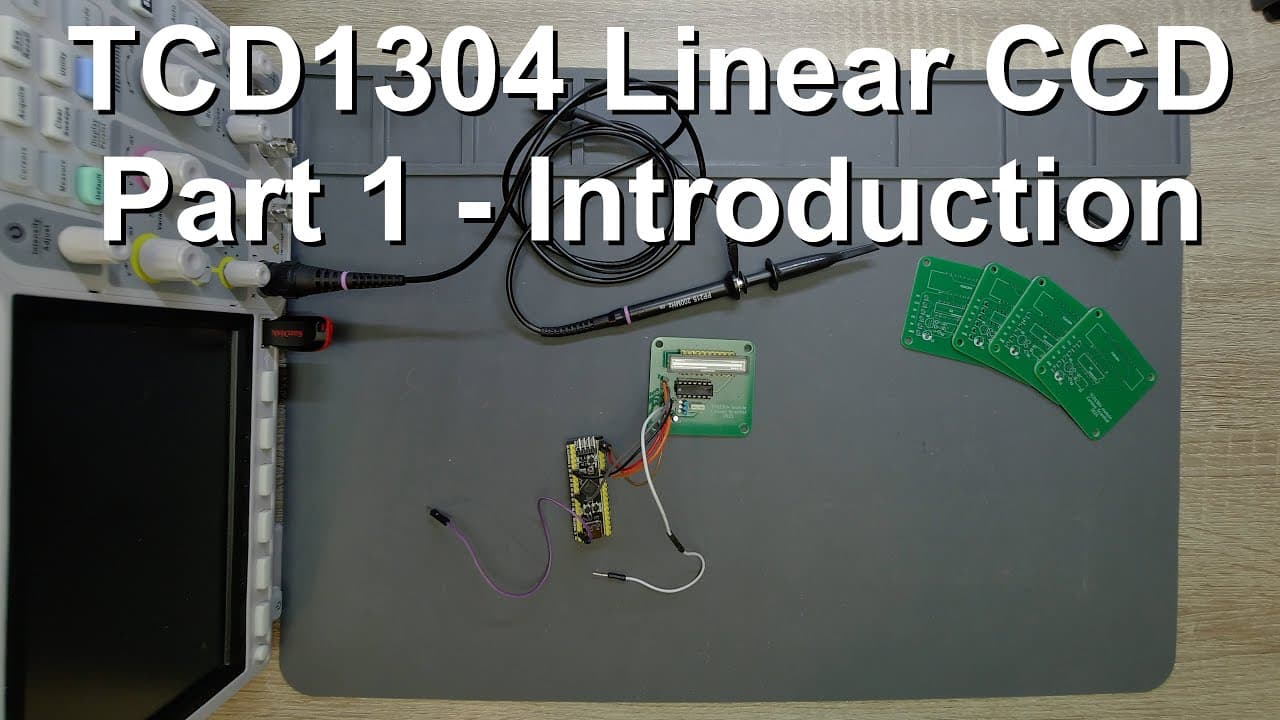
TL;DR
Overview of a new series on using a linear CCD for various applications.
Transcript
welcome everyone in this video i'm going to start a new series and this part will be the introductory part of this series so i will introduce you the device i will talk about it a little bit and then finally i will show you some potential applications and in the upcoming parts i will go deeper and i will show you how to use this device how to progr... Read More
Key Insights
- ⚡ The linear CCD's TCD 1304 model offers a high-resolution detection method with 3,648 elements, improving light capture capabilities.
- ❓ Using the STM32F401 microcontroller enhances performance, providing a versatile and budget-friendly solution for complex data processing tasks.
- ⏰ Proper timing for clock signals is critical for the accurate operation of the linear CCD and the associated microcontroller, necessitating careful programming.
- 🙂 The ability to visualize light intensity and shadow patterns through the oscilloscope demonstrates the CCD's effectiveness in various practical applications.
- 💖 The series intends to explore multiple projects that showcase different functionalities of the linear CCD, sparking interest in DIY electronics.
- 🎨 Creative design options, like customizing PCB colors, can enhance project aesthetics and engage a community via design contests related to circuit boards.
- 💳 The creator encourages audience engagement through subscriptions, indicating a commitment to developing and sharing knowledge in electronics and programming.
Install to Summarize YouTube Videos and Get Transcripts
Explore YouTube Video Summarizer or Get YouTube Transcript Extractor
Questions & Answers
Q: What is a linear CCD and how does it work?
A linear CCD, like the TCD 1304, is a sensor that consists of an array of light-sensitive pixels. It detects light intensity rather than color by measuring how much light hits each pixel. The resulting electrical signals provide data for further processing with a microcontroller, allowing users to create images based on light patterns.
Q: Why was the STM32F401 microcontroller chosen for this project?
The STM32F401 microcontroller was selected due to its superior specifications compared to alternatives, such as the Blue Pill. It is more powerful, has greater memory, and provides enhanced functionality, making it ideal for tasks involving rapid data processing and extensive control signals required for operating a linear CCD.
Q: What are the essential components needed to work with the linear CCD?
In addition to the linear CCD, the circuit requires a few key components, including a hex inverter, two capacitors, three resistors, and a transistor. These components play crucial roles in amplifying the output signals from the CCD and preparing the data for further processing by the microcontroller.
Q: How many clock signals does the linear CCD need to operate?
The linear CCD requires three clock signals to function properly: a master clock, a shift gate signal, and an integration clear gate signal. Each of these signals needs to be correctly timed to ensure that the pixel data is shifted out properly and captured without errors.
Q: What applications does the creator envision for the linear CCD?
The creator plans to build a variety of applications including a displacement sensor, a spectroscope, and a camera system based on the linear CCD. These projects will leverage the sensor's ability to detect light patterns and translate them into useful data for various scientific and practical purposes.
Q: How does the presented circuit demonstrate the use of the linear CCD?
The presenter shows the circuit working with an oscilloscope, capturing signals when different objects are placed over the CCD. By adjusting the light exposure and observing how shadows cast by these objects affect the signals, viewers can see how the CCD reads and processes data effectively.
Q: Will the series include software development for the projects?
Yes, the series will feature comprehensive guidance on developing software for the STM32F401 microcontroller, including programming it to control timing correctly for capturing data from the linear CCD and managing USB communication to transmit data to a computer.
Summary & Key Takeaways
-
The video introduces a new series focused on utilizing a TCD 1304 linear CCD sensor, which consists of 3,648 light-sensitive elements to capture images based on light intensity.
-
The presenter highlights the use of an STM32F401 microcontroller as a powerful and affordable component for processing data, suitable for demanding tasks involving light capture.
-
Future episodes will delve into programming the microcontroller, exploring practical applications, and creating projects such as a displacement sensor and a spectroscope.
Read in Other Languages (beta)
Share This Summary 📚
Summarize YouTube Videos and Get Video Transcripts with 1-Click
Try YouTube Summary with ChatGPT & Claude or YouTube Transcript Generator
Explore More Summaries from Curious Scientist 📚


Summarize YouTube Videos and Get Video Transcripts with 1-Click
Try YouTube Summary with ChatGPT & Claude or YouTube Transcript Generator