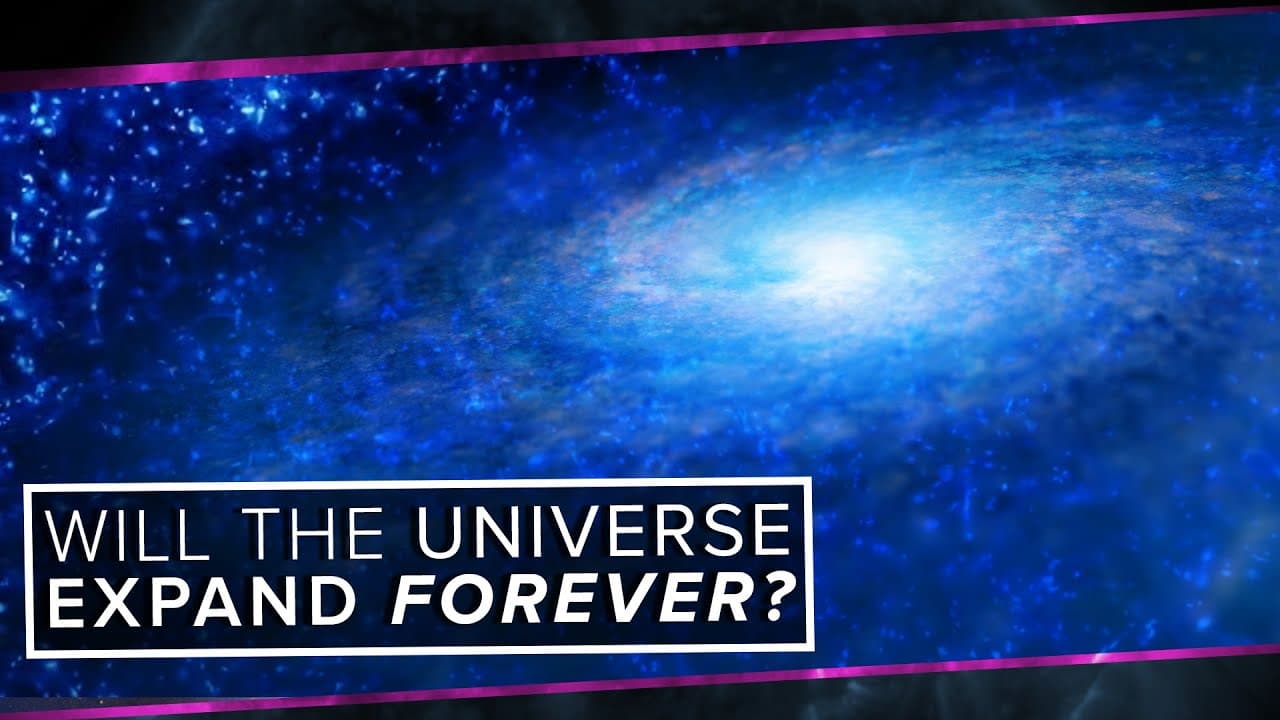
Will the Universe Expand Forever?
TL;DR
The universe will expand forever due to insufficient density.
Transcript
How will this universe end? This may be the one prediction of general relativity that we never directly verify until, well, the very end. Yet the fact that Einstein's theory allows us to learn the answer to this question is incredible. Let's see how this is even possible. [THEME MUSIC] Soon after Albert Einstein proposed his general theory of relat... Read More
Key Insights
- Einstein's general relativity allows predictions about the universe's fate, revealing its expansion through redshift observations.
- Alexander Friedmann applied general relativity to the universe, leading to the discovery of its expansion and the concept of dark energy.
- Dark energy is a mysterious force that will dominate the universe's future expansion, requiring deep mathematical understanding to comprehend.
- The Einstein field equations describe spacetime's shape and energy, with the Friedmann equations simplifying this for the universe's large-scale structure.
- The universe's fate depends on the balance between expansion's kinetic energy and gravitational potential energy, analogous to an apple's escape velocity.
- The universe's expansion rate, measured by the Hubble constant, indicates it will expand forever due to insufficient density to reverse expansion.
- The shape of the universe, as described by the Friedmann equations, is intrinsically tied to its expansion and density, hinting at the existence of dark energy.
- Dark energy accelerates the universe's expansion, challenging traditional notions of energy conservation and gravity on cosmic scales.
Install to Summarize YouTube Videos and Get Transcripts
Explore YouTube Video Summarizer or Get YouTube Transcript Extractor
Questions & Answers
Q: What role does dark energy play in the universe's expansion?
Dark energy is a mysterious force that dominates the future expansion of the universe. It accelerates the expansion, ensuring that the universe will continue to grow indefinitely. This acceleration challenges traditional notions of energy conservation and gravity, as dark energy's influence becomes more pronounced over cosmic scales.
Q: How do the Friedmann equations simplify the Einstein field equations?
The Friedmann equations reduce the complexity of the Einstein field equations by focusing on the universe's large-scale structure. By assuming a smooth distribution of galaxies, these equations simplify the ten independent components of the Einstein equations into two relationships, allowing for an analysis of the universe's expansion and density over vast distances.
Q: Why is the universe's density insufficient to reverse its expansion?
Astronomical observations have shown that the universe's density is only about a quarter of what is needed to reverse its expansion. Despite extensive measurements of galaxies and dark matter, the gravitational potential energy is not enough to overcome the kinetic energy of expansion, leading to the conclusion that the universe will continue to expand indefinitely.
Q: How does the concept of escape velocity relate to the universe's expansion?
Escape velocity, derived from Newton's law of gravitation, describes the minimum speed needed for an object to overcome gravitational pull. Similarly, the universe has an escape velocity that determines whether galaxies can escape each other's gravitational influence. The universe's expansion rate, if equal to this escape velocity, would mean it expands indefinitely, which current observations support.
Q: What is the significance of the Hubble constant in understanding the universe's expansion?
The Hubble constant measures the current expansion rate of the universe, approximately 70 kilometers per second per megaparsec. It is a crucial parameter in understanding the universe's dynamics, indicating that the universe is expanding at a rate that ensures it will not collapse but continue to grow indefinitely due to insufficient density.
Q: How does the universe's shape relate to its expansion and density?
According to the Friedmann equations, the universe's shape is intrinsically linked to its expansion and density. The equations describe how matter influences spacetime curvature, suggesting that the universe's fate is tied to its spatial curvature. This relationship hints at the existence of dark energy, which affects the universe's expansion and overall geometry.
Q: What challenges do dark energy pose to traditional physics?
Dark energy challenges traditional physics by accelerating the universe's expansion, defying conventional notions of energy conservation and gravity. Its influence becomes more pronounced on cosmic scales, requiring a re-evaluation of fundamental principles and a deeper understanding of how energy and gravity operate in an expanding universe.
Q: What insights can be gained from the Friedmann equations about dark energy?
The Friedmann equations suggest that dark energy must exist to account for the universe's observed expansion and spatial curvature. These equations reveal that dark energy accelerates expansion, providing insights into its nature and role in the universe's dynamics. Understanding these equations is crucial for comprehending dark energy's impact on cosmic evolution.
Summary & Key Takeaways
-
Einstein's general relativity allows us to predict the universe's fate, revealing its expansion through redshift observations. Alexander Friedmann's application of relativity led to the discovery of the universe's expansion and the concept of dark energy, a mysterious force that will dominate future expansion.
-
The universe's fate is determined by the balance between expansion's kinetic energy and gravitational potential energy, similar to an apple's escape velocity. The Hubble constant measures the expansion rate, indicating the universe will expand forever due to insufficient density to reverse it.
-
Dark energy accelerates the universe's expansion, challenging traditional notions of energy conservation and gravity. The Friedmann equations describe the universe's large-scale structure, linking its shape to expansion and density, hinting at dark energy's existence and its role in cosmic expansion.
Read in Other Languages (beta)
Share This Summary 📚
Summarize YouTube Videos and Get Video Transcripts with 1-Click
Try YouTube Summary with ChatGPT & Claude or YouTube Transcript Generator
Explore More Summaries from PBS Space Time 📚

Summarize YouTube Videos and Get Video Transcripts with 1-Click
Try YouTube Summary with ChatGPT & Claude or YouTube Transcript Generator